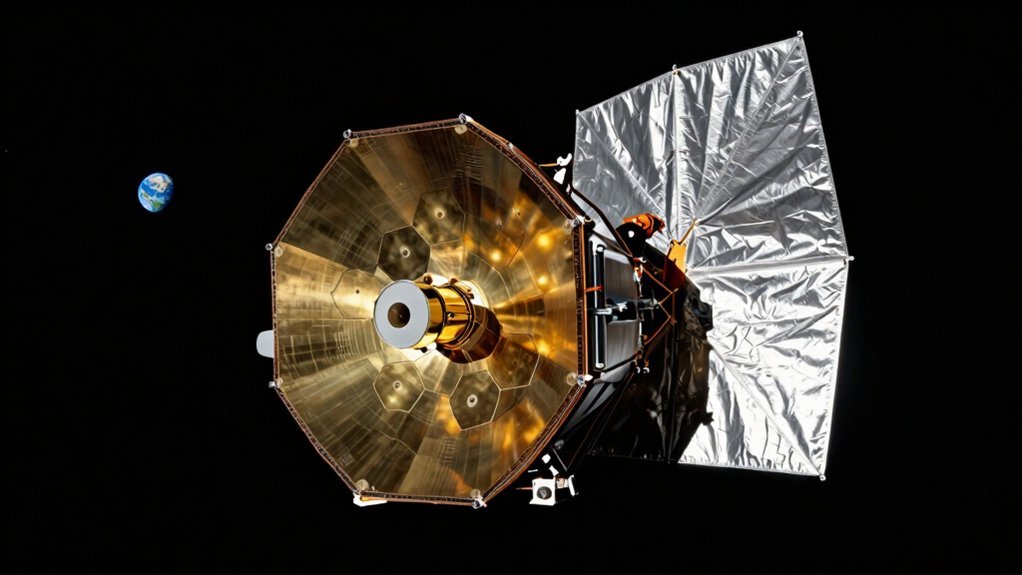
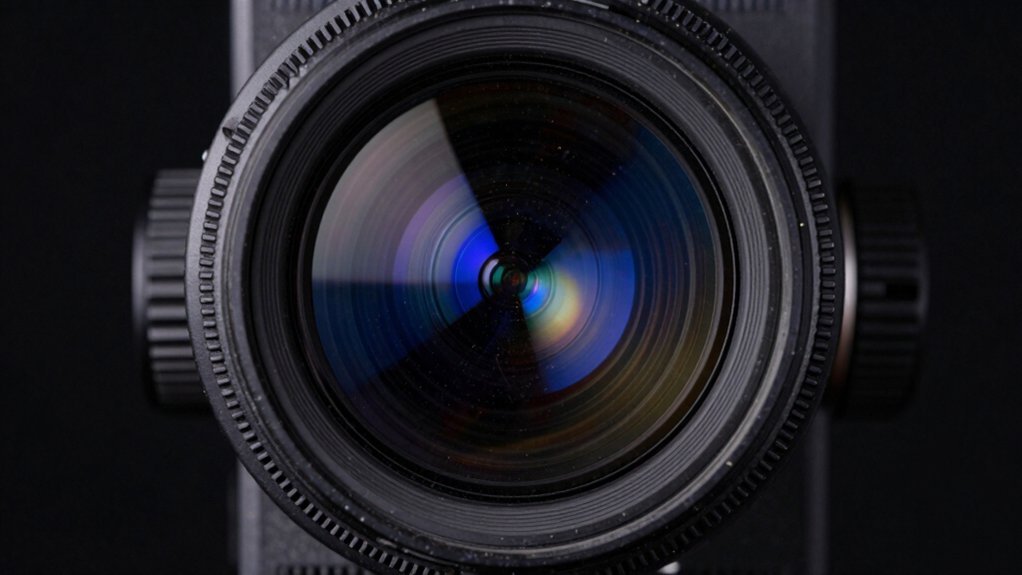
You’re wondering how giant mirrors catch faint starlight without Earth’s blurry atmosphere ruining the view. You collect photons like rain in a bucket, where curved glass focuses everything onto tiny sensors. Now, orbiting above the air stops stars from twinkling, giving you crystal-clear images instantly. These detectors turn light into digital data, revealing hidden galaxies behind dust clouds. Stick around to see exactly how we rebuild those signals into stunning cosmic pictures.
How Do Space Telescope Mirrors Gather Faint Light?
That faint glimmer you’re staring at needs a massive bucket to catch it. You’re wondering how telescopes actually grab those weak signals from deep space. Obviously, your eyes miss most of it because they’re too small.
Here’s the thing: the mirror area acts exactly like a giant rain collector. A bigger surface intercepts more photons traveling across the universe for billions of years. You need that huge scale just to gather enough particles for a picture.
Now, light concentration happens when curved mirrors focus everything onto one tiny spot. This process boosts the brightness so your detectors can finally measure the signal. Without this specific trick, distant galaxies would remain completely invisible to you forever. To get the clearest view, you must find a location with minimal light pollution away from city glow. The precision of these optical systems relies heavily on maintaining perfect alignment to prevent image distortion.
When comparing optics and performance, different telescope designs offer unique advantages for various stargazing needs.
You’ve got the basics on gathering light down pat now. Next, you’ll want to know exactly why those curved shapes focus photons so perfectly onto detectors.
Why Do Curved Mirrors Focus Photons Onto Detectors?
Geometry is the secret sauce behind your telescope’s sharp focus. You might wonder how flat light becomes a clear picture. It happens because every photon obeys strict rules of reflective geometry.
Concave mirrors bend those incoming parallel rays inward toward one spot. Your mirror curvature dictates exactly where that focal point sits. Stronger curves create shorter focal lengths for tighter focusing.
Unlike lenses, these mirrors avoid color fringing entirely. They guide all wavelengths to the same detector location perfectly. The surface tilt changes continuously across the glass to redirect light.
Now, imagine thousands of rays crossing precisely at the prime focus. This convergence forms a real image ready for your sensors. Smooth surfaces guarantee rays don’t scatter into a blurry mess.
You get a spatially ordered map of the sky instantly. Next, consider how staying above Earth keeps that image crisp. Understanding the optical path length ensures that light waves arrive in phase for maximum clarity. Different telescope designs utilize specific mirror configurations to optimize this focus for various astronomical observations. Navigating current locations allows astronomers to track celestial coordinates with ease for precise targeting.
How Does Orbiting Avoid Earth’s Atmospheric Blur?
Why does looking through air make stars twinkle and blur? Constantly moving air cells refract incoming starlight unevenly. This atmospheric turbulence creates that annoying shimmer you see from your backyard.
Now, imagine flying 300 miles up where the air vanishes completely. You escape those distorting layers entirely. Your telescope captures steady, unwavering light without any weather interference.
Here’s the thing: removing this blur drastically boosts your image resolution. You finally reach the optics’ true theoretical limits. Ground telescopes fight hard with adaptive mirrors, but you avoid the problem simply by orbiting above it all. Space-based instruments utilize specialized optics designed to function perfectly in the vacuum of space without atmospheric distortion.
Obviously, clearer views mean spotting fainter objects too. You get sharp pictures because nothing scrambles the light path anymore. That altitude makes all the difference for your cosmic snapshots. This breakthrough allowed astronomers to unveil the legacy of revolutionary telescopes that changed our understanding of the cosmos. By eliminating atmospheric interference, these observatories enabled the discovery of key figures whose work defined a new era in astronomical history.
How Is Cosmic Light Converted Into Digital Science Data?
Since you’re wondering how faint cosmic sparks become sharp digital files, let’s trace that exact journey. Your telescope’s mirrors gather invisible rays and focus them tightly onto a specialized sensor array. This critical light detection step turns individual photons into tiny electrical charges within specific pixels.
Now, the system must handle these fragile analog signals before noise corrupts them entirely. Onboard electronics perform rapid signal processing right next to the cold detectors to preserve purity. Chips like Webb’s SIDECAR amplify weak voltages and instantly convert them into precise 16-bit digital numbers. Effective signal amplification ensures that the weakest celestial signals are boosted without introducing distorting electronic noise. Maintaining cryogenic cooling prevents thermal interference from overwhelming the faint signals during this delicate conversion process.
You get streams of binary data instead of pretty pictures at this stage. The spacecraft packs these numbers securely for transmission across space to Earth’s waiting receivers. Ground computers later reconstruct this raw binary flow into the stunning images you eventually see. You now understand the complex translation from cosmic energy to usable scientific information. Crucially, this process relies on specialized sensor arrays to ensure that every captured photon contributes accurately to the final dataset.
What Hidden Universe Features Do Space Telescopes Reveal?
While visible light hits a cosmic wall, you’re missing the hidden show happening right behind the dust. Infrared eyes pierce those thick clouds, revealing baby stars nesting inside the Carina Nebula. You see warm gas glowing where optical telescopes find only darkness.
Now, look deeper at distant worlds. Spectra from exoplanets like WASP-96b show you water and clouds directly. This isn’t just a dot of light; it’s a real atmosphere with chemistry you can read.
All right, let’s zoom out to the biggest picture. Surveys map the cosmic web, the universe’s actual skeleton connecting everything. These hidden structures include faint filaments stretching back thirteen billion years. Gravitational lensing acts like a natural magnifying glass, showing you ancient galaxies forming quickly.
You finally understand how matter assembled into today’s grand architecture. By avoiding atmospheric distortion, these instruments achieve the sharp resolution needed to distinguish fine details in deep space. Unlike ground-based options that struggle with weather and light pollution, space observatories provide uninterrupted viewing for consistent data collection. This advantage allows them to detect faint infrared signals that are otherwise absorbed by Earth’s atmosphere before reaching the ground. Ready to explore how scientists actually capture these incredible infrared signals?