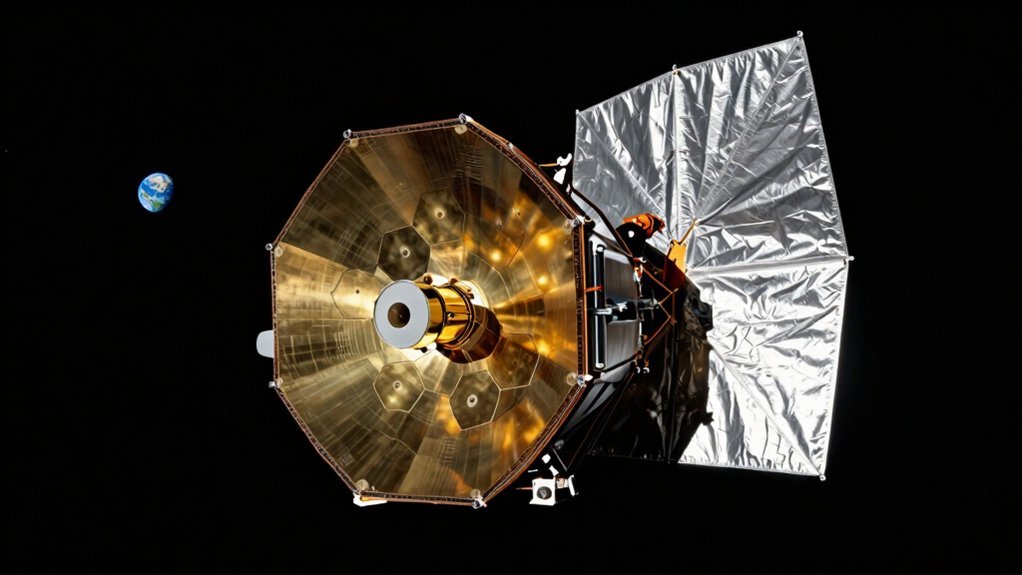
You’re wondering exactly where Hubble is right now, and the answer is it’s zipping around Earth at 17,000 miles per hour. It orbits just 326 miles up, staying above the atmosphere to capture crystal-clear images without air turbulence blocking the view. Obviously, this high-speed lap takes only 95 minutes, letting you track its changing position easily. Keep exploring to see how this unique orbit reveals the universe’s deepest secrets for you.
Where Is the Hubble Telescope Right Now?
Where exactly is Hubble hanging out right now? You’re wondering if it’s lost in deep space, but it’s actually circling Earth. It hangs about 326 miles up, zooming through low Earth orbit constantly.
Obviously, its spot changes every second since it isn’t fixed over one city like a geostationary satellite. Live tracking tools show you the exact sub-Earth point beneath it at any specific moment.
You might catch Hubble sightings with your own eyes if you know when to look up tonight. Real-time data reveals its altitude drifting slightly due to atmospheric drag over time. To successfully spot the telescope, you must ensure you have clear viewing conditions free from light pollution and cloud cover.
Don’t trust static numbers because the telescope moves fast, covering different global regions continuously. Check a dynamic map for the precise location valid for right now only. Unlike ground-based instruments that suffer from atmospheric distortion, Hubble’s position above the air allows it to capture incredibly sharp images.
Your next step involves finding those live coordinates to plan your own stargazing session effectively. Understanding the conditions needed for clear viewing will help you maximize your chances of spotting the telescope against the night sky.
How High and Fast Does Hubble Orbit?
Since you’re wondering about Hubble’s exact cruising altitude, let’s clear up those conflicting numbers you’ve seen. NASA states the Hubble altitude sits near 300 miles, though live trackers often show it higher. Atmospheric drag slowly pulls it down, while past shuttle missions occasionally pushed it back up.
Now, consider how fast this giant moves through space. The Hubble speed reaches roughly 17,000 miles per hour to maintain its stable path. You would circle Earth every 95 minutes if you traveled at that incredible pace. Obviously, this rapid motion keeps the telescope safely above most of our thick atmosphere. Unlike ground-based instruments that struggle with atmospheric distortion, Hubble’s position allows it to capture sharp images without such interference. Just as beginners need clear skies free from light pollution to see faint stars, Hubble requires this high vantage point to avoid the glow and turbulence of Earth’s lower atmosphere. This specific low Earth orbit places the observatory well above the weather systems that disrupt ground observations.
Your takeaway? Hubble flies high and fast in a constantly shifting low Earth orbit. Next, you might ask why this specific height actually matters for capturing those stunning deep-space images.
Why Does Hubble’s Altitude Improve Images?
Although you might think bigger lenses make sharper photos, Hubble’s altitude actually does the heavy lifting. You see, floating above the atmosphere eliminates atmospheric distortion that blurs ground-based views. This clear path boosts image resolution considerably.
Now, consider how air turbulence makes stars twinkle. Hubble avoids this entirely, letting you see fine details like individual stars in distant galaxies. Its sharpness reaches 0.05 arcseconds, far beyond earthly limits.
Here’s the thing: light pollution from cities and airglow fades away up there. You get darker skies and better contrast for faint objects. This height expands observational capabilities by blocking noise.
Obviously, cleaner data means clearer pictures of nebulae. You now understand why location matters more than size alone. By avoiding atmospheric interference, the telescope achieves superior angular resolution compared to ground-based instruments. Understanding how optical systems function helps explain why this specific orbit was chosen for such precision. The mission’s success relied heavily on key figures who championed the project despite early technical setbacks. Ready to explore what colors Hubble actually sees?
What Wavelengths Does Hubble Observe?
While you might assume Hubble only snaps visible pictures, it actually catches ultraviolet and near-infrared light too. You see, this telescope observes wavelengths from 100 to 2500 nanometers. That range lets you peek at hot stars using ultraviolet light.
Visible light shows familiar structures in galaxies clearly. Meanwhile, near infrared light penetrates thick dust clouds easily. Hubble’s instruments switch between these bands one at a time. Effective use requires understanding how optical systems gather light across these specific ranges to maximize scientific return.
You get the full story through multiwavelength imaging techniques. Combining these views reveals hidden cosmic details you’d otherwise miss. Hot gas glows bright in UV, while distant galaxies shine in infrared. Infrared images reveal more stars than visible light images.
This broad spectrum makes Hubble a versatile cosmic explorer, utilizing advanced optical systems to maintain sharp focus across these varied bands. Selecting the right telescope aperture is equally critical for gathering sufficient light within these specific bands to ensure clear observations. You now understand exactly what colors Hubble truly sees. Next, you’ll wonder how long it has kept watching.
How Long Has Hubble Been in Space?
How long has this cosmic workhorse actually kept watching? You might think it retired years ago, but it’s still up there. Launched April 24, 1990, Hubble has orbited Earth for over thirty-six years now. That’s way past its original fifteen-year goal.
Here’s the thing: five shuttle missions fixed its aging parts. These repairs boosted Hubble longevity remarkably beyond early expectations. You see, engineers swapped out gyroscopes and computers regularly. This kept Hubble operations running smoothly through the 2020s. Obviously, hardware issues happen, like that 2021 computer glitch. But teams switched to backups quickly. Science never stopped for long.
Now, expect more data until at least 2030. No new shuttle visits exist, so component wear dictates the end. Yet, this telescope keeps surprising everyone with its resilience. You’ve got a front-row seat to history. Its three-decade run proves great engineering lasts. What amazing image will it capture next? Understanding effective telescope use helps observers appreciate why Hubble’s specific orbit and maintenance history remain critical to its ongoing success. Regular maintenance is vital because optical alignment ensures the telescope continues to deliver sharp, high-resolution images despite its age. Just as ground-based observers must consider light pollution to maximize clarity, Hubble’s position above the atmosphere eliminates this interference entirely, allowing for uninterrupted viewing.