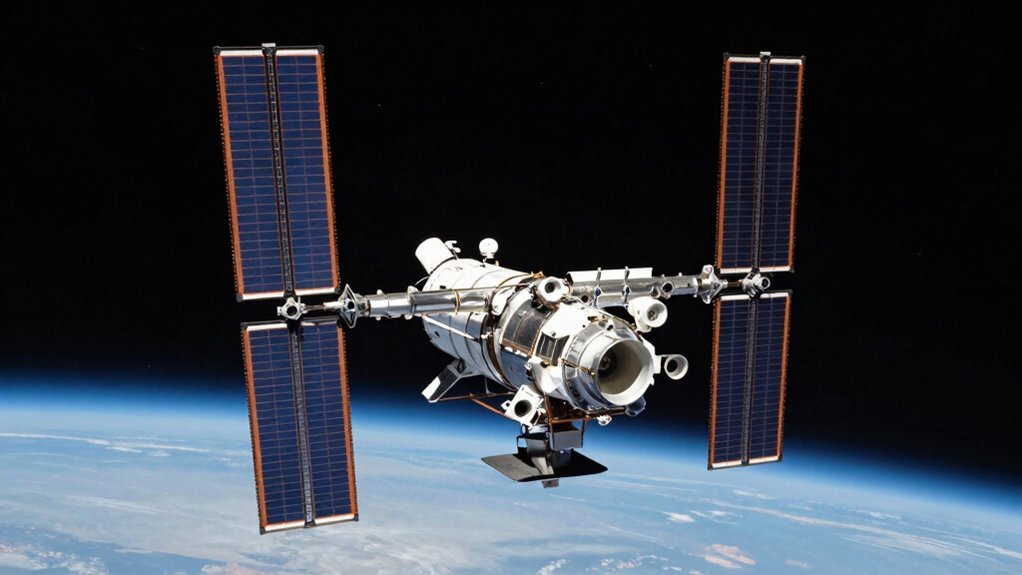
You’re wondering where Webb hangs out, and it’s not circling Earth like Hubble did. It actually orbits the Sun near the L2 point, roughly 1.5 million kilometers away. Here’s the thing: this spot lets its sunshield block heat from Earth, Moon, and Sun simultaneously. Now, it maintains a stable “halo orbit” there, requiring small thruster tweaks every 42 days to stay balanced. Obviously, this unique position is why you’ll see even clearer infrared images if you explore how it works.
Where Is the James Webb Telescope Located?
Where exactly is this massive telescope hanging out? You might think it circles Earth, but Webb actually orbits the Sun near the L2 point. This spot offers perfect gravitational balance, keeping you from worrying about constant course corrections.
Webb telemetry confirms its halo variations span huge distances while maintaining L2 stability. Complex orbital mechanics guide this dance, ensuring the craft never drifts too far from its cosmic observations zone. You see, it stays a million miles away, far beyond our Moon’s path.
All right, so it’s not stuck in one static spot either. The telescope moves in a large loop, avoiding shadows that would ruin your data. Obviously, this unique position keeps instruments incredibly cold for sensitive infrared work. By utilizing a sunshield, the observatory blocks heat from the Sun, Earth, and Moon to maintain the necessary operating temperatures.
You now understand why this location matters so much for science. Ready to calculate just how far that really is in miles? Understanding how telescopes work reveals why this specific orbital environment is critical for capturing clear infrared images without interference from Earth’s heat. Unlike ground-based options where optics performance varies with atmospheric conditions, Webb’s distant orbit ensures uninterrupted clarity for deep space observation.
How Far Is Webb From Earth Right Now?
You’re wondering exactly how many miles separate us from Webb right now. It sits roughly one million miles away, or about 1.5 million kilometers. This specific Webb distance changes constantly because the telescope orbits the L2 point. You can’t pin it to a single static number since it moves in a halo orbit.
Now, consider that light travel takes just over five seconds to reach you. That delay proves it is far beyond our Moon but still close cosmically. Live trackers show precise figures like 1,512,608 kilometers, yet NASA often rounds this down. Obviously, those numbers fluctuate as Webb navigates its unique path around the Sun-Earth system.
Remember that four times the Moon’s distance puts you in the right ballpark. This vast gap keeps instruments cold while maintaining steady communication links with Earth. Next, you might ask why it circles the Sun instead of our planet directly. Unlike ground-based telescope options that must contend with atmospheric interference, Webb’s remote location ensures optimal optical performance for deep space observation. Understanding the mechanics of orbital stability at Lagrange points explains why this specific trajectory allows the observatory to maintain its position with minimal fuel consumption. Effective observation from such a distance requires precise thermal control to shield sensitive instruments from solar radiation while capturing faint infrared signals.
Why Does Webb Orbit the Sun Instead of Earth?
Since Earth constantly moves, Webb orbits the Sun to stay lined up with us while we both circle the star. You might wonder why it doesn’t just loop around our planet like Hubble does. Here’s the thing: this path keeps the sunshield function working perfectly by blocking heat from the Sun, Earth, and Moon simultaneously.
Obviously, avoiding direct sunlight is essential for your infrared data. This specific orbit guarantees thermal stability, letting the telescope stay cold without constant fuel burns. You get uninterrupted views 24/7 because Webb never slips into Earth’s shadow every 90 minutes.
All right, so this clever route saves energy and protects sensitive instruments. You now understand why circling the Sun makes sense for deep-space observation. Next, you’ll want to know exactly how it stays put near that L2 point. By maintaining this position at the second Lagrange point, the telescope achieves a stable gravitational balance that minimizes the need for course corrections.
What Is a Halo Orbit Around the L2 Point?
Now that you know why Webb circles the Sun, you’re probably wondering how it actually stays put near that L2 point. You can’t just park there because the L2 point is unstable, like balancing a ball on a hilltop. Instead, Webb traces a giant, three-dimensional halo orbit around this empty spot in space.
This path isn’t a circle around a planet but a complex loop shaped by gravity and centrifugal force. The telescope constantly moves, tracing a lobe-like path roughly 800,000 kilometers wide while staying near L2. Small station-keeping maneuvers correct any drift, saving fuel compared to holding a fixed position. Just as selecting the right optical design ensures clear images for Earth-based observers, this precise trajectory minimizes thermal interference for space instruments. Mastering these orbital mechanics is essential for maintaining the stable environment required for sensitive infrared observations.
You get a stable platform for years without needing massive propulsion. This clever dance keeps Webb perfectly positioned for its deep-space gaze. Understanding these orbital mechanics is similar to evaluating how optics and performance determine the right telescope for every stargazer. Next, let’s see how this specific location boosts infrared astronomy.
How Does the L2 Location Help Infrared Astronomy?
While you might wonder how a distant spot aids infrared views, L2 solves your heat problem perfectly. You see, the Sun, Earth, and Moon stay in one direction, letting your single sunshield block them all effectively. This setup keeps your instruments extremely cold, which stops thermal noise from swamping faint cosmic signals. Obviously, cold optics are essential for detecting weak infrared light from the early universe.
Now, consider how L2 advantages create uninterrupted viewing windows for your deep-space research. Earth never blocks your line of sight here, so you avoid constant heating cycles that ruin data. This stability lets you take long exposures without annoying interruptions or fuel-wasting maneuvers. You achieve true infrared excellence because your telescope stays steady and dark. Unlike Hubble, Webb’s orbit avoids Earth’s shadow, enhancing thermal stability for consistent observations. Maintaining this thermal equilibrium is critical for the sensitive detectors to function without internal heat interference. Just as smart savings tips help buyers manage web page costs, this orbital efficiency conserves fuel to extend the mission’s lifespan significantly. Understanding the optical design ensures that the primary mirror collects maximum light while maintaining the precise alignment needed for such distant observations.
Your observatory therefore captures clear images of forming stars without background glow interference. Ready to check the specific numbers behind this stable orbit?
What Are Webb’s Key Orbital Statistics?
If you’re picturing Webb parked at a fixed dot, you’ve got the wrong idea entirely. You’re actually tracking a halo orbit around the Sun-Earth L2 point, roughly 1.5 million kilometers away. This path isn’t static; it loops every six months while staying aligned with Earth’s journey.
Here’s the thing about orbit stability: L2 isn’t naturally stable, so Webb fires thrusters every 42 days to stay on track. You’ll see significant distance variability too, swinging between 250,000 and 832,000 kilometers from that specific L2 marker. Obviously, this dance keeps the telescope out of Earth’s shadow while maintaining a steady thermal environment. This precise positioning allows for uninterrupted infrared observations that would be impossible from low Earth orbit due to atmospheric interference. Just as ground-based observers must consider how optical performance varies with atmospheric conditions, Webb’s location eliminates these distortions entirely.
Your takeaway? Webb constantly moves within a bounded region rather than sitting still at one precise coordinate. Just as stargazers must weigh optics and performance when choosing their own instruments, understanding Webb’s unique orbital mechanics reveals why it operates so differently from ground-based options. Now that you grasp its dynamic motion, aren’t you curious how it stays so cold out there?