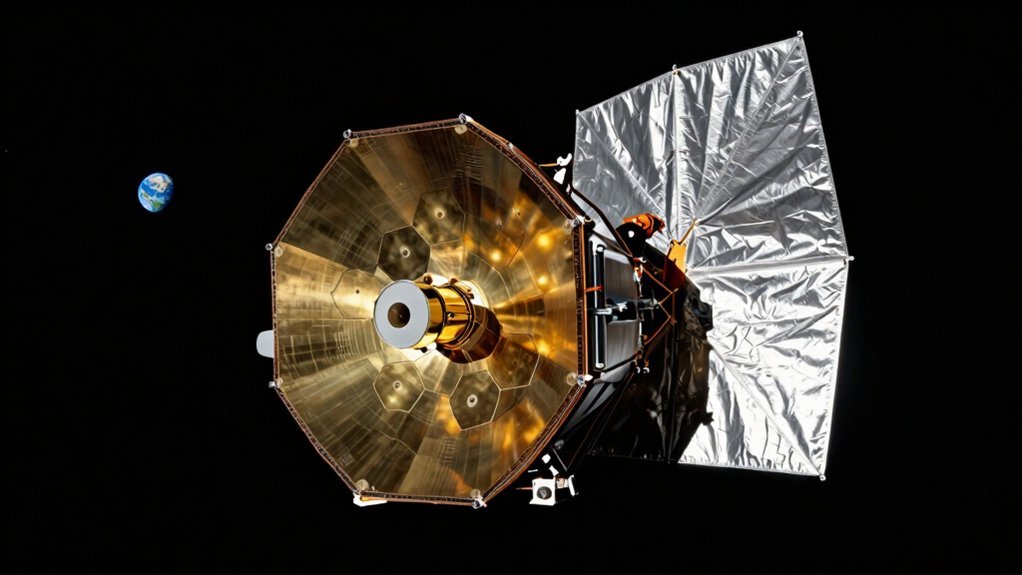
You’re wondering if 3I/ATLAS is finally visible after hiding in the Sun’s glare. Now, you can spot this interstellar visitor with a telescope, though it remains too faint for naked eyes. Obviously, you’ll need serious gear to catch its magnitude 14 glow as it speeds away at 61 km/s. Rest easy, since this comet poses zero danger to Earth while offering unique chemical clues. Stick around to uncover exactly when and how you can track its rare exit.
What Makes 3I/ATLAS a Rare Interstellar Visitor?
Why does 3I/ATLAS stand out when you’ve already heard about ‘Oumuamua and Borisov? You’re wondering if this third visitor truly offers anything new. Obviously, rarity defines its interstellar uniqueness since only three such objects exist.
Here’s the thing: its orbital characteristics prove it hails from deep space. You see a hyperbolic path that no solar gravity can capture. It zooms past at sixty-one kilometers per second, far too fast to stay.
Now, consider how it slices through the ecliptic plane unusually close. Most random visitors miss this finely tuned alignment entirely. You get a rare chance to study ancient material from another star.
This comet might even predate our Sun by billions of years. Its distinct chemistry hints at formation in a vastly different system. You hold a unique key to revealing universal planet-formation secrets today.
To maximize your viewing experience, ensure you utilize expert-backed guidance for optimal telescope alignment and tracking of such high-velocity celestial bodies, as understanding aperture size is critical for gathering enough light to resolve faint, fast-moving interstellar objects. Remember that successful observation also depends heavily on finding a location with minimal light pollution to ensure the faint glow of the comet is not washed out by city lights.
Ready to track where this speedy traveler heads next?
When Did the Comet Reach Its Closest Point to the Sun?
Since you’re wondering exactly when this traveler swung closest to the Sun, let’s pin down that critical moment. You’ll find most sources agree 3I/ATLAS hit perihelion on October 29, 2026, near 11:50 UTC. NASA sometimes cites October 30, but that’s just rounding differences in their clocks. Obviously, timing matters less than the actual event itself.
These perihelion details place the comet about 1.4 AU from our star, sitting between Earth and Mars. That’s roughly 203 million kilometers away during its closest approach. You couldn’t see it then because the Sun’s glare hid the visitor completely. Ground telescopes lost track until mid-November when it reemerged safely. While the comet was hidden, astronomers relied on understanding how different telescope optics perform to plan observations for its reappearance in varying light conditions. Selecting the right aperture size is also crucial for gathering enough light to detect such faint, distant objects against the dark sky. Choosing the correct telescope type ensures astronomers can effectively track celestial bodies across different phases of visibility and brightness.
Is 3I/ATLAS Dangerous to Earth?
You might worry that a fast-moving space rock heading our way spells trouble. Honestly, that fear makes total sense given the headlines. But NASA confirms 3I/ATLAS poses zero danger to our planet. Its closest approach stays 170 million miles away, far beyond the Moon.
Now, let’s tackle the impact risk directly. The comet follows a hyperbolic path, meaning it just visits briefly. It never intersects Earth’s orbit, so collision is impossible. High speed alone doesn’t create a threat here.
Here’s the thing about public misconceptions: online doomsday claims lack scientific backing. Sensational stories exaggerate theoretical damage, but official data calls the trajectory safe. Scientists study this visitor to improve tracking, not to prepare for disaster. By analyzing its hyperbolic trajectory, researchers gain critical insights into the composition of objects from outside our solar system. This pursuit of knowledge echoes the legacy of revolutionary telescopes that allowed key figures to first understand the mechanics of our cosmos.
To get the best view of such fleeting celestial events, enthusiasts should ensure their equipment is properly collimated for maximum clarity.
Obviously, you can breathe easy tonight. This interstellar guest offers research opportunities, not planetary emergencies. You should focus on viewing it through telescopes soon.
Why Is the Comet Invisible to the Naked Eye?
How come you can’t spot this interstellar visitor with your own eyes? You face serious Earth based challenges right now. The comet hides too close to the Sun, drowning in glare. Even at dawn, thick atmosphere steals its dim light before you see it.
Here’s the thing: Intrinsic faintness dooms your naked-eye hopes completely. This object glows at magnitude 14, far weaker than your limit of 6. Its light spreads thin across a fuzzy coma, not a sharp point. You need big glass to gather enough photons for a peek.
Obviously, tiny apertures won’t cut it against such a weak target. Your eyes simply lack the power to pierce this cosmic gloom alone. Don’t strain your neck looking up without proper optical help tonight. Grab a telescope instead to finally catch this elusive traveler. Selecting the right instrument requires understanding how aperture size directly determines the amount of light gathered to reveal such faint objects. Different telescope designs offer varying levels of light gathering power which is critical when observing objects as dim as this comet. For those seeking to observe such elusive targets, choosing a model with the correct optical design ensures maximum efficiency in capturing faint starlight.
When and How Can You View 3i/Atlas With a Telescope?
Where exactly do you point your scope to catch this ghost? You’ll find it near Regulus in Leo during pre-dawn hours. Aim east about ninety minutes before sunrise through September 2025.
Your telescope recommendations matter immensely here since naked eyes fail completely. Grab a ten-inch scope minimum, though twelve inches works better. Smart telescopes with apps like Sky Tonight simplify your hunt considerably.
Mastering observing techniques requires dark skies and an unobstructed eastern horizon view. Start watching two hours early while the background sky stays truly dark. Current ephemerides guide your aim as the comet shifts positions daily.
You need clear conditions because this faint blur hides easily from light pollution. Small telescopes might show a ghostly smudge if your horizon stays low. Don’t wait until twilight kills the contrast you desperately need now.
Check your local sunrise time tonight and plan your early wake-up call. Understanding that larger aperture sizes collect more light is crucial for detecting such faint objects with the recommended equipment. Successful observation also depends on allowing your eyes to fully adapt to the dark adaptation process before scanning the low eastern sky.
What Are Spacecraft Learning From This Flyby?
Since you’re wondering what all those spacecraft actually found, let’s explore the data. Twelve NASA assets captured imagery from unique angles, refining the comet’s path ten-fold. You see, this distributed geometry sharpens our orbital estimates considerably.
Now, instruments are probing the mysterious comet composition directly. MAVEN imaged hydrogen while SPHEREx detected a massive carbon dioxide coma. Surprisingly, data suggests more carbon dioxide than water, plus unusual nickel levels.
Here’s the thing: these advanced observation techniques reveal strange chemistry. Scientists compare gas tails against solar heating to understand particle distribution. You get clear pictures of activity that ground telescopes miss entirely. The upcoming close approach to Mars on October 3rd will allow orbiters and surface robots to gather even more critical data. Unlike space-based sensors, Earth-bound observers must carefully select the right telescope to distinguish such faint interstellar details from background noise. For optimal viewing of such faint objects, enthusiasts should prioritize a mount with precise tracking to keep the target steady during long observations. Understanding the aperture size is also crucial, as a larger diameter collects more light to reveal dim celestial bodies.
All right, so the nucleus size remains uncertain between feet and miles. Yet, every new image narrows those physical property estimates quickly. Obviously, this hyperbolic orbit confirms its interstellar origin beyond doubt.
You now hold key insights into this visitor’s unique structure. What other secrets might these diverse spacecraft detect next?
Where Will 3I/ATLAS Go After Leaving the Solar System?
You’re probably wondering where this cosmic traveler heads once it clears our neighborhood. It follows a hyperbolic orbit, meaning it never returns to our Sun. Your comet zooms past Jupiter in March 2026, then Saturn by July. By the early 2030s, it leaves the planetary region entirely behind.
Now, consider its future trajectory into the vast, cold dark. Estimates suggest it hits the inner Oort cloud around the year 2189. No specific star awaits it, just an endless interstellar journey through space. You won’t see it with naked eyes as it fades quickly. Obviously, this departure marks a permanent goodbye from our solar family.
Here’s the thing: it poses absolutely no threat to Earth or anyone. Its path keeps it safely distant from all our planets. So, you can watch its exit without any worry whatsoever, perhaps using safe cleaning methods to ensure your optics remain pristine for future observations. Choosing the right telescope optics will help you track this faint object as it ventures deeper into the void. Understanding how light gathering works is essential for detecting such dim, distant objects before they disappear forever. What other cosmic mysteries do you want to explore next?