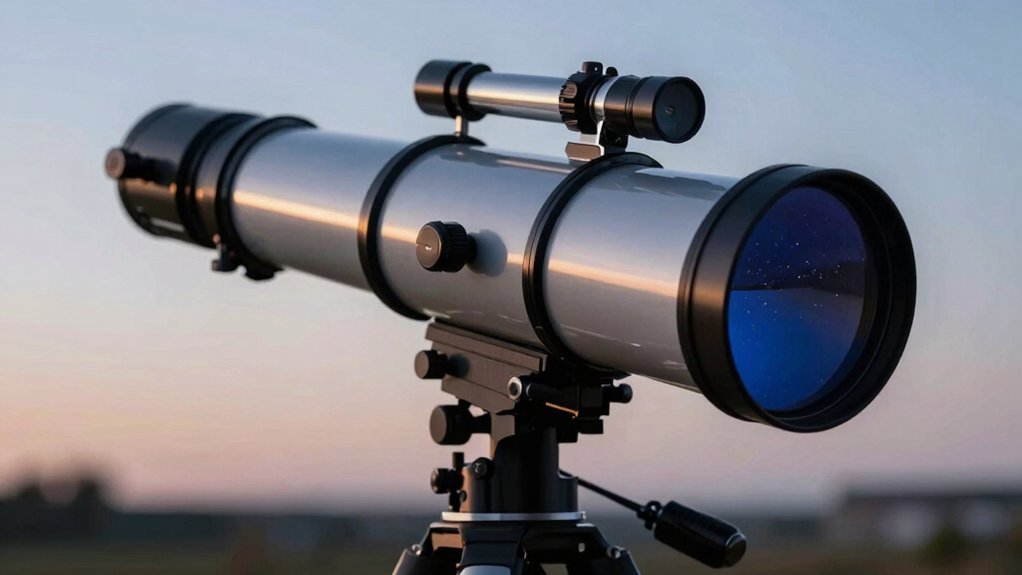
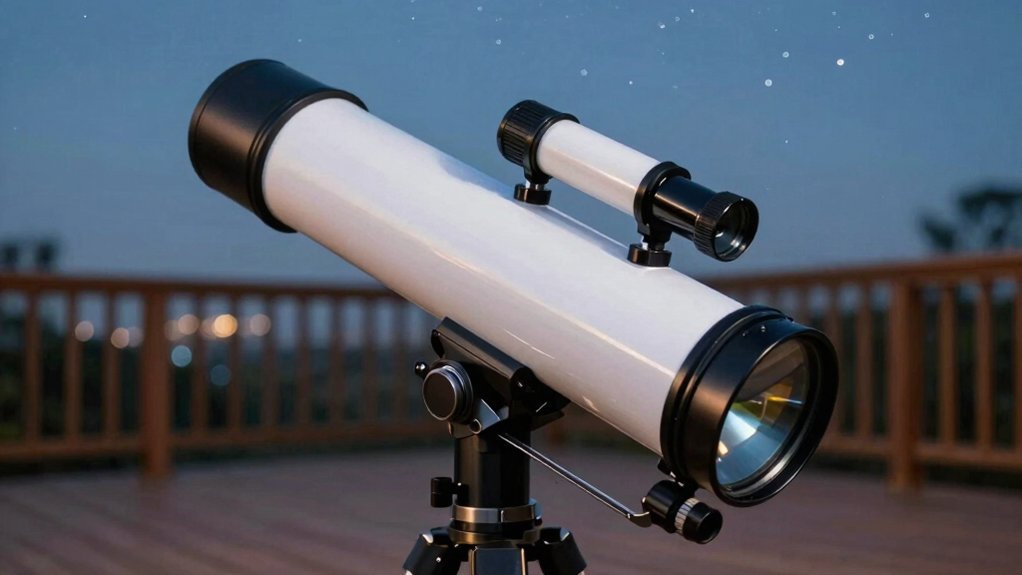
You’re confused by refractors, reflectors, and catadioptrics, but you’ve asked the right question. Refractors use lenses for sharp planet views, while reflectors grab more light for faint nebulae. Catadioptrics mix both for portability. Obviously, aperture matters most; doubling it quadruples your light gathering. Now, consider if you need to detect invisible radiation or escape Earth’s atmosphere entirely. Stick around to uncover exactly which design fits your specific observing goals.
What Are the Three Main Telescope Types?
You’re staring at a dozen telescope names and wondering which three actually matter. Ignore the marketing fluff; only refractors, reflectors, and catadioptrics truly count. These categories depend entirely on their primary optical properties for gathering light.
Refractors use lenses, while reflectors rely on mirrors to focus your view. Catadioptrics mix both elements into one compact, versatile system for your backyard. Each design offers unique telescope features like portability or massive light-gathering power.
Obviously, specific model names like Dobsonian just describe variants of these main types. You need to understand these core differences before comparing aperture sizes or costs. Don’t let fancy branding confuse your research into how these instruments work.
Focus on whether you want simplicity, raw power, or a portable package. Now you know the real foundation for choosing your perfect stargazing tool. Understanding how optical aberrations affect image clarity is also vital when selecting between these designs. The choice of glass or mirror coating directly impacts chromatic aberration levels in your final view. Different optical layouts also determine the overall maintenance requirements needed to keep your instrument performing at its best. Next, let’s explore exactly how those lenses bend light for you.
How Do Refractor Telescopes Focus Light?
At the heart of every refractor, a simple lens bends light just like your old magnifying glass. You might wonder how exactly that glass creates such sharp views of distant stars. Obviously, it relies on refraction to pull parallel rays into a single focal point inside the tube.
Now, this precise light bending forms a small, inverted image right at the focal plane. Your eyepiece then grabs that tiny picture and magnifies it for your eye to enjoy. The whole system depends on perfect optical clarity to keep those star images crisp and bright.
Here’s the thing: longer focal lengths usually mean higher magnification when you swap eyepieces. You get a straight, simple path from the front lens straight to your eye. This design delivers steady, high-contrast views without complex mirror alignments messing up your night. Unlike other designs, this setup offers superior optical clarity for bright celestial targets. Because the light travels in a straight line, the sealed optical tube prevents air currents from degrading the image quality. This construction makes them ideal for observing the moon and planets where high contrast is essential for seeing fine surface details.
You now understand the basic magic behind these classic instruments. Ready to see how mirrors handle faint objects differently?
Why Do Reflectors Excel at Viewing Faint Objects?
Mirrors handle faint objects differently because they gather far more light than those simple lenses you just learned about. You see, aperture drives everything here. Larger diameters collect more photons from dim galaxies, making them suddenly visible to your eye.
Here’s the thing: mirrors cost far less to make than huge lenses. This economic reality lets you buy a massive reflector on a tight budget. Those reflector benefits mean you get way more glass for your money immediately. Obviously, bigger mirrors reveal faint nebulae that smaller scopes simply miss entirely.
Now, consider your local sky conditions. Even under heavy light pollution, a large aperture punches through the glow effectively. You’ll spot star clusters that remain hidden in smaller instruments despite the urban haze. Mirrors also avoid colorful fringing, keeping those deep-sky views sharp and accurate naturally. Crucially, this design eliminates chromatic aberration entirely, ensuring that bright stars remain crisp points of light without distracting color halos. Since reflectors do not suffer from this optical flaw, they provide superior light-gathering power for observing deep-sky objects compared to refractors of similar cost. Additionally, the open structure of many reflector designs allows for faster thermal equilibrium, ensuring the optics stabilize quickly to match the night air temperature for clearer viewing.
What Makes Catadioptric Telescopes a Hybrid?
Confusion about hybrids makes sense when you’ve only seen pure lenses or mirrors. You expect telescopes to use just one method, not both together.
Here’s the thing: a catadioptric system merges refractor lenses with reflector mirrors. This hybrid optical design folds light internally, creating a compact tube. Obviously, this layout lets elements fix each other’s specific image flaws instantly.
Now, consider the real catadioptric advantages like reduced color fringing and sharper stars. You get a wide, clear view without massive equipment weighing you down. The corrector lens shapes light before mirrors bounce it to your eye.
This clever mix delivers long focal lengths in short, portable packages easily. However, central obstructions do slightly lower contrast compared to pure mirror designs. Still, the balance offers incredible versatility for your night sky adventures today. By combining these optical paths, the system effectively corrects for spherical aberration while maintaining a manageable physical size. The integration of both optical types allows for superior image correction across a broad spectrum of viewing conditions. Choosing the right telescope depends on understanding how these hybrid optical designs balance portability with performance for specific observing goals.
Ready to see how size changes what you actually spot out there?
How Does Aperture Affect Light Gathering?
You just saw how hybrids balance optics, but now you’re wondering why size actually matters for what you see. Aperture defines your main lens diameter, yet light collection depends on that opening’s total area. Doubling the size quadruples the photons you catch, making faint galaxies suddenly pop.
Here’s the thing: aperture effects scale fast because geometry works in squares. An 8-inch scope gathers four times more light than a 4-inch one. This boost brightens dim nebulae and sharpens planetary details considerably. You’ll spot stars at magnitude 13.5 with a large tube versus only 10.5 with a small one.
Obviously, bigger mirrors mean better views of deep-sky treasures. Your limiting magnitude climbs as you capture more target photons per second. The light gain with bigger apertures is exponential, not linear. So, prioritize aperture if you want to see the universe’s faintest secrets clearly tonight. Remember that a larger primary mirror directly increases the surface area available to collect these essential photons. Understanding the optical resolution helps explain why this increased light also reveals finer details alongside brighter images. While cost often rises with size, comparing telescope options side by side ensures you find the perfect balance between performance and budget for your specific stargazing needs.
Which Specialized Designs Suit Your Needs?
So, how do you pick the right tool when every design seems to promise something different? You match specific telescope applications to your actual observing goals. Refractors under 80mm offer sharp views without heavy maintenance. Newtonians give you wide fields cheaply but need regular collimation.
Now, consider your portability needs versus raw power. Cassegrains fold light paths for compact, high-magnification setups perfect for planets. Smart telescopes bypass eyepieces entirely, capturing deep-sky details automatically via apps. Specialized optics like Ritchey-Chrétien systems deliver edge-to-edge clarity for serious imaging. For those prioritizing image quality over cost, apochromatic lenses eliminate color fringing to provide superior contrast on bright objects. Dobsonian mounts provide a stable yet affordable base for large aperture Newtonians, making them ideal for visual observing of faint deep-sky objects.
Here’s the thing: no single scope does everything perfectly. You trade cost, size, and upkeep for specific performance gains. Choose the design that fits your most frequent night-sky targets. Different optical designs excel at distinct tasks, so understanding telescope comparisons helps align your gear with your primary observing interests. Next, you’ll wonder what lies beyond visible light entirely.
Can Telescopes Detect Invisible Radiation?
Now, you’re probably wondering how astronomers see what your eyes physically can’t. They detect invisible radiation across the entire electromagnetic spectrum. Your eyes only catch visible light, missing huge cosmic clues.
Specialized tools grab radio waves, infrared heat, or deadly X-rays. Radio dishes listen to cold gas clouds while infrared scopes peer through dust. Obviously, Earth’s atmosphere blocks many signals, so we launch telescopes into space. Different telescope designs utilize specific optical systems to collect and focus these varied forms of energy effectively.
These instruments convert hidden energy into data computers translate into images. You aren’t just seeing stars; you’re witnessing black holes and newborn galaxies. This approach reveals the universe’s secret, energetic processes completely.
Understanding these wavelengths changes everything you thought you knew about space. Next, you’ll need to decide which telescope type fits your own curiosity. However, before investing in equipment, you should first master observing tips to maximize what you can see with your naked eye under realistic night sky conditions.
How to Choose the Right Telescope Today
How do you cut through the confusing specs to find a scope that actually works? You prioritize aperture first because it gathers light. A 70mm lens beats a cheap 4-inch mirror every time. Avoid scopes under $100 since they frustrate you quickly.
Now, weigh your budget considerations against actual performance needs. Spend $200 to $400 for a quality starter instrument. Refractors offer easy setup, while reflectors give bigger views for less cash. Don’t ignore portability factors if you hike to dark skies. Heavy tubes stay home, ruining your observation plans.
Here’s the thing: magnification matters less than steady mounts. Unstable tripods make high power useless regardless of optics. Aim for smooth tracking rather than computerized gimmicks early on. Your best view comes from matching gear to your specific storage space. Choose wisely so you actually look up tonight.
Where Do Space Telescopes Fit In?
Where exactly do these orbital giants fit in your understanding of astronomy? You might think they replace ground tools, but they actually complement them. Their location defines their unique role in your research.
Space telescope significance lies in escaping Earth’s blurring atmosphere. You get sharp images of ultraviolet or X-rays that ground sites miss. Hubble sits 515 kilometers up, capturing light ground telescopes can’t see.
These instruments enable critical astronomical observations across the spectrum. You study galaxy evolution or exoplanet atmospheres without atmospheric noise. They act as time machines, showing you the distant past.
Ground and space telescopes work together, not against each other. You use space data to find targets, then ground tools for details. This partnership reveals the full universe for your study.
Now you see how they fill specific gaps in your toolkit. Ready to explore which mission matches your curiosity next?