You’re wondering if telescopes just make things bigger, but that’s not quite right. Their main job is gathering faint light like a bucket catches rain, where a four-meter mirror collects 16 times more photons than a one-meter one. Obviously, bigger apertures sharpen details better than zooming ever could. Now you see why brightness beats magnification every time. Keep exploring to uncover how modern sensors reveal stars invisible to your naked eye.
What Is the Primary Function of a Telescope?
You’re probably wondering if a telescope’s main job is just to make things look bigger. That’s a common guess, but you’d be wrong. Magnification actually ranks third behind collecting light and sharpening details.
Here’s the thing: true telescope functionality focuses on gathering faint photons from deep space. Your eyes miss these dim objects entirely without that extra help. The instrument concentrates scattered rays into a bright, usable picture for your brain. By increasing the aperture size, the telescope captures significantly more light, allowing observers to detect celestial bodies that would otherwise remain invisible to the naked eye.
Obviously, image quality matters more than sheer size when viewing distant planets. Poor resolution leaves you with a big, blurry mess instead of crisp craters. You need sharpness to separate close stars or see surface features clearly. Understanding light gathering power reveals why larger apertures detect fainter galaxies that smaller instruments simply cannot see. Success also depends on finding a location with minimal light pollution to ensure the sky is dark enough for your equipment to perform at its best.
How Telescopes Gather Light Like a Bucket
Imagine a bucket catching rain; that’s exactly how your telescope grabs starlight. You might wonder why size matters so much for seeing faint stars. Obviously, a wider opening captures more photons, just like a bigger bucket holds more water.
Your telescope’s aperture drives this entire light collection process. A four-meter mirror gathers sixteen times more light than a tiny one-meter version. This massive increase makes dim galaxies suddenly visible to your enthusiastic eyes.
Curved mirrors or lenses then handle the essential light concentration task. They bend those gathered rays into a sharp, bright focal point. Without this focus, you’d just see a blurry mess of scattered illumination.
You need both gathering power and precise focusing to reveal the cosmos. Now you understand why astronomers obsess over aperture diameter above all else. Ready to see how that collected light actually forms clear images?
Choosing the right instrument depends on balancing optics performance with your specific stargazing goals and budget, while also considering how different telescope options compare regarding cost and suitability for various observers. Selecting the ideal device requires understanding how optical design directly influences image clarity and field of view for your specific needs.
Why Aperture Size Determines Image Resolution
Now you’ve got the light, but can you actually see the fine details? Your telescope’s aperture directly dictates this clarity. Light waves bend around edges, creating diffraction effects that blur tiny points into fuzzy Airy disks. A small scope makes these disks huge, merging close stars into one blob.
Here’s the thing: bigger mirrors shrink those disks considerably. Doubling your aperture roughly halves your minimum resolvable angle. The aperture impact is clear; a 200mm lens resolves details a 100mm one simply cannot. You aren’t just gathering more photons; you are sharpening the very pixels of your view.
Obviously, atmospheric turbulence sometimes fights this physics, but your instrument sets the theoretical ceiling. Larger objectives separate lunar craters and planetary bands that smaller tubes miss entirely. Don’t confuse this raw resolving power with simple zooming later. Your aperture defines the finest detail you can ever hope to see. This fundamental limit, known as the Rayleigh limit, proves that resolution for distant objects is uniquely determined by the telescope diameter and the wavelength of light. Ultimately, maximizing this capability requires understanding how optical diffraction fundamentally constrains the sharpness of any image formed by a circular aperture. When selecting equipment, remember that optical performance relies heavily on balancing aperture size with portability and cost to match your specific stargazing goals. Just as a well-structured web page layout guides a visitor’s eye to essential information, a telescope’s optical design directs light to reveal the universe’s finest details.
Can Magnification Alone Improve Your View?
So, does cranking up the magnification actually sharpen your view? Not really. You might think bigger means better, but magnification only enlarges what is already there. It cannot create new detail if your telescope lacks the resolution to see it first.
Here’s the thing: pushing past your instrument’s magnification limits just makes the image dimmer and blurrier. As you increase power, image brightness drops markedly, often hiding faint objects entirely. A 4-inch scope usually tops out around 200x on a good night.
Obviously, atmospheric turbulence often caps your usable power even lower than that. You need to match your magnification to the specific target and current sky conditions. Moderate power frequently delivers the sharpest, most satisfying views for most celestial bodies. Don’t let marketing hype about extreme numbers fool you into expecting miracles. Remember that maximum useful magnification is generally limited to twice the telescope’s aperture in millimeters to avoid fuzzy results. The primary role of any instrument is actually light gathering ability, which determines how faint an object you can detect before worrying about size. High-quality optical coatings can further enhance contrast and transmission, ensuring you get the most from every photon collected. This fundamental reliance on aperture size means that resolution limits are dictated by physics rather than the eyepiece you choose.
Ready to see how optics actually gather that light? Let’s look next at lenses and mirrors.
How Lenses and Mirrors Focus Distant Light
Two main tools gather starlight for you: convex lenses and concave mirrors. You might wonder how they actually work. Obviously, distant stars send parallel rays that need concentrating.
Lenses use light refraction to bend those rays inward. As light slows down inside the glass, curved surfaces force convergence at a specific focal point. This creates a real image you can see.
Mirrors rely on mirror reflection instead. A concave surface catches incoming light and bounces it directly to a focus without slowing the beam. Large telescopes often prefer this method for gathering power because it avoids chromatic aberration, a color distortion common in lens-based systems. While reflectors excel at eliminating color issues, refractor telescopes remain popular for their low-maintenance sealed tubes and sharp planetary views.
Your telescope’s focal length determines exactly where that bright image forms. Whether bending or bouncing light, the goal remains collecting and concentrating faint signals into something visible. Now you know the core mechanism behind your view. Next, let’s distinguish what makes refractors differ from reflectors. Just as a well-structured web page guides a visitor clearly, these optical components guide light precisely to your eye.
What Distinguishes Refractors From Reflectors?
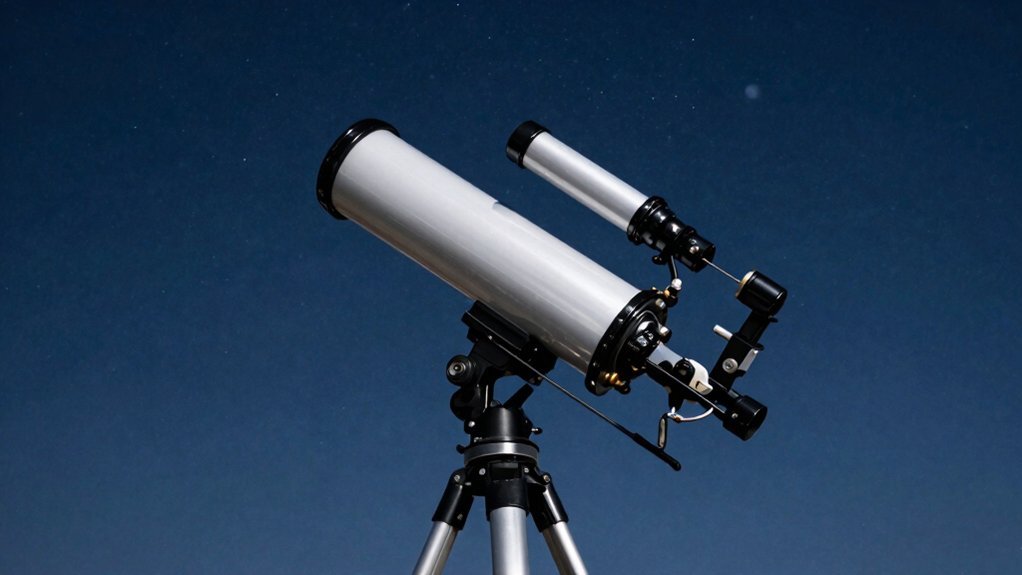
Since you’ve seen how lenses and mirrors focus light, you’re probably wondering what actually makes these two telescope types different. Refractors use glass lenses to bend light, while reflectors bounce it off curved mirrors. This fundamental design choice drives every other difference you’ll encounter.
Refractor advantages include crisp, high-contrast views perfect for planets and minimal maintenance thanks to sealed tubes. However, large models get heavy and expensive quickly. You also might see color fringing on bright stars sometimes. Expert enthusiasts often recommend checking the chromatic aberration levels in cheaper lenses to ensure sharp planetary details.
Reflector disadvantages involve open tubes that collect dust and require occasional mirror alignment called collimation. Yet, they offer huge apertures for faint galaxies at a fraction of the cost. Mirrors avoid color errors entirely, giving you clearer deep-sky images. The optical path in a reflector often requires a secondary mirror to direct light to the eyepiece, which can slightly reduce contrast compared to unobstructed refractor designs. Choosing the right optical design ensures your instrument matches your specific observing goals and budget constraints.
Ultimately, you choose between portable precision or budget-friendly light-gathering power. Now you understand the core trade-offs before considering image brightness next.
Why Brightness Beats Zoom Power Every Time
Although you might think zooming in makes things clearer, it actually dims the view instantly. You spread limited light over a larger area, hurting viewing contrast. Brightness factors rely on light collection, not magnification limits. Your aperture gathers photons; zoom just spreads them thin.
Now, consider resolution challenges. Pushing past 50x per inch creates blur, not detail. Atmospheric effects often cap usable power well below theoretical maximums. You cannot force clarity where optics fail. Imaging techniques need bright targets, not empty magnification. Different telescope designs offer varying levels of optical performance that directly influence how much detail you can resolve before hitting these physical limits.
Here’s the thing: low surface brightness objects vanish when you over-zoom. A galaxy dims rapidly as you increase power unnecessarily. You need enough magnification for detail, not the highest number possible. Prioritize a bright, sharp image over a large, fuzzy one.
Choose eyepieces that balance size and illumination effectively. Understanding the conditions needed for clear viewing ensures you maximize your telescope’s potential before considering how modern detectors actually capture those faint objects you seek.
How Modern Detectors Capture Faint Objects
Capture those faint glimmers by turning light into electricity. You might wonder how cameras see what your eyes miss. Modern sensors convert incoming photons directly into measurable electrical signals for analysis.
CCD technology captures up to ninety percent of striking photons efficiently. Meanwhile, CMOS advancements now offer similar sensitivity with much lower power consumption. You get detailed images because these grids collect every tiny bit of light.
Signal accumulation lets you expose for hours, stacking weak photons into strong data. This process reveals dim galaxies that vanish instantly to human vision. Obviously, longer integration times mean clearer pictures of the deepest universe.
Infrared detection exposes cool stars invisible in normal visible light spectra. Space telescopes avoid atmospheric noise, spotting a four-watt bulb on the Moon. You finally see objects ten times fainter than ground-based tools allow.
Your detector acts as a light bucket, holding photons until they form an image. Now you understand why exposure time matters more than magnification power.
What Details Become Visible Through a Telescope?
Ever wonder exactly what pops into view when you finally look through that lens? You’ll instantly spot rugged lunar craters and dark maria on the Moon’s surface. Even a small scope reveals these features clearly under good skies.
Now, turn your gaze outward to catch stunning planetary details like Jupiter’s bands. You can separate tight binary stars that blur together for the naked eye. Larger apertures split these pairs into distinct, colorful points of light easily.
All right, let’s hunt for faint deep sky objects hiding in the dark. Small telescopes show globular clusters as fuzzy patches, but bigger ones resolve individual stars. You need aperture to see spiral arms in distant galaxies clearly. Mid-range telescopes improve visibility of brighter Messier objects like the Great Orion Nebula.
Your view depends entirely on how much light your instrument gathers effectively. Start with the Moon, then push your limits toward fainter cosmic targets today.