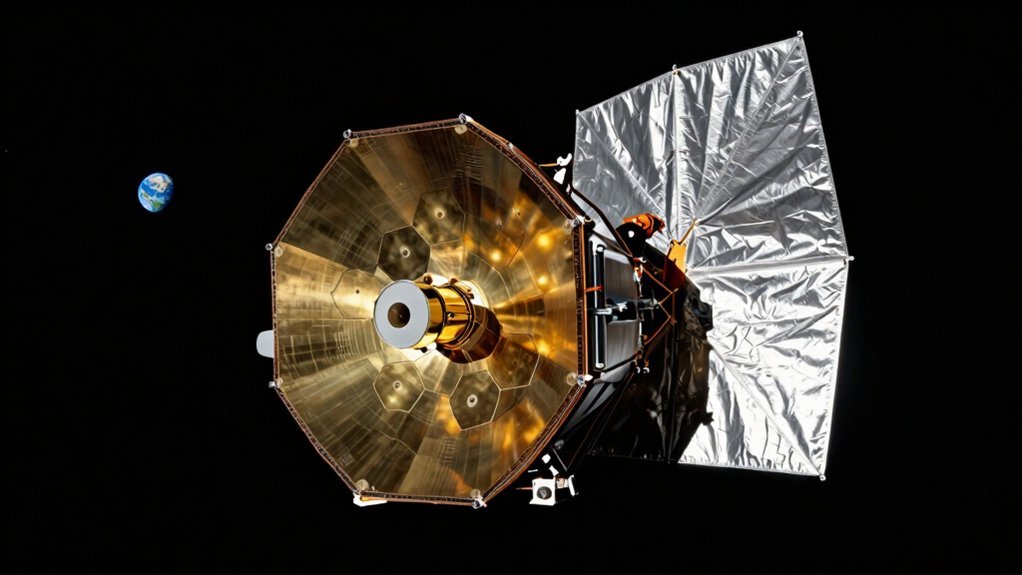
You’re wondering what a telescope actually does, and it’s not just about making things look bigger. The real job is gathering light; doubling your aperture quadruples the photons you catch, revealing faint details instantly. Obviously, bigger mirrors resolve finer angles, but atmospheric turbulence caps useful magnification around 50x per inch. Now, you need to match that aperture to your specific sky goals without overloading your back. Choosing wisely here reveals the deeper cosmic data waiting for you in the next section.
Why Aperture Determines Telescope Brightness
Aperture is the big opening that grabs light for your telescope. You’re wondering why size matters so much for brightness, right? Obviously, bigger openings catch more photons from faint galaxies. This directly boosts your view’s clarity.
Here’s the thing: light gathering power depends on the area, not just width. When you check telescope specifications, prioritize diameter because it squares your light collection. A 100mm lens gathers four times more light than a 50mm one. That means dim nebulae suddenly pop into view.
Now, remember focal ratio shapes geometry, but aperture controls actual grasp. You need that extra light to see fine details sharply. Don’t let magnification fool you; without enough light, images just get dark and blurry. Increasing the light-gathering power allows observers to detect celestial objects that are otherwise invisible to the naked eye. A larger aperture also significantly improves the angular resolution, enabling you to distinguish finer details on planets and separate close double stars.
Your takeaway? Big apertures make faint objects visible. Next, consider how doubling that size quadruples your power. Crucially, expert guidance suggests that optical quality remains vital even when maximizing aperture for the best viewing experience.
How Doubling Aperture Quadruples Light Gathering
You’re wondering why doubling the size doesn’t just double the light, right? It happens because aperture significance relies on area, not diameter. Your telescope’s mirror acts like a circle, so area grows quadratically with size.
When you double that diameter, you actually quadruple your total light collection power. A six-inch scope gathers four times less light than a twelve-inch one. Obviously, this square-law relationship means small jumps yield huge brightness gains for faint galaxies.
Think of it as gaining two full photographic stops instantly. You see dimmer objects clearly without lengthening your exposure times at all. This massive boost makes deep-sky observing possible where smaller instruments fail completely. The resolution limit of your instrument also improves with larger apertures, allowing you to distinguish finer details on planets and double stars alongside the increased brightness.
Remember that every doubling equals a fourfold jump in photon gathering ability. Now you understand why astronomers constantly chase larger mirrors for better views. Expert observers note that maximizing light gathering power is often more critical than magnification for viewing faint celestial bodies. Different optical designs offer unique advantages when selecting telescope options for specific stargazing goals. Ready to see how this extra light reveals finer details next?
Why Larger Apertures Resolve Finer Details
Diffraction sets the hard limit on how much detail you can actually see. You might wonder why bigger mirrors matter if light gathering isn’t the only goal. Here’s the thing: your telescope’s angular resolution depends directly on aperture size.
Larger diameters shrink diffraction patterns, letting you separate tighter double stars easily. A 10-meter scope resolves angles 100 times smaller than a tiny 10-centimeter one. Obviously, this means finer planetary features pop into view instantly.
You capture more wavefront information, which sharpens clarity beyond just brightness. While atmosphere sometimes blurs ground-based views, the physical potential remains huge. Space telescopes use this full advantage to reveal incredible nebula structures. Following a practical step-by-step walkthrough ensures you master the basics before attempting complex observations.
Understanding the specific focal ratio of your instrument helps determine the field of view and magnification limits you can effectively utilize. Your next step? Consider how local seeing conditions affect these theoretical gains. Remember that even with a large aperture, poor seeing conditions can prevent you from reaching the instrument’s maximum resolution potential.
The Real Limit on Useful Telescope Magnification
You’ve got the aperture sorted, but now you’re wondering why cranking up the magnification doesn’t always show more detail. Here’s the thing: useful magnification hits a hard ceiling around 50x per inch of aperture. Pushing beyond this limit just makes your view dimmer and softer without revealing new features.
Now, consider atmospheric turbulence. Even perfect optics fail when shaky air blurs the image before it reaches your eye. On average nights, this factor often caps practical power at merely 250x to 350x total. These magnification limitations mean you rarely use your telescope’s theoretical maximum during typical observing sessions. Side-by-side comparisons of different models reveal that optical quality significantly impacts how well an instrument handles these high-power limits under real-world conditions. Selecting a telescope with superior optical coatings can further maximize light transmission and contrast when pushing against these atmospheric barriers.
Obviously, bright planets tolerate higher power than faint galaxies do. You must match your eyepiece choice to both the sky conditions and your specific target type. Stop chasing empty magnification and start optimizing for clarity instead. Ready to see how aperture truly unveils deep sky secrets? Since light gathering ability determines the brightness of the image, understanding light gathering power is essential before selecting an eyepiece for faint objects.
How Aperture Enables Deep Sky Spectral Analysis
Since you’ve hit the magnification wall, you’re probably wondering how aperture actually helps with faint deep-sky spectra. It’s simple: bigger mirrors grab more light, boosting your photon collection greatly. This extra signal strengthens weak spectral lines against detector noise, making dim galaxies readable.
Now, consider spectral resolution. While aperture offers potential for finer detail, seeing often limits sharpness. Yet, without enough photons, you can’t extract those subtle absorption features reliably. You need that raw light first to make any analysis work. Understanding the relationship between light gathering power and signal fidelity is essential for interpreting complex celestial data accurately.
Obviously, faint nebulae demand every photon you can gather before noise overwhelms the data. Higher signal-to-noise ratios let you spot structures that smaller scopes miss entirely. Your exposure times drop, and your data quality jumps up immediately. When comparing different optical designs, choosing the right telescope option ensures your specific stargazing goals align with the instrument’s light-gathering capabilities. Crucially, the primary mirror diameter directly dictates the theoretical limit of resolution and the faintest magnitude visible to your system.
Choosing the Right Aperture for Your Goals
If you’re staring at a list of telescope sizes wondering which one actually fits your night sky goals, you’re asking the right question. Aperture dictates your light-gathering power, so bigger isn’t always better if you can’t carry it.
Now, apply smart aperture selection strategies based on your targets. Planetary watchers need at least four inches, while deep-sky hunters truly benefit from eight to ten inches. Doubling that size quadruples your collected light, revealing faint galaxies instantly. Remember that the aperture diameter is the most critical factor for gathering light and resolving fine detail. Different optical designs like refractors and reflectors manage this light differently, but optical quality remains paramount for sharp views regardless of the telescope type chosen. Refractors use lenses to bend light while reflectors utilize mirrors to gather it, creating distinct optical path characteristics for each design.
Here’s the thing: beginner telescope recommendations often suggest manageable eight-inch scopes for balanced performance. You avoid heavy gear that stays in the garage gathering dust. Obviously, portability limits your real-world maximum size more than budget does. For those prioritizing ease of transport without sacrificing too much light grasp, compact models offer a practical compromise for frequent observers.
Choose an aperture you will actually use under your specific sky conditions. Ready to calculate your maximum useful magnification next?