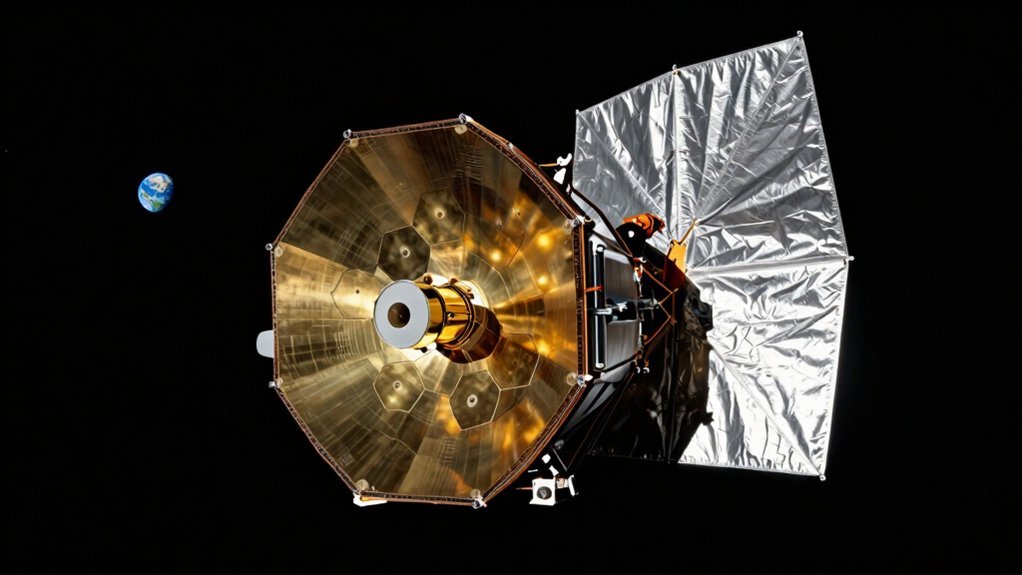
You’re right to wonder why ground telescopes aren’t enough, since Earth’s atmosphere blocks essential light. Obviously, air absorbs all gamma rays and X-rays while turbulence blurs your view into fuzzy blobs. Now, space removes this distortion, letting you see sharp infrared details inside stellar nurseries without light pollution. This clarity reveals cosmic secrets ground-based mirrors simply miss, transforming how you understand the universe. Stick around to uncover exactly how these missions justify their massive costs.
Why Can’t Ground Telescopes See All Light?
Why does the air above us block so much of the universe’s light? You might think glass lenses fail, but Earth’s thick blanket of gas actually eats specific colors before they reach your eyes. This process, called atmospheric absorption, stops most ultraviolet and infrared waves dead in their tracks.
Now, consider how turbulent air smears starlight into fuzzy blobs instead of crisp points. These ground limitations mean you miss faint details even with huge mirrors on high mountains. Obviously, city lights make this worse by washing out the dark sky you need for deep views. Overcoming these barriers required the revolutionary telescope designs that eventually allowed humanity to peer beyond our atmospheric veil.
You simply cannot see the full electromagnetic spectrum from down here because our atmosphere acts like a selective filter. Space telescopes bypass this messy air entirely to capture sharp, complete pictures of the cosmos. Understanding the electromagnetic spectrum reveals exactly which dangerous rays never touch the ground, guiding astronomers to place instruments in orbit for unobstructed viewing. Just as a telescope uses an aperture to gather light, placing it above the atmosphere ensures that no photons are lost to air turbulence or absorption. Ready to learn exactly which dangerous rays never touch the ground?
What Blocks Gamma Rays and X-Rays on Earth?
You just learned how air blurs visible light, but that same shield stops something far more extreme. High-energy gamma rays and X-rays never reach your backyard telescope because Earth’s atmosphere blocks them completely.
Nitrogen and oxygen molecules in the thermosphere absorb these dangerous photons through intense radiation interactions. This process, called atmospheric absorption, converts high-energy waves into harmless particles before they touch the ground.
Obviously, you can’t observe cosmic explosions from sea level when the air acts like a thick lead wall. The atmosphere selectively filters specific wavelengths, letting visible light pass while stopping everything more energetic.
Ground instruments miss out because these critical signals vanish high above your head. You need space telescopes to catch X-rays before the air destroys them.
Just as ground-based optics struggle with atmospheric turbulence, high-energy astronomy is impossible without leaving the planet entirely. This limitation highlights why understanding optical clarity is essential when deciding between ground-based and orbital observatories.
Space-based platforms avoid this filtering entirely, providing an unobstructed view for high-energy astronomy.
Ready to see how escaping the atmosphere clears up your view entirely?
How Does Space Remove Atmospheric Blur?
How exactly does leaving the air fix your blurry images? You see, atmospheric turbulence constantly bends light through moving pockets of varying density. This chaos creates wavefront distortion, warping starlight before it ever hits your ground-based mirror.
Now, imagine trying to read a sign through shimmering heat waves; that is basically what happens down here. Even clever tricks like adaptive optics or stacking quick exposures can’t fully cancel out this relentless shifting. They help, sure, but they only correct part of the view at any single moment. While systems using artificial guide stars can significantly improve ground-based clarity, they cannot entirely eliminate the fundamental limitations imposed by the atmosphere.
All right, so here is the real solution: you simply launch your telescope above the entire atmosphere. Space removes the air completely, letting light travel in perfectly straight lines to your sensors. Your images instantly become sharp because nothing disturbs the incoming wavefronts anymore. You finally achieve the telescope’s true theoretical resolving power without fighting nature every second. By avoiding atmospheric interference, the instrument can detect fainter objects with greater light gathering power. This stability also allows for longer exposure times to capture deep sky objects that would otherwise be lost in atmospheric noise. Unlike ground-based equipment that requires careful handling of cleaning solutions to maintain optical clarity, space telescopes remain free from dust and contaminants that necessitate such maintenance. Next, consider how darkness itself improves your view even further.
How Space Eliminates Sky Glow and Light Pollution
Since you’re wondering why city lights ruin your view, let’s talk about that glowing dome above populated areas. Artificial light sources scatter in our atmosphere, creating a bright haze that washes out faint stars. This sky glow lowers contrast, effectively shrinking your telescope’s power by hiding deep-space objects. You struggle to see galaxies because the background isn’t truly dark.
Now, imagine lifting your instrument above all that mess. Space eliminates this problem entirely since no air exists to scatter city lights back into your lens. You gain a perfectly black background, boosting contrast for those elusive, dim targets. Ground observers constantly fight for sky glow mitigation, yet expanding LED usage keeps worsening conditions. Space telescopes skip this battle completely, offering stable darkness without needing remote deserts. This capability mirrors the legacy of groundbreaking telescope milestones that proved escaping the atmosphere is essential for clear astronomical history. Unlike ground-based optical designs that must compensate for atmospheric interference, space instruments achieve their theoretical performance limits immediately upon deployment. By operating above the atmosphere, these observatories avoid the turbulent air that distorts light and blurs images for Earth-bound viewers.
Obviously, removing atmospheric scattering reveals structures ground-based glare hides. You get consistent, superior data for faint-object astronomy right from orbit. Ready to see how infrared vision changes everything?
Why Infrared Space Telescopes Reveal Star Formation
While visible light gets stuck in cosmic dust, infrared rays slip right through to show you the action. You’re wondering how we spot newborn stars hidden deep inside those thick, dark clouds. Obviously, dense molecular blocks stop optical views cold, but infrared capabilities let you peek right inside stellar nurseries.
Here’s the thing: warm dust glowing around young protostars shines brightly at these specific wavelengths. You see structures and gas plumes that visible telescopes completely miss because they cannot penetrate the grime. This radiation reveals the true rate of collapse and identifies water ice in forming disks. Beginners often overlook that mastering the basics of wavelength selection is crucial for interpreting these complex cosmic signals correctly.
Now, you understand why space instruments map star formation across galaxies and cosmic time so effectively. They detect faint brown dwarfs and trace intense activity where planets are born. Your next question might be whether ground-based tools can ever match this unique, unobstructed clarity from orbit. Unlike ground-based options limited by atmospheric interference, choosing the right telescope for deep-space observation often requires escaping Earth’s atmosphere entirely to capture these critical infrared signals. Even from a backyard, knowing that light pollution drastically reduces contrast helps explain why space telescopes are essential for capturing the faintest infrared details without Earth’s glowing sky interfering.
Can Ground Telescopes Match Space Views?
Now, you’re wondering if big ground telescopes can actually match those crisp space views. Honestly, Earth’s atmosphere constantly distorts light, blurring your images considerably. Yet, adaptive optics systems correct much of this distortion in real time effectively.
These advanced tools narrow the gap between ground and space observations substantially. You can achieve near-space image quality when conditions align perfectly with guide stars. However, turbulence remains a fundamental obstacle that space telescopes simply avoid entirely.
Large mirrors boost your light collection, helping brighter targets look incredibly sharp sometimes. Still, faint galaxies suffer because the sky glows and the point-spread function wavers. Space platforms offer stable views for ultra-precise tasks like finding Earth-mass planets. The Hubble Space Telescope demonstrated how escaping atmospheric interference revolutionized our ability to capture deep cosmic history. While ground-based observatories excel in collecting area, optical performance is often limited by atmospheric stability compared to the vacuum of space. Beginners must remember that essential tips for success online often highlight starting with clear, foundational knowledge before tackling complex comparisons.
Ground and space telescopes truly complement each other rather than replacing one another. You need both for the complete cosmic picture today. Which wavelength interests you most for your next exploration?
How Space Telescopes Enable Continuous Viewing
Because Earth’s rotation constantly cuts your view, you might wonder how space telescopes see without stopping. Now, imagine watching a movie that pauses every twelve hours; that’s ground astronomy. Space telescopes dodge this by orbiting above our planet’s daily spin. They achieve true continuous viewing, especially near the ecliptic poles where Webb observes 365 days yearly. Positioned at Lagrange point L2, the telescope benefits from a stable gravitational environment that further supports these uninterrupted observations.
Here’s the thing: you get uninterrupted observations for capturing fleeting cosmic events like supernovae. Ground telescopes miss these gaps, but space instruments maintain steady stares on faint targets. Webb spends 70% of its time collecting light, not waiting for nightfall. You secure long data streams essential for studying variable stars or deep fields. By eliminating atmospheric interference, these instruments deliver sharper images that reveal details impossible to resolve from the ground.
Obviously, avoiding weather and daylight lets you monitor objects for days straight. This stability transforms how you track rapid changes in the universe. Unlike ground-based observers who must wait for clear skies to get a good look, space telescopes operate independently of terrestrial weather patterns. Ready to weigh if these powerful eyes justify their hefty price tags?
Are Space Missions Worth the High Cost?
You’ve just seen how space telescopes never blink, but that non-stop viewing comes with a staggering price tag. You wonder if billions spent up there really help us down here. It’s a fair question when hunger costs billions too.
Here’s the thing: every dollar spent returns seven to fourteen dollars economically. This massive economic impact creates high-skilled jobs and fuels a four-hundred-billion-dollar global industry. You gain GPS, weather forecasts, and new medical therapies from this investment.
Obviously, critics worry about opportunity costs, yet space benefits extend far beyond pretty pictures. Research drives inventions that solve Earthly problems like drought and disease. Your tax dollars actually build a stronger, smarter economy right here at home.
How Space Telescopes Complete the Cosmic Picture
That blurry star you see? Earth’s atmosphere twists its light, ruining your view. Space telescopes escape this turbulence, delivering crystal-clear images instantly. You get advanced imaging that separates close objects easily.
Now, imagine seeing only red paint while missing blue and green. Our atmosphere blocks most cosmic light, hiding huge secrets from you. Multiwavelength analysis fixes this gap completely. Hubble sees ultraviolet light, while James Webb spots infrared heat.
You witness hidden star nurseries and violent black holes together. These tools act as time machines, showing you the universe’s infancy. Combining every wavelength creates one complete cosmic map for your study.
You finally understand how hot gas and cold dust interact. This full picture reveals the true story of galaxy evolution. Ready to explore what specific telescope found next?