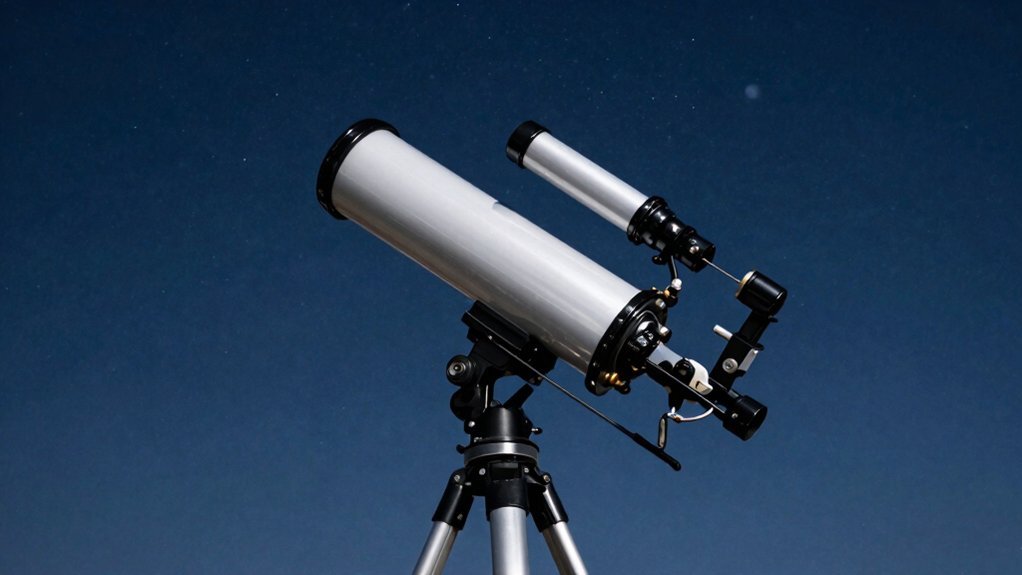
You’re wondering why aperture matters so much on spec sheets. It’s simply the diameter of your main lens or mirror, and obviously, bigger sizes gather more light. A 200mm scope captures four times more light than a 100mm one, revealing faint galaxies you’d otherwise miss. Now, huge apertures can get heavy and struggle with wind, so balance is key. Keep exploring to find the perfect size for your sky.
What Is Telescope Aperture and Why It Matters
Aperture is simply the diameter of your telescope’s main light-collecting lens or mirror. You’re probably wondering why this single number matters so much for your viewing experience. It defines your clear opening for incoming light, acting as the foundation for everything you see.
Now, let’s look at aperture types. Refractors use a lens, while reflectors rely on a primary mirror. Your aperture measurement usually appears in millimeters or inches, like 70 mm or 200 mm. Obviously, bigger numbers mean you catch more light and resolve finer details on planets. This increased light-gathering power allows observers to distinguish subtle surface features on distant celestial bodies that smaller instruments miss.
Here’s the thing: aperture dictates your ability to spot faint galaxies and sharp lunar craters. A 200 mm scope gathers four times the light of a 100 mm one. This spec directly limits how deep you can peer into the cosmos tonight. When selecting equipment, understanding the trade-offs between telescope types ensures you choose a model that aligns with your specific viewing goals and budget. While larger apertures offer superior views, beginners should also consider the portability and cost of the instrument to ensure it remains a practical choice for regular use.
How Aperture Size Dictates Light-Gathering Power
Since you’re wondering how size actually translates to brighter views, let’s break down the math behind the magic. You might think doubling diameter just doubles light, but area scales quadratically. A 200mm scope gathers four times more photons than a 100mm one.
Here’s the thing: light gathering efficiency depends entirely on that circular surface area. You capture sixteen times more light with a 4-meter telescope versus a 1-meter instrument. Obviously, this massive boost reveals faint galaxies hidden from smaller lenses. Even under perfect dark sky conditions, a small aperture may struggle to show these distant wonders clearly. This fundamental relationship means that resolution limits also improve as the aperture increases, allowing you to distinguish finer details on planets and double stars.
Now, consider these aperture advantages when hunting dim deep-sky objects. Your view brightens considerably because collected light grows with the square of the ratio. However, remember that atmospheric turbulence can sometimes limit these theoretical gains in real skies.
Ultimately, bigger openings push your detection threshold deeper into the cosmos. Ready to see how this extra brightness sharpens those fuzzy cosmic details? When selecting your gear, remember that optical performance varies significantly across different telescope designs even with identical aperture sizes.
Why Larger Apertures Reveal Finer Cosmic Details
While brighter views grab your attention first, you’re probably wondering how a bigger tube actually sharpens those fuzzy details. Your telescope’s resolving power scales directly with aperture diameter, so wider openings separate close features effortlessly. This resolution enhancement lets you spot cloud bands on Jupiter or divisions in Saturn’s rings clearly.
Now, magnification alone just enlarges blur without adding real detail. You need that physical aperture limit to reveal fine nuances in bright objects effectively. Bigger mirrors expose faint extensions in distant galaxies and separate crowded stars within clusters too.
Here’s the thing: more detail per unit of image scale matters most for cosmic clarity. You gain sharper images at practical magnifications rather than merely bigger, fuzzier ones. Obviously, light gathering helps, but discrimination defines what you actually see out there tonight. Focus on aperture size to disclose these hidden structural edges now. However, even the largest instrument cannot overcome poor atmospheric stability, so checking seeing conditions is essential before expecting to resolve those fine cosmic details. The theoretical limit of this clarity is governed by the physics of diffraction limits, which dictates the smallest angle two point sources can be distinguished regardless of optical quality. Different telescope designs manage this light differently, but understanding optical tube assemblies helps you choose the right instrument for your specific observing goals.
When Bigger Aperture Becomes a Liability
Although you might assume bigger always means better, that huge tube can actually stop you from observing. Heavy optics create serious transport challenges, discouraging spontaneous night sky sessions. You face stability issues when wind shakes your massive setup, blurring those fine details you paid for.
Atmospheric limitations often cap useful magnification at 200x, wasting extra aperture on turbulent nights. Cost considerations rise sharply as you buy stronger mounts to handle the weight. Usability factors decline when assembly takes hours instead of minutes, leaving you inside watching TV. Application drawbacks appear when large scopes become too specialized for casual backyard viewing. Large apertures also require significant thermal equilibrium time to cool down before they can deliver sharp images. Furthermore, the physical bulk of these instruments often demands a dedicated observatory space rather than simple backyard storage. Additionally, the light gathering power of massive mirrors can overwhelm the eye when viewing bright objects like the Moon without proper filtration. You need a balance where performance meets practicality without overwhelming your routine. Don’t let gear size dictate your hobby’s enjoyment level tonight.
How to Choose the Best Telescope Aperture for You
Now that you’ve seen how giant scopes can backfire, you’re probably wondering what size actually works for your backyard. You need a balance between light-gathering power and actual usability for your specific situation.
For most new stargazers, beginner recommendations suggest starting with a 4 to 6-inch aperture. This range offers sharp views of planets while remaining manageable for regular setup and transport. If you prioritize travel, consider portable telescopes with 3 to 5-inch apertures for bright lunar targets.
Remember that aperture dictates your maximum useful magnification, roughly 50x per inch of diameter. Larger mirrors gather more light, revealing faint galaxies that smaller lenses simply miss completely. Obviously, your observing goals should drive this critical decision more than any marketing hype does. Before heading out, ensure you find a location with minimal light pollution to maximize the visibility of celestial objects.
Different telescope designs offer unique advantages in optics and performance depending on whether you prioritize planetary detail or deep-sky brightness. Refractors utilize lenses to provide high-contrast images ideal for observing the lunar surface and planets, whereas reflectors use mirrors to excel at capturing faint deep-sky objects.
Choose the largest aperture you can comfortably carry and set up every single time. What specific celestial objects excite you enough to drag equipment outside tonight?