You’re wondering who truly pointed a telescope skyward first, and that’s a smart question. While Dutch makers built the initial device in 1608, Thomas Harriot actually observed the Moon in July 1609, months before Galileo. However, Galileo improved the lens to 30x magnification and published his findings, changing astronomy forever. If you keep exploring, you’ll reveal exactly how his specific revelations shattered ancient myths about the heavens.
Who Was the First Scientist to Use a Telescope?
So, who actually pointed the first telescope at the stars? You likely wonder if Galileo truly deserves all that credit in telescope history. While Dutch makers built the device in 1608, Galileo turned it into a real scientific tool in 1609. He didn’t just look; he recorded everything using strict scientific methods to prove his findings.
Now, consider Thomas Harriot, who mapped the Moon slightly earlier that same summer. Yet, Galileo published influential results about Jupiter’s moons and Venus’s phases that changed astronomy forever. You see, being first matters less than making your observations count for the whole world. This pivotal shift from simple magnification to systematic astronomical observation marked the true beginning of modern astrophysics.
Here’s the thing: Galileo remains the definitive answer because he transformed casual viewing into systematic study. His work proved the heavens weren’t perfect, shattering old beliefs with hard data. Obviously, you need this clarity to understand how modern observation began. The historical record shows that Hans Lippershey filed the earliest known patent application for the device in the Netherlands before Galileo’s improvements. The initial Dutch design offered only three times magnification, but Galileo quickly improved the optical power to thirty times, allowing him to see details no one else could. Next, you’ll want to explore who invented the telescope before Galileo even touched one.
Who Invented the Telescope Before Galileo?
You’re probably wondering who actually built that first telescope before Galileo ever touched one. Well, Hans Lippershey, a Dutch spectacle-maker, filed the earliest known patent on October 2, 1608. He wanted exclusive rights for his device that made distant objects appear near.
Here’s the thing: the government denied his patent because others claimed the idea too. Jacob Metius applied just weeks later, while Zacharias Janssen’s involvement remains shaky. Obviously, telescope origins are messy and contested among these Dutch makers. Middelburg was buzzing with lens crafters experimenting simultaneously. Galileo Galilei later improved upon existing Dutch design by creating an advanced version with a 20x magnification. Different optical configurations eventually led to varying levels of light gathering power and image clarity for future stargazers. Modern comparisons often evaluate these early instruments based on their specific optical performance to understand their historical significance. Choosing the right telescope today still depends on balancing cost and performance for different stargazing needs.
So, no single person holds the undisputed title today. Historians see this invention as a cluster effort rather than one lone genius. Lippershey remains the strongest documented candidate simply because his paperwork survives. You should remember that Galileo only heard about this Dutch tool in 1609. He improved it massively but didn’t create the original concept.
Now you know the real inventors predate Galileo’s famous observations. Ready to see who pointed it at the sky first?
Did Thomas Harriot Observe the Moon First?
How did an English mathematician beat Galileo to the Moon? You might think Galileo was first, but Harriot actually looked up months earlier. His dated sketch from July 26, 1609, proves he saw lunar details before anyone else recorded them.
Obviously, you need concrete evidence, not just claims. Harriot’s sketches show craters and mountains drawn with simple telescopic techniques using a 6x magnifier. He didn’t publish his findings, which is why you rarely hear his name compared to Galileo’s fame.
Here’s the thing: priority depends on surviving records, and Harriot’s drawings are the earliest we have. He observed the Moon about four months before Galileo pointed his telescope skyward. While Galileo shared his revelations widely, Harriot kept his private notes hidden for centuries. For beginners seeking accuracy, following a step-by-step guide ensures you verify historical timelines with the same rigor applied to scientific observation. Understanding the optical principles behind these early instruments helps clarify why Harriot’s modest 6x device was sufficient to reveal lunar topography despite its limitations. Just as modern stargazers must consider telescope optics when choosing equipment, the specific design of Harriot’s refractor dictated the clarity of his pioneering lunar maps.
How Did Galileo Improve the Early Telescope?
You might wonder how Galileo leapfrogged Harriot’s early sketches to see so much more. He didn’t just grab any glass; he mastered lens optimization by grinding specific plano-convex and plano-concave shapes. This clever pairing boosted magnification from a weak 3x up to an incredible 30x.
Now, consider optical clarity. Galileo polished his lenses meticulously to reduce blurriness and chromatic aberration. He even masked lens edges with cardboard, forcing light through only the sharpest center parts. This trick created markedly crisper views than crude spyglasses ever offered.
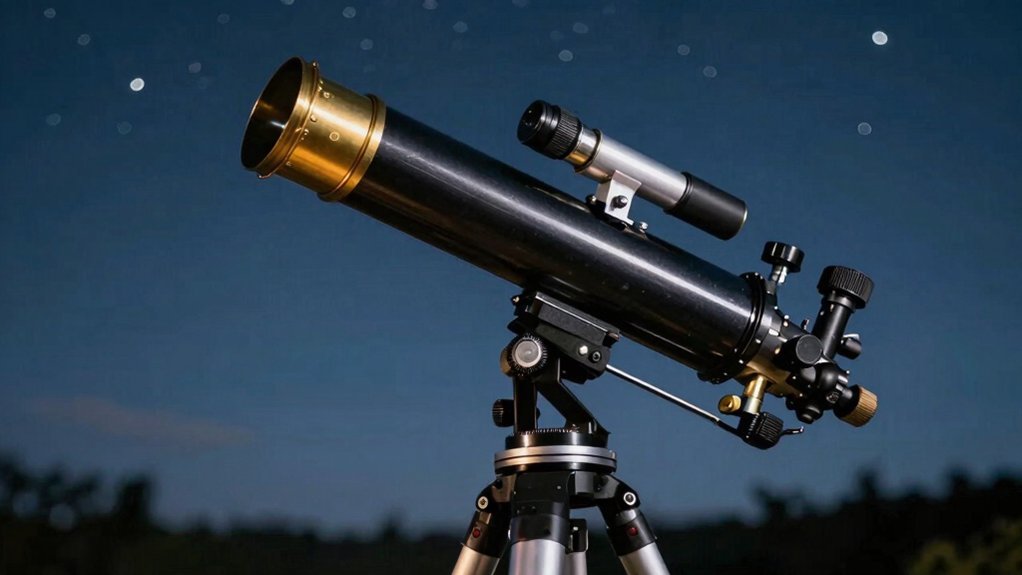
He also built stable mounts to stop vibrations during long viewing sessions. These upgrades transformed a simple toy into a serious scientific instrument capable of precise measurement. You now understand exactly how he refined the hardware itself. Next, you’ll want to see what those clear views actually revealed. As detailed in expert guides for enthusiasts, mastering these lens optimization techniques remains fundamental for achieving high-quality observations today. Understanding the optical tube assembly is equally critical, as it maintains the precise alignment required for such high-magnification viewing. For those seeking similar precision, utilizing expert-backed guidance ensures that modern equipment performs at its theoretical best.
What Did Galileo Discover With His Telescope?
Since you’ve just seen how he sharpened his lenses, you’re probably wondering what those clear views actually revealed. You’d see mountains casting shadows on the Moon, proving lunar observations showed a rugged world, not a perfect sphere. He even calculated mountain heights using those shifting shadows.
Now, look at Jupiter. You’d spot four tiny dots dancing around it, completely rewriting celestial mechanics by showing not everything orbits Earth. These moons demonstrated other centers of motion existed.
You’d also watch Venus cycle through phases like our Moon, confirming it reflects sunlight while circling the Sun. Sunspots drift across the solar face too, proving stars change and rotate over time.
Finally, you’d realize the Milky Way isn’t a cloud but countless individual stars. These revelations shattered old myths about flawless heavens forever. You now hold the key to his revolutionary sky map. To truly appreciate these sights today, beginners should prioritize finding a location with dark sky conditions free from city light pollution. Expert observers recommend using red-light flashlights to preserve your night vision while navigating the terrain. Successful observation also requires allowing your eyes ample time to adjust to the dark adaptation process before scanning the heavens.
How Did Galileo Change Astronomy Forever?
While you might think he invented the telescope, Galileo actually just turned a Dutch toy into a serious science tool back in 1609. You see, he didn’t just look; he systematically tested ideas against the sky. This shift defined modern telescope evolution forever.
Now, consider his new observational techniques. He recorded reproducible data, proving Venus orbited the Sun. Obviously, this shattered the old Earth-centered model instantly. You can’t ignore mountains on the Moon or countless stars in the Milky Way. These findings killed the myth of perfect, unchanging heavens. He also discovered moons orbiting Jupiter, providing critical evidence for the heliocentric theory that Earth orbits the sun. His pioneering work established the foundation for modern observational astronomy by prioritizing empirical data over philosophical speculation. The historical record confirms that his initial instrument provided only three-power magnification before he rapidly improved the design to reach thirty times magnification. Expert guidance suggests that understanding these early optical limitations helps enthusiasts appreciate the significance of lens quality in achieving clear celestial views today.
Here’s the thing: Galileo made evidence king over ancient authority. He forced astronomers to observe, record, and compare everything. That standard still drives your science today. So, how did he change astronomy? He made it real. Next, you should investigate how his specific revelations challenged church doctrine directly.