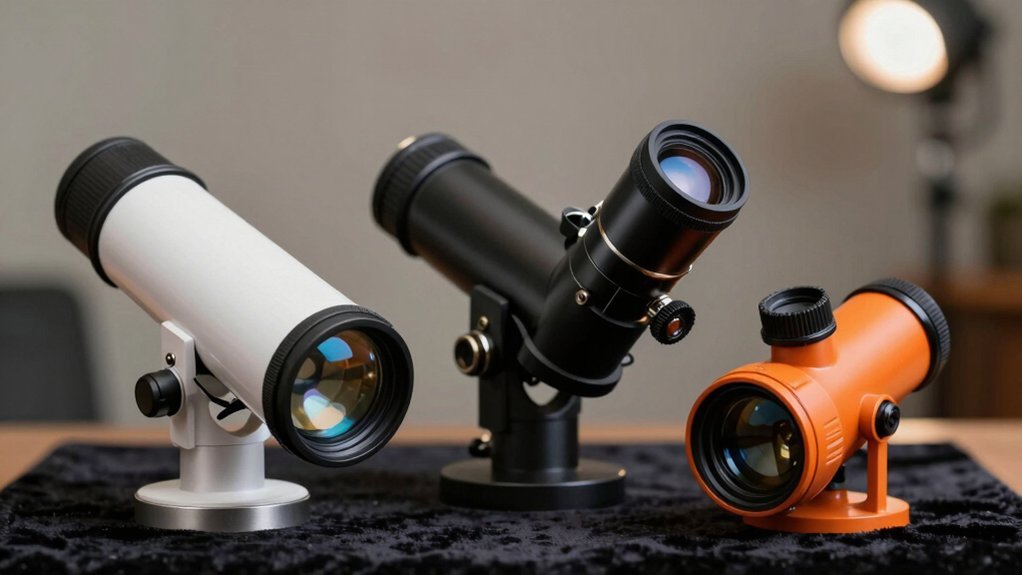
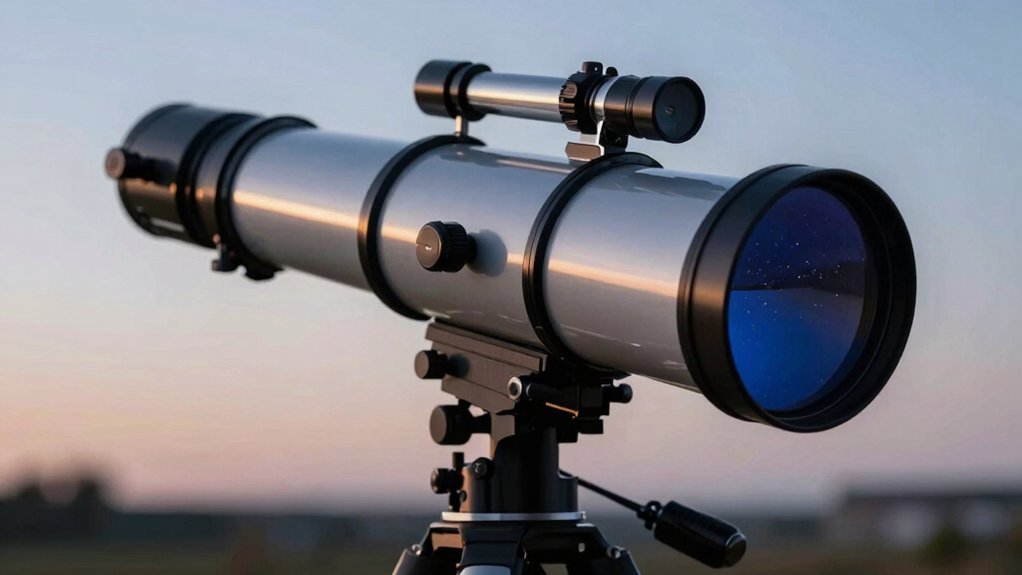
You’re wondering what a refractor telescope actually is, and it’s simpler than you think. These scopes use glass lenses to bend light directly to your eye, creating sharp, high-contrast views without central obstructions. Obviously, different lens designs like achromats or apochromats handle color fringing differently, so your choice depends on specific observing goals. Now that you grasp the basics, let’s explore how lens size limits their maximum practical aperture.
How Refractor Telescopes Bend Light to Form Images
You’ve probably wondered how a simple piece of glass can pull distant stars into focus. It all starts with light behavior changing as rays hit the lens. Glass bends incoming parallel light because it slows down inside the denser medium. This bending action, called refraction, forces the light rays to converge sharply.
Now, imagine those rays meeting at specific focal points behind the main lens. The curvature controls exactly where this image forms within the tube. Stronger curves bend light more, creating shorter focal lengths for compact designs. Obviously, different colors bend slightly differently, which can cause some color fringing issues. Modern designs often utilize achromatic lenses to correct these chromatic aberrations and sharpen the view.
Here’s the thing: your telescope gathers far more light than your naked eye ever could. This concentration makes faint objects appear brighter and clearer instantly. You see a magnified virtual image once the eyepiece enlarges that focused spot. Ready to see what sits inside the tube holding these lenses? The precise bending relies on Snell’s Law to define the relationship between the angle of incidence and the resulting refraction. Effective telescope selection depends on understanding how optical quality impacts the clarity and resolution of the final image you observe. The primary lens at the front is technically known as the objective lens and determines the instrument’s light-gathering capability.
Inside the Tube: Essential Refractor Components and Functions
Peering inside that long tube reveals the specific parts making your view possible. You might wonder how these pieces actually work together to show you distant stars.
The objective lens function gathers light, while your eyepiece magnification enlarges that captured image. Optical tube stability keeps everything perfectly aligned so your view stays sharp and steady.
You turn the focuser; its accuracy brings blurry dots into crisp, clear focus instantly. A diagonal mirror convenience saves your neck by bending light ninety degrees for comfortable viewing.
Don’t ignore the finderscope utility, as it helps you locate targets before looking closely. Obviously, every component plays a crucial role in delivering those breathtaking cosmic sights tonight.
Understanding these mechanics prepares you to choose the right glass design for your needs. Refractors utilize lens-based optics to minimize maintenance while providing high-contrast images ideal for lunar and planetary observation. By preventing color fringing through advanced glass combinations, modern designs ensure that bright objects remain sharp without distracting halos. The sealed tube design also prevents air currents from disrupting the image, ensuring stable views even as temperatures change.
Achromatic vs. Apochromatic: Selecting the Right Lens Design
Now that you grasp the tube’s mechanics, lens design choices probably feel overwhelming. You wonder which glass truly clears up those annoying color fringes on bright stars.
Achromats fix two wavelengths using crown and flint glass pairs. You gain considerable achromatic benefits through lower costs and solid visual performance for casual nights. However, you might still spot purple halos on high-contrast edges during viewing sessions.
Apochromats correct three wavelengths using special ED glass or fluorite elements. You access major apochromatic advantages like sharper images and virtually zero false color. These triplets demand stricter manufacturing tolerances, driving their higher price tags considerably. While refractors excel at contrast, other designs like Newtonian reflectors offer larger apertures for deep-sky viewing at a lower cost per inch.
Choose an achromat for budget-friendly visual observing without worrying about perfection. Pick an apochromat if you demand crisp details for imaging or high-power views. Your specific observing goals ultimately dictate which optical path fits your needs best. Understanding how light refraction bends through these different glass types clarifies why one design eliminates color errors more effectively than the other. Before selecting your optics, remember that observing conditions such as atmospheric stability and light pollution significantly impact what you can realistically see regardless of your telescope type.
Why Refractors Offer Superior Contrast for Astrophotography
Contrast is the secret sauce you’re missing in those blurry astrophotos. You want crisp details, not washed-out gray blobs. Refractors deliver this because their unobstructed optics concentrate 84% of starlight directly into the Airy disk.
Here’s the thing: internal scatter drops to just 1% with fluorite lenses. This sharp separation boosts your image quality greatly. You’ll see faint nebular filaments clearly against the dark sky background.
Now, consider those annoying diffraction spikes on bright stars. Refractors eliminate them entirely since they lack spider vanes. This cleanliness offers huge astrophotography benefits for wide-field shots. Your stars remain perfect points without distracting artifacts.
Obviously, better contrast means separating subtle gradients becomes much easier. You capture planetary belts and galaxy arms with stunning clarity. The sealed tube also keeps dust and air currents away.
Your final images look cleaner and sharper immediately. Ready to see how lens size affects these gains? While reflectors often suffer from central obstruction losses, unobstructed optics ensure maximum light transmission for superior contrast in every exposure. Diagrams often show how light path clarity prevents the scattering that plagues other telescope designs. Unlike reflectors that require periodic mirror alignment, refractors maintain collimation stability indefinitely, ensuring consistent optical performance for every session.
Understanding the Physical Limits of Large Refractor Lenses
You might wonder why we don’t just build bigger lenses to get even sharper images. Here’s the thing: gravity causes severe lens sagging in large glass pieces supported only at their edges. This deformation ruins your view by distorting the light path before it even reaches your eye.
Obviously, optical aberrations like chromatic fringing worsen as you push aperture sizes beyond one meter. You also face massive structural stability issues because heavy lenses flex differently as your telescope tracks across the sky. Maintaining perfect alignment becomes nearly impossible when tons of glass shift inside the tube. The pioneering work on achromatic doublets was essential in mitigating some early color distortions, though it could not solve the fundamental scaling problems of massive single elements.
Longer focal length designs help reduce color errors but create unmanageably long tubes that strain mounts. You simply cannot scale refractors up indefinitely without sacrificing image quality or mechanical integrity. That’s why modern observatories use mirrors instead of giant lenses for serious research today, as reflecting telescopes avoid these specific structural and optical limitations entirely. The historical limit was reached with the Yerkes Refractor in 1898, which featured a 40-inch lens that remains the largest ever successfully built. Additionally, the sheer weight of large objective lenses requires complex support systems to prevent lens deformation under their own mass.