You’re wondering if Mars pops out at night without gear. Absolutely, you’ll spot it as a steady red dot, not a twinkling star. It shines brightest every 26 months during opposition, so timing matters. Just let your eyes adjust for twenty minutes in the dark. Now, you can easily find it, but catching surface details requires more power. Stick around to uncover exactly when and how to lock onto that rusty world.
Can You See Mars Without a Telescope?
Ever wonder if that rusty dot in the sky is actually Mars? You can definitely see it without a telescope, just like Venus or Jupiter. Mars visibility peaks roughly every two years during opposition, when it shines brightest all night.
Now, you won’t see surface details, but that steady red glow is unmistakable. Planetary tracking apps help you find it moving through familiar constellations night after night. Dark skies away from street lights make spotting this wandering star much easier for your eyes.
Here’s the thing: you need about fifteen minutes for your eyes to adjust to the darkness. Avoid phone screens, or use a red light to keep your night vision sharp. Obviously, binoculars won’t show craters, but they do help confirm you’re looking at the right spot. While naked-eye viewing reveals the planet’s distinct color, understanding how different telescope optics work can help you decide when to upgrade for viewing surface features. Finding a location with minimal light pollution significantly enhances your ability to spot fainter celestial objects and improves overall contrast. Navigating to areas with current location insights allows you to quickly identify the best viewing spots based on real-time weather and sky conditions.
Why Mars Appears as a Steady Red Dot
Watch that rusty dot closely, and you’ll notice it doesn’t twinkle like the stars nearby. Stars are distant points that atmospheric turbulence scrambles easily, making them flicker wildly. Mars, however, presents a tiny disk that averages out this shaky air, appearing steady.
Its distinct red hue comes from iron oxide rust covering the entire planet surface. You see these specific celestial colors because sunlight reflects off that dusty, oxidized soil directly. This chemical signature makes planetary visibility unique compared to the blue or white stars surrounding it.
Obviously, brightness fluctuates as orbits shift, yet that rusty tone remains constant year-round. You don’t need magnification to spot this difference; your naked eye catches the contrast instantly. The steady glow combined with the red tint confirms you’re looking at a world, not a star. Now you can confidently identify Mars whenever it graces our night sky above. To get the best view, ensure you find a location with dark sky conditions to minimize light pollution interference. For optimal clarity, experts recommend allowing your telescope to reach thermal equilibrium with the outside air before observing to prevent internal heat distortion. Understanding these basic mechanics helps explain why planetary light behaves differently than starlight in our atmosphere.
When Is the Best Time to Spot Mars?
When exactly should you look up to catch Mars at its best? You need to watch for opposition timing, which happens every 26 months. During these weeks, Earth sits between Mars and the Sun, making the planet appear huge. Obviously, this specific window offers your brightest view without any telescope help.
Aim for midnight when Mars reaches its highest altitude in the dark sky. Looking straight up cuts through less atmosphere, so the red dot stays steady. Low horizons blur the image because thick air distorts your view considerably.
Pick clear, dark nights away from city lights for maximum clarity. Your best bet involves waiting for those rare opposition months rather than checking yearly. To ensure optimal visibility, you must also consider moon phases as a bright lunar presence can wash out the contrast needed to spot planetary details. Additionally, allowing your eyes to adjust to the dark adaptation process for about 20 minutes will significantly improve your ability to detect fainter celestial objects. For the sharpest possible view, try to observe on nights with excellent atmospheric stability to minimize the twinkling that obscures planetary features. Now that you know when to look, how do you actually identify it?
How to Tell Mars Apart From Stars
Now, watch for twinkling. Stars shimmer wildly due to atmospheric turbulence, but Mars shines with a steady, calm light. You’ll notice this steadiness clearly when the planet sits high above your horizon. Choosing a location with minimal light pollution will further enhance your ability to distinguish the planet’s steady glow from the flickering of distant stars. To master the basics of sky watching, beginners should focus on practical step-by-step methods that ensure accurate identification from the start.
Finally, try motion observation over several nights. Stars stay fixed in their patterns, yet Mars slowly drifts against them. Tracking this shift confirms you’re watching a planet, not a distant sun. Combine these color differences and movement clues to identify Mars confidently tonight. Grab your sky app next to verify your finding immediately. Remember that atmospheric turbulence affects starlight more than planetary light, which is why the Red Planet appears so stable.
What Weather Makes Mars Most Visible?
The right weather turns a faint red dot into a bold beacon you can’t miss. You probably wonder why some nights make Mars glow while others hide it. Low humidity and dry air sharpen that reddish hue instantly.
Now, atmospheric conditions dictate how steady the planet looks. Calm air stops Mars from boiling or shimmering wildly. Obviously, thick clouds or haze scatter light and blur your view.
Here’s the thing: visibility factors include your local sky darkness too. City lights wash out contrast, so flee to darker spots. High altitude overhead reduces distortion considerably compared to low horizons. Understanding atmospheric turbulence is crucial because it determines how much the air distorts the light before it reaches your eyes.
Late summer often brings those stable, clear skies you need. Opposition seasons offer the brightest, largest views all night long. A little haze sometimes steadies the air better than perfect clarity.
Target calm, dry nights far from streetlights for best results. Check the horizon next to verify nothing blocks your sight. Additionally, allowing your eyes time for dark adaptation will significantly improve your ability to distinguish the planet’s color against the night sky. Remember that moon phases also impact sky brightness, so planning observations during a new moon can reveal fainter details near the planet.
How to Find Mars With Sky Apps
You’ve found the perfect clear night, but spotting that red dot without help still feels like guessing. Don’t worry; you’re asking exactly the right question. Apps like Sky Tonight or Stellarium solve this instantly.
Just type “Mars” into the search bar and tap the target icon. Hold your phone up, then follow the on-screen arrow directly to the planet. These app features use your compass to match the screen with the real sky above.
Check visibility conditions first, ensuring Mars sits above your horizon before you look. The app shows if that reddish-orange point shines steadily instead of twinkling like a star. You’ll see it clearly when magnitude hits 1.3 during favorable windows. Understanding the light-gathering power of optical instruments helps explain why planets appear as steady points of light rather than twinkling stars to the naked eye.
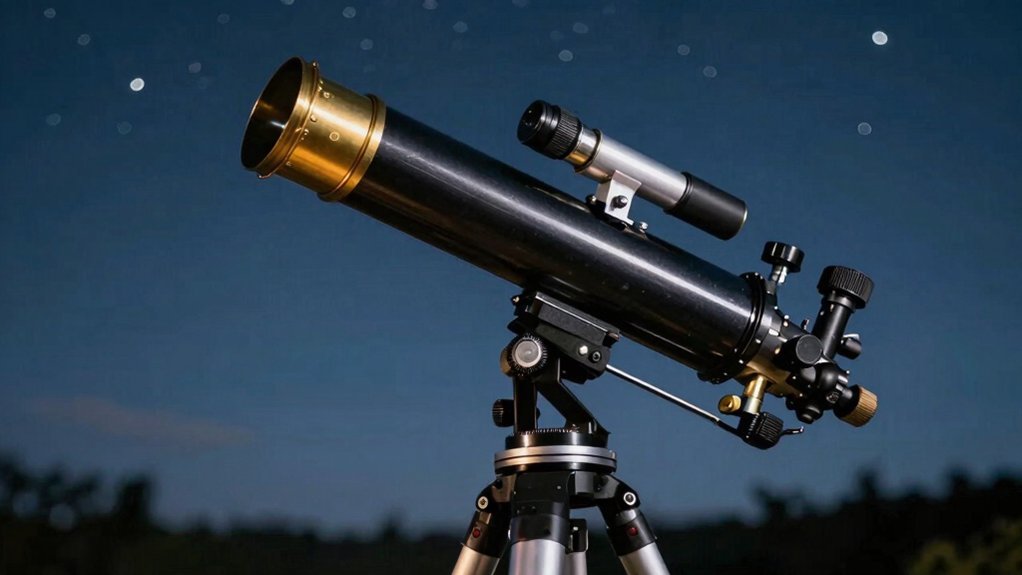
Now you know exactly where to look tonight. Ready to verify that bright dot is actually Mars? While apps guide your view, understanding how telescope optics function can further enhance your observation of planetary details when you decide to upgrade your equipment. Selecting a model with the correct aperture size ensures you gather enough light to distinguish surface features once you transition from naked-eye viewing.
What Features Are Invisible to the Naked Eye?
Why does that bright red dot look so plain compared to telescope photos? You see a steady, reddish point, but zero surface details resolve for your unaided eyes. Those dark regions like Syrtis Major or massive volcanoes such as Olympus Mons stay completely hidden. Obviously, the planet’s thin atmosphere and swirling dust storms also vanish without magnification.
You cannot spot the famous polar caps either, even though they exist at both poles. These icy features need at least 50x magnification to appear as distinct white spots on the limb. Your vision simply merges everything into one bright, featureless disk against the black sky. This limitation occurs because the human eye lacks the light-gathering power required to separate faint planetary details from the surrounding darkness. Even under the best viewing conditions, the unaided eye cannot resolve the fine details that telescopes reveal.
Do Binoculars Help You See Mars Better?
Can binoculars actually reveal more than that tiny red dot? Yes, they make Mars brighter and sharpen its distinct red color against the dark sky. You won’t see surface details yet, but finding the planet becomes much easier for you.
Choosing the right binocular specifications matters greatly here. Aim for 7x to 10x magnification with 50mm lenses to gather enough light without shaking. Higher power often blurs the image unless you use a tripod for stability.
Your observing techniques determine success more than gear alone. Wait for clear nights when Mars sits high above the horizon to avoid atmospheric haze. Obviously, city lights ruin contrast, so find a darker spot if possible.
Binoculars bridge the gap between naked eyes and telescopes perfectly. They confirm Mars’s presence but won’t show polar caps just yet. Ready to upgrade your view beyond a simple glowing dot?