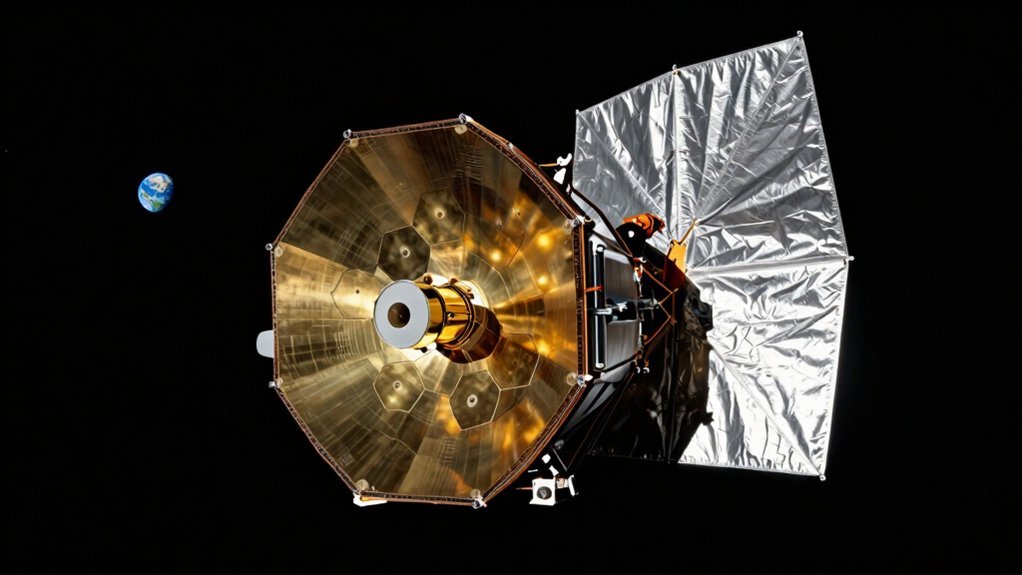
You’re wondering how golden mirrors capture light from the dawn of time. Webb uses eighteen beryllium segments to reflect infrared photons, bypassing glass lenses that absorb this heat. A five-layer sunshield blocks solar radiation, cooling instruments to 40 Kelvin so faint signals don’t vanish. This setup lets you see galaxies 13.5 billion light-years away, hidden behind cosmic dust. Stick around to unveil exactly how those mirrors align with microscopic precision.
Why Does Webb Use Mirrors Instead of Lenses?
Why exactly did engineers skip glass lenses for the James Webb? You might think glass works for everything, but it fails here. Glass absorbs infrared light, making it effectively opaque to Webb’s vision.
Here’s the thing: lens limitations block those vital red wavelengths completely. Mirrors reflect light off a thin surface instead, avoiding absorption issues entirely. This design captures faint signals from 13.5 billion light-years away.
Now, consider mirror advantages regarding size and weight. A 6.5-meter lens would be impossibly heavy and fragile for launch. Engineers chose lightweight beryllium segments coated in gold to solve this problem.
Obviously, reflection beats transmission for deep space observation. This setup guarantees high throughput across the 0.6–28.8 micron range without thermal headaches.
You now see why reflection wins for infrared astronomy. Next, you’ll wonder how eighteen tiny pieces form one giant eye. While selecting equipment for personal use involves balancing optics and performance, Webb’s specialized mirror design was the only viable solution for its specific infrared mission. Unlike refracting telescopes that rely on large glass elements, understanding telescope optics reveals why reflective systems are essential for avoiding chromatic aberration and supporting massive apertures in space. The revolutionary telescope legacy endures because this innovative approach allowed scientists to peer further back in time than ever before.
How Do Eighteen Hexagonal Segments Form One Mirror?
Since you’re wondering how eighteen separate pieces act as one giant eye, you’ve hit on Webb’s most clever trick. These beryllium segments, each 1.32 meters wide, unfold in space to create a massive 6.5-meter aperture. The hexagonal design tiles perfectly without gaps, maximizing light collection while fitting inside the rocket.
Now, actuators move each piece with microscopic precision. Mirror alignment guarantees every segment shares the exact same focal point. You need this perfect curvature to blur nothing. Engineers adjust positions until the whole array behaves like a single concave mirror. Thermal stability matters hugely here, so cooling happens first. Each of the 18 hexagonal mirror segments contributes to additional spikes at focus due to their design. This process relies on wavefront sensing to ensure the optical surface remains flawless. Unlike smaller instruments where choosing the right telescope often depends on balancing optics and cost for different stargazers, Webb utilizes a specialized gold coating on its mirrors to maximize infrared reflectivity. Understanding the primary mirror size is essential because it directly determines the telescope’s ability to resolve faint details in the distant universe.
All right, think of it as a team rowing in perfect sync. One wrong move ruins the picture. Once aligned, they gather infrared light as one unified surface. This precise cooperation defines Webb’s incredible vision. Next, you’ll see where that captured light actually travels.
Tracing Infrared Light From Space to Sensors
Now that your mirror acts as one giant eye, you’re probably wondering where that captured light actually goes. Your massive primary mirror starts the light gathering process by funneling faint infrared photons directly into the optical path. These rays travel past filters and spectrographs that separate specific wavelengths for detailed chemical analysis.
Here’s the thing: your own heat could easily swamp those tiny signals without strict thermal management. The sunshield keeps your instruments below 50 Kelvin so warm hardware doesn’t blind the sensitive detectors. This extreme cold guarantees every recorded photon comes from space, not your telescope itself. By blocking thermal radiation from the Sun, Earth, and Moon, the sunshield design creates the necessary shadow to maintain these cryogenic temperatures. This revolutionary approach builds upon the legacy of past telescopes by pushing the boundaries of what human engineering can achieve in the vacuum of space.
Finally, specialized sensors convert those incoming photons into measurable electrical signals based on exact counts. You don’t get finished photos immediately, but rather raw data streams ready for deep scientific processing. Your journey from space dust to digital signal is now complete. Understanding the optical path ensures you grasp how light travels from the primary mirror to the final detectors without interference.
Why Does Infrared Vision Reveal the Early Universe?
Though those first stars burned bright with visible light, cosmic expansion stretched their glow into infrared by the time it reached you. This redshift moves ancient photons into wavelengths your eyes can’t see. You need infrared advantages to pierce through thick dust clouds hiding young galaxies.
Now, imagine trying to see a candle behind a foggy window. Infrared light cuts right through that obstruction like a knife. Webb captures this hidden universe from just 100 million years after the Big Bang. These observations reveal secrets of cosmic history that visible telescopes miss completely.
You finally witness the very first galaxies forming over 13.5 billion years ago. Spectroscopy reveals how neutral gas turned transparent during reionization. This data connects early black holes to dark matter’s role in evolution. Your understanding of the universe’s birth becomes suddenly clear and complete. Next, you’ll wonder how the telescope stays cold enough to see this faint heat. While visible light telescopes excel for general stargazing, infrared optics are specifically required to detect the heat signatures of these ancient, distant objects. Successful observation also depends on maintaining extreme cold temperatures to prevent the telescope’s own heat from interfering with faint infrared signals. Just as selecting the right aperture is crucial for light gathering in amateur instruments, optical resolution determines the sharpness of details Webb can distinguish in those primordial structures.
How Does the Five-Layer Sunshield Block Solar Heat?
You’re wondering how a telescope survives the Sun’s blast while staying colder than deep space. Well, five massive layers block that intense solar radiation step by step. Each tennis-court-sized sheet stops heat transfer before it reaches your precious optics.
Now, notice those shiny surfaces. Reflective coatings made of aluminum and silicon bounce most energy away immediately. The first layer alone rejects ninety percent of incoming heat, keeping the rest shaded.
Here’s the thing: layers never touch, so conduction stays impossible in that vacuum. Heat absorbed by one sheet radiates out the sides instead of moving down. This design drops temperatures from boiling hot to forty kelvins on your cold side. Expert enthusiasts know that maintaining this thermal equilibrium is critical for the longevity and accuracy of space-based instruments.
Obviously, this passive system acts like a giant heat pump for your instruments. You get stable, frigid conditions essential for spotting faint infrared signals from the early universe. The angled configuration of these sheets strategically facilitates heat rejection to prevent overheating. Just as clear skies are vital for ground observers, this isolation ensures optimal viewing conditions for the telescope’s sensitive detectors. By preventing atmospheric distortion, this setup allows for uninterrupted observation of distant celestial objects without the interference found in Earth-based systems. Next, let’s see how engineers separate hot electronics from those freezing mirrors.
Separating Hot Electronics From Cold Optics
Two distinct zones split your telescope right down the middle. You might wonder how hot electronics stay away from cold optics. The warm side holds your power systems while the cold side keeps mirrors chilly. This thermal isolation stops heat from ruining your sensitive infrared views.
Now, imagine a giant umbrella blocking the sun’s fierce glare. Your five-layer sunshield enables passive cooling without needing liquid coolant. It drops temperatures by 570 degrees across those thin layers. Obviously, this huge gap lets optics radiate heat straight into deep space. Just as web mechanics rely on clear separation between client and server to function efficiently, the telescope depends on this physical divide to maintain operational stability. The multi-layer design ensures that thermal radiation is effectively blocked from reaching the cryogenic instruments.
Your detectors need below 50 Kelvin to spot faint cosmic signals. Placing noisy electronics on the sunny side protects those fragile instruments. This clever architecture guarantees your telescope stays dark enough for science. You get clear data because the hot and cold never mix. Understanding telescope terms helps clarify why this strict temperature separation is vital for infrared astronomy. Next, you’ll see how those cold instruments actually turn light into data.
How Do NIRCam and MIRI Turn Light Into Data?
Since you’ve got the cold optics ready, you’re probably wondering how NIRCam and MIRI actually turn that faint light into real data.
First, distinct filters separate incoming photons into usable wavelength channels for analysis. NIRCam detectors capture near-infrared light using ten specific HgCdTe sensors with over four million pixels each. Meanwhile, MIRI imaging tracks warmer dust emissions across much longer mid-infrared wavelengths up to 28 microns. These instruments don’t just snap pictures; they convert light intensity directly into electronic counts. Spectroscopy then spreads that light out to reveal chemical compositions and temperatures hidden within. You get raw digital signals that scientists later calibrate into stunning, physically meaningful images. Ultimately, this process transforms invisible energy into concrete numbers you can trust. Understanding how optical filters isolate specific wavelengths is key to interpreting these digital signals accurately. Just as ground-based observers must select the right telescope types for their specific goals, JWST relies on these specialized instruments to match its scientific objectives. Now you understand the conversion, but why does the telescope need such a specific orbit to keep working?
Why Does the L2 Orbit Ensure Stable Observations?
While you might think L2 is a fixed spot, it’s actually a gravitational balance point 1.5 million km away where Sun and Earth forces cancel out. You don’t park exactly there though, because that spot is unstable like a saddle top. Instead, you trace a massive halo orbit around the point every six months.
This path keeps the Sun, Earth, and Moon on one side for constant shading. That geometry guarantees thermal stability by blocking heat that would ruin your sensitive infrared detectors. Obviously, you still drift slightly without help, so station keeping burns tiny thruster fuel every few weeks. These small nudges maintain your perfect viewing angle while avoiding Earth’s shadow entirely.
Your L2 observations benefit from this cold, dark environment where nearly half the sky opens up. You get long, uninterrupted looks at space without fighting temperature swings or complex maneuvers. Ready to see what those stable views actually reveal?
Detecting Faint Galaxies 13.5 Billion Light-Years Away
You’ve probably wondered how we spot galaxies that existed just 300 million years after the Big Bang. Cosmic expansion stretches their light into infrared wavelengths, hiding them from visible-light telescopes. You need extreme sensitivity to catch these ancient signals before they fade completely.
Here’s the thing: JWST performs faint galaxy detection by seeing objects one hundred times dimmer than Hubble. Its mirrors gather light across 0.6 to 28.5 micrometers, revealing redshifted secrets from 13.5 billion years ago. Deep surveys like JADES isolate these tiny, intrinsically faint sources near the detectability threshold.
Spectral measurements confirm distances, proving galaxies like JADES-GS-z14-0 truly date back to cosmic dawn. You now understand how infrared eyes pierce the early universe’s darkness effectively. This clarity sets the stage for comparing Webb’s unique capabilities against Hubble’s legacy.
What Makes Webb Different From Hubble?
You’re wondering why we need a new telescope when Hubble still works so well. Here’s the thing: they see different light. Hubble captures visible and ultraviolet waves, while Webb optimization targets infrared observations. This lets you peer through cosmic dust clouds where stars are born.
Webb’s massive 6.5-meter mirror offers incredible mirror sensitivity compared to Hubble’s smaller 2.4-meter one. You get views of objects 100 times fainter than before. Obviously, size matters here for collecting distant starlight.
Don’t think Webb replaces Hubble; they create powerful telescope synergy. Hubble orbits Earth closely, but Webb sits a million miles away at L2. This cold spot blocks heat interference perfectly. Together, they cover the full spectrum from ultraviolet to deep infrared.
You now understand their unique roles in exploring our universe. Ready to see how Webb actually captures those stunning infrared images?