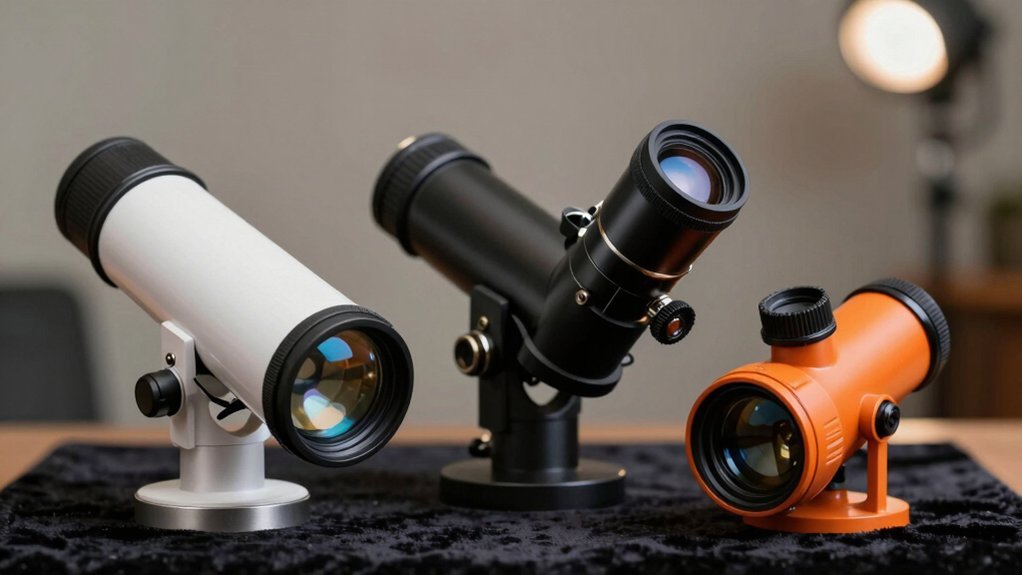
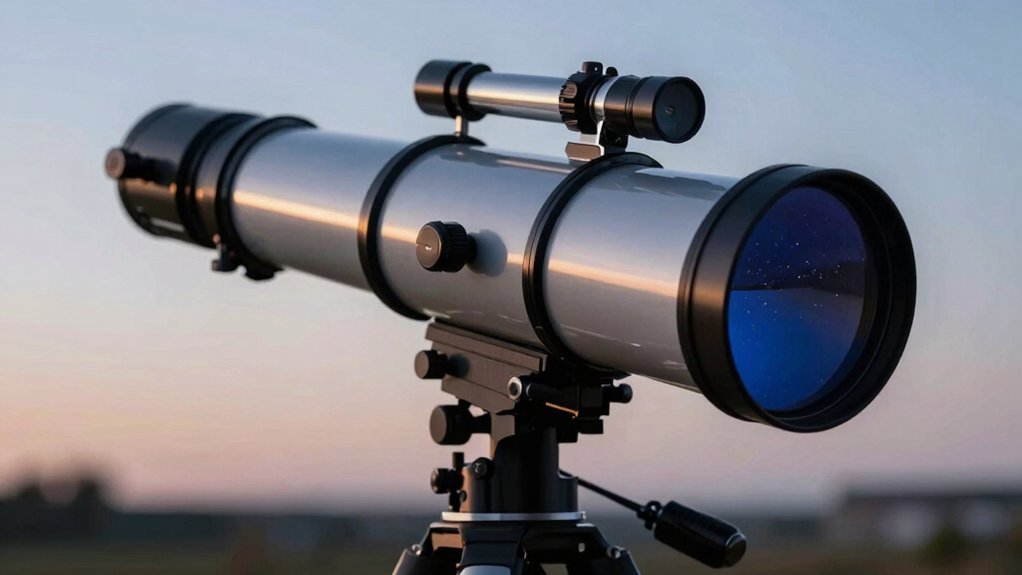
You’re stuck choosing between sharp planetary views and deep-sky power, and that’s exactly the right dilemma. Refractors use lenses for crisp moon details, while reflectors use mirrors to gather more light for faint galaxies. Obviously, mirrors cost less per inch, letting you buy bigger apertures on a budget. Now, consider if you prioritize portability or raw light-gathering ability before deciding. Your specific observing goals will soon point you toward the perfect optical design.
How Do Refracting and Reflecting Telescopes Differ?
Since you’re wondering how these two telescope types actually differ, you’ve hit on the core of optical design. Refractors use a front lens to bend light, while reflectors bounce it off a back mirror. This fundamental choice defines their entire light collection strategy and physical build.
Now, consider size. Large lenses get heavy and expensive fast, limiting refractor apertures considerably. Mirrors stay thinner and lighter, letting you build huge tubes easily. You’ll find reflectors dominate professional observatories for this exact scaling reason. Reflecting telescopes are notably lighter than refracting telescopes of equivalent size, which further supports their use in large-scale applications. Because mirrors can be supported from behind, they avoid the sagging distortion that often plagues large lenses under their own weight.
Here’s the thing: lenses suffer color fringing, but mirrors avoid that issue completely. Refractors offer crisp views yet struggle with big apertures. Reflectors gather massive light cheaply but need occasional alignment. Your choice depends on whether you prioritize portability or raw power.
Obviously, both deliver focused images to your eyepiece eventually. The path just differs wildly inside the tube. You now understand the mechanical heart of each system. Next, you’ll want to know which one actually shows sharper stars. While reflectors excel in aperture size, refractors often provide higher contrast views ideal for observing bright planets and the moon. Additionally, the open tube design of reflectors allows them to reach thermal equilibrium faster than the sealed tubes of refractors, reducing image distortion caused by trapped heat.
Which Telescope Type Delivers Sharper Image Quality?
So, which scope actually shows sharper stars? You might expect a simple answer, but sharpness relies on optical precision, not just the type. A high-quality refractor often delivers superior image clarity because it lacks a central obstruction that softens contrast. However, a well-collimated reflector with a large aperture can match or even exceed that detail easily.
Here’s the thing: poor alignment or cheap glass ruins any telescope’s performance instantly. You need true parabolic mirrors or apochromatic lenses to really see fine differences in star points. Obviously, a bigger mirror gathers more light, revealing faint details a small lens misses. While refractors avoid secondary mirror shadows, reflectors utilize primary mirrors to collect light without the chromatic aberration sometimes found in lenses. Refractors generally require less maintenance since their sealed tubes protect the lens alignment from dust and air currents that can degrade reflector performance over time.
Ultimately, specific build quality matters far more than the general category you choose. Don’t blame the design if your optics are misaligned or inferior. Focus on finding the best-made model within your budget for the crispest views possible. Remember that optical precision is the foundation of clear viewing regardless of the telescope type selected. Next, let’s explore if refractors truly dominate planetary viewing.
Are Refractors Better for Planetary Viewing?
Why do so many folks swear refractors are the ultimate planet hunters? You crave crisp views, and their unobstructed light path delivers exactly that. Without a secondary mirror blocking the way, you gain superior visual contrast on bright worlds.
Now, consider how dust or air currents ruin your night. Sealed tubes protect optics, ensuring steady planetary clarity while other scopes cool down slowly. You also skip tedious collimation, letting you observe sooner with less fuss.
However, don’t ignore aperture limits. Large lenses cost a fortune, so you might sacrifice raw resolution for sharpness. A cheap achromat still shows color fringes that soften fine details on Mars. This optical flaw occurs because chromatic aberration bends different wavelengths of light at varying angles within the lens. While reflectors use mirrors to avoid this issue, refractors rely on glass lens elements to bend light directly to the focal point.
Ultimately, you choose refractors for high-contrast simplicity, not sheer light-gathering power. If you prioritize easy setup and stunning contrast, this path fits your needs perfectly. Next, let’s see if reflectors truly dominate the faint deep-sky domain.
For those just starting out, mastering the basics ensures you get it right the first time with any instrument you select.
Do Reflectors Capture Faint Deep-Sky Objects Best?
Two main factors decide if you’ll spot faint galaxies, and aperture tops the list. You need serious light gathering to see dim nebulae clearly. Reflectors win here because mirrors scale up easier than lenses do.
A 300 mm reflector reaches magnitude 15, while a 100 mm refractor stops near 12. Obviously, that extra glass makes huge differences for faint detection. You’ll find cheap Dobsonians outperforming premium small scopes on deep-sky targets every time.
Wide fields help you locate these ghostly objects before zooming in. Just remember that optical quality still matters despite the size advantage. Central obstructions exist, but they rarely stop you from seeing faint fuzzies. While refractors offer sharp contrast, the cost per inch of aperture makes reflectors the practical choice for serious deep-sky observation. Additionally, larger mirrors avoid the chromatic aberration issues that often plague refracting telescopes when viewing bright stars. Understanding the specific light gathering capacity of your chosen instrument ensures you maximize visibility for the faintest celestial targets.
Why Are Large Reflecting Telescopes More Cost-Effective?
Since you’re wondering where your money goes, let’s talk about why big mirrors beat big lenses on price. Large mirrors cost far less to make than huge glass lenses needing complex correction. You get serious aperture efficiency without breaking the bank, making reflectors the clear economical choice today.
Manufacturing simplicity drives this huge savings because mirrors avoid costly chromatic aberration fixes entirely. Structural support stays easy since you back heavy optics instead of hanging them precariously by edges. This mechanical ease lowers costs for both amateur gear and massive professional telescopes considerably. Beginners should focus on mastering the basics of optical design to understand why these structural advantages matter so much for long-term value. Unlike lenses which must be flawless throughout the entire volume of glass, mirrors only require a precise surface curve on the front, significantly reducing material waste and production time.
Your cost comparison shows an eight-inch reflector often costs half as much as a four-inch refractor. Optical designs using mirrors simply scale better, giving you more light grasp per dollar spent. Obviously, bigger apertures remain affordable only through reflecting technology. Choose wisely for your budget.
While refractors struggle with weight and sagging in larger sizes, reflectors maintain optical stability more effectively as the aperture increases.
How Does Aperture Size Impact Brightness and Price?
Aperture acts as your light bucket, and you’re probably wondering exactly how its size changes what you see and what you pay. Obviously, bigger mirrors gather more photons, making faint galaxies pop against the dark sky. A 200mm scope collects four times the light of a 100mm one, drastically improving your view. These aperture effects directly boost both brightness and fine detail on planets. Since light gathering power increases exponentially rather than linearly, doubling the diameter results in a fourfold increase in collected light. Understanding optical resolution is also critical, as larger apertures allow you to distinguish finer details that smaller lenses simply cannot resolve. Just like a web page requires a clear step-by-step build to ensure a working result, selecting the right telescope involves balancing specific components for optimal performance.
However, price climbs fast as glass or mirror diameter grows. An 8-inch Dobsonian might cost $600, while a 12-inch model easily exceeds $1,000. Your budget considerations must balance this cost against portability and mount stability. You cannot ignore that larger tubes need heavier, pricier supports too. For those prioritizing ease of use, a Dobsonian mount often provides the most stable platform for large apertures without breaking the bank.
Ultimately, buy the biggest aperture you can comfortably afford and transport. Don’t overspend on size if you cannot move the telescope easily. Now, are you ready to learn about keeping your chosen instrument clean?
What Maintenance Do Reflectors Require vs. Refractors?
If you’re wondering why your reflector needs more tweaking than a refractor, you’ve hit on a key difference. You must perform mirror collimation regularly, especially after transporting your scope or noticing weird star shapes. Obviously, vibrations knock those delicate mirrors out of alignment, demanding your immediate attention to fix them.
Refractors demand far less fuss regarding lens maintenance since their sealed tubes protect the glass. You rarely adjust optics; instead, just keep caps on and blow off loose dust gently. Cleaning liquids go on your cloth, never directly on the lens, to prevent serious damage.
Both designs need dry storage and occasional mechanical tightening to stop rust or loose screws. Humidity invites fungus, so stash silica gel packs inside your case during wet seasons. Your telescope lasts longer when you store it properly in a climate-controlled environment tonight. Understanding optical alignment is crucial because it directly impacts the clarity and resolution of the images you see through the eyepiece. Reflectors generally offer larger apertures for the price, allowing you to gather more light than a similarly priced refractor.
Choose based on how much tinkering you actually enjoy doing under the dark sky.
Which Design Fits Your Budget and Observing Goals?
All right, you’ve sorted the maintenance headaches, but now your wallet and your stargazing dreams need to match up. You want maximum bang for your buck without sacrificing your specific viewing desires.
Reflectors deliver more aperture per dollar, making them ideal for deep-sky hunting on a tight budget. Large mirrors cost far less than precision lenses, so you get bigger light-gathering power cheaply. Conversely, small refractors offer excellent value if you prioritize portability and sharp planetary views.
Your budget considerations must align directly with your observing priorities. Do you crave faint galaxies or crisp lunar details? Choose a Dobsonian reflector for deep-space reach or a compact refractor for travel-friendly planet watching. Don’t overspend on glass you won’t use effectively.
Balance cost against your actual night-sky targets before deciding. Which celestial objects make your heart race the most?
Should You Choose a Refractor or Reflector Today?
So, how do you actually pick between these two optical paths right now? You must weigh specific design considerations against your personal user preferences. Refractors offer sharp, high-contrast views perfect for planets without needing constant mirror alignment. They stay sealed and clean, making them ideal if you hate maintenance tasks.
Reflectors, however, gather way more light for faint galaxies at a much lower cost. You get bigger apertures easily, but you will need to collimate mirrors occasionally. Obviously, portability matters if you hike to dark sites often. Refractors win there with rugged, simple tubes ready for instant viewing.
Choose a refractor for easy, crisp lunar looks or astrophotography cleanliness. Pick a reflector if deep-sky hunting on a budget drives your night. Which target excites you most when you look up tonight? That answer decides your perfect telescope match immediately.