You’re wondering if Uranus is truly visible without a telescope. Yes, but its faint +5.7 magnitude demands perfectly dark skies and sharp eyes to spot that steady blue-green dot. Obviously, light pollution ruins your chances, so you’ll need to escape the city glow. Now, grab some binoculars to transform that uncertain speck into a clear target. Keep going to find out exactly when and where you can catch it.
Is Uranus Visible Without a Telescope?
Can you actually spot Uranus with just your eyes? Yes, but barely, since it sits right at the edge of human perception. You need incredibly dark skies and excellent vision to catch this faint, magnitude +5.7 point of light.
Here’s the thing: visibility challenges make confirming its presence really tough for most casual stargazers tonight. It looks like a steady, blue-green star rather than a distinct planetary disk without optical aid.
Now, experienced observers often use star charts to distinguish it from background stars during opposition. You’ll find success only when the moon is down and your eyes fully adapt to the darkness.
Obviously, binoculars make this hunt much easier, yet naked-eye detection remains technically possible under perfect conditions. Your best bet involves finding a remote location far from city lights immediately.
Ready to learn why those dark skies matter so much for your success? Understanding how light pollution affects contrast is essential for selecting the right observing site.
Just as maintaining optical clarity is critical for telescope performance, ensuring your unaided vision operates in pristine conditions is equally vital for detecting such a faint object.
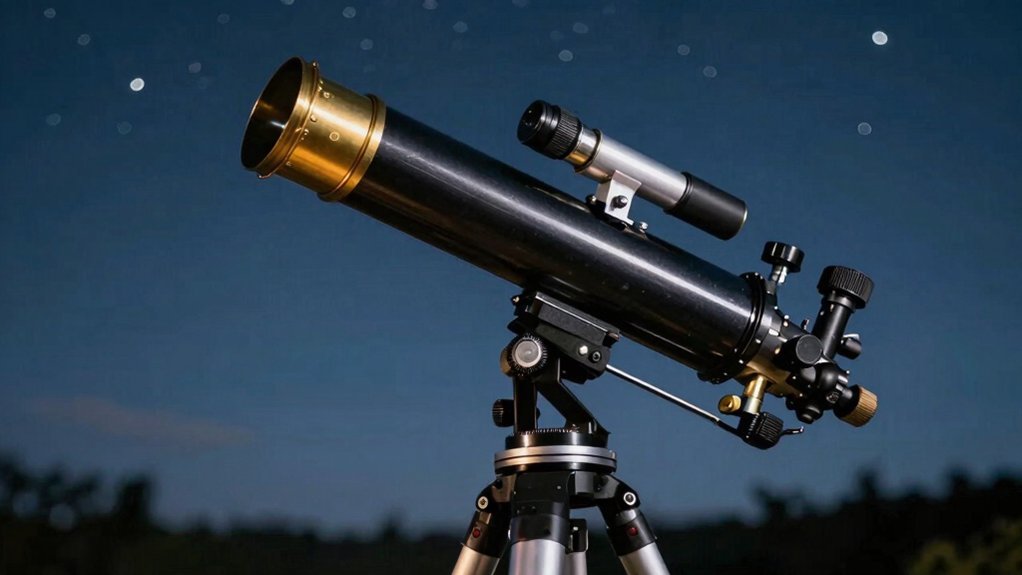
Selecting the right telescope optics can significantly enhance your ability to resolve the planet’s disk once you have located it in the sky.
Why Are Dark Skies Crucial for Seeing Uranus?
Why do those pitch-black skies matter so much for your success? Urban glow washes out Uranus, hiding its faint magnitude 6 light completely. You need genuine darkness to spot that tiny, steady blue-green dot.
Now, consider your eyes. Full dark adaptation takes about twenty minutes of total silence from bright lights. Any stray bulb resets your rod cells, making that dim speck vanish instantly. Patience here separates success from failure every single time.
Here’s the thing: sky transparency matters just as much as location. Haze or moisture scatters light, lowering contrast against the background stars. Clear, dry air helps Uranus stand out as more than just another faint star.
Obviously, you must escape city limits to find these perfect conditions. Travel far enough away so streetlights don’t ruin your night vision. Only then can you hope to catch this elusive ice giant. Additionally, checking a light pollution map before you travel ensures you reach a location dark enough for naked-eye observation of such faint objects. While high magnification is often prized for planetary detail, viewing Uranus with the naked eye relies entirely on optical aperture of the human pupil to gather sufficient photons in the darkest environments. To maximize your chances, aim for nights when the moon phase is new or a thin crescent to prevent lunar glare from washing out the faint planet.
When Is Uranus Brightest and Easiest to See?
So, when exactly does Uranus put on its best show for you? It shines brightest during opposition timing, when Earth sits directly between the planet and Sun. You’ll see it rise at sunset, stay up all night, and set near dawn.
This peak happens every 369.6 days, shifting your perfect viewing window slightly each year. In 2026, mark November 21 on your calendar for maximum brightness at magnitude +5.6. Obviously, that’s barely visible to naked eyes without incredibly dark skies.
Seasonal visibility centers around autumn months, often peaking from October through December. You want to look near midnight when Uranus climbs highest above atmospheric distortion. Clear, steady air helps you spot that tiny, steady point of light. Finding a location with minimal light pollution significantly improves your chances of detecting such a faint object. Remember that atmospheric stability is just as critical as darkness, since turbulent air can blur the planet’s faint glow even in remote areas.
Grab your binoculars if naked-eye viewing fails, since confirmation gets much easier with aid. Now you know exactly when to look, but where do you actually point your eyes? For optimal results, align your observation schedule with the planet’s opposition timing to ensure it remains visible throughout the entire night.
How Do You Find Uranus Using Star Charts?
How exactly do you pinpoint a planet that hides among thousands of stars? You need current star charts showing the correct month, since Uranus shifts constantly against background stars. Digital apps work great for matching real skies instantly.
Start by finding a bright landmark like Aries or the Great Square of Pegasus. These familiar patterns act as your anchor for locating planets in the vast dark expanse. Obviously, you want the highest contrast object visible tonight.
Now, follow a star-hop route from those bright stars toward fainter guide stars. Move step-by-step until you reach the spot where Uranus should appear as a faint point. Check multiple nights to confirm its slight movement against fixed stars.
Remember to orient your chart correctly to match the actual sky above your head. This careful hopping method turns a confusing search into a simple, logical journey across the heavens. To ensure success, rely on expert-backed guidance to refine your observation techniques and maximize your viewing experience. Utilizing optical magnification can further assist in distinguishing the planet’s disk from surrounding starlight once you have narrowed down its location. Understanding the telescope aperture is also crucial, as a larger opening gathers more light to make faint objects like Uranus easier to distinguish from the background stars.
Are Binoculars Better Than Naked-Eye Viewing?
You’ve mapped the stars, but staring up at that faint spot still leaves you wondering if it’s really Uranus or just another background star. Honestly, naked eye challenges make this nearly impossible unless you possess exceptional vision and perfect skies. Light pollution usually hides magnitude +5.7 completely, turning your hunt into a frustrating guess.
Now, consider binocular advantages. A simple 7×50 pair boosts brightness considerably, revealing that steady, blue-green dot instantly. You don’t need dark adaptation or moonless nights anymore; suburban skies work fine too. Binoculars confirm the planet by holding it steady against twinkling stars, removing all doubt. Understanding how optical aperture gathers light explains why these instruments reveal celestial details invisible to the unaided eye.
Obviously, unaided viewing remains a rare trophy for ideal conditions only. Most observers find binoculars transform a barely perceptible target into a repeatable success. Grab your optics tonight to finally spot the ice giant with total confidence. To maximize your viewing experience, ensure you consult expert-backed guidance for the best equipment settings and observation times.