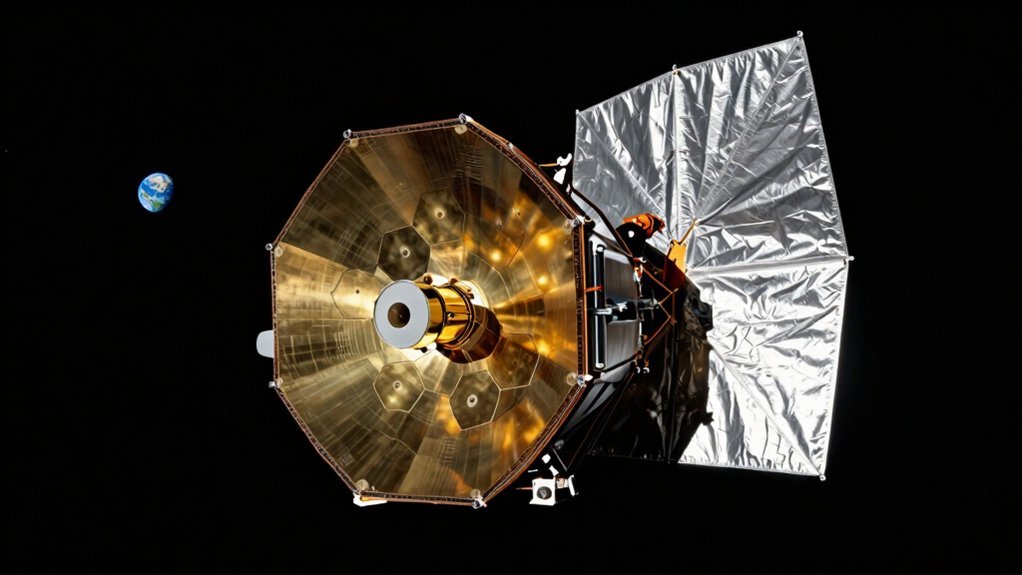
You’re wondering if your telescope can spot that tiny Apollo flag, and honestly, it’s a great question. Here’s the thing: Earth’s atmosphere blurs anything smaller than a kilometer, so even huge scopes miss the 1.2-meter flag. You’d need a massive 200-meter mirror just to resolve it from down here. Obviously, our current tech tops out way below that size limit. Keep exploring to see how orbital cameras actually captured those waving flags.
Can Earth Telescopes See the Apollo Moon Flag?
Ever wonder why your backyard scope can’t spot that tiny Apollo flag? You’re asking the right question because flag visibility depends entirely on distance and size. That six-foot banner sits 239,000 miles away, making it incredibly small from your perspective.
Here’s the thing: telescope limitations prevent resolving objects smaller than one kilometer on the lunar surface. Even massive professional observatories lack the resolution needed to isolate such a tiny artifact against the gray dust. You need hundreds of meters of aperture just to theoretically distinguish it, which nobody currently possesses. Selecting a telescope with the correct aperture size is fundamental to maximizing light gathering and theoretical resolution limits.
Obviously, magnification alone won’t save you if the optics can’t separate those fine details. Spacecraft like the Lunar Reconnaissance Orbiter succeed because they orbit much closer, capturing images from just miles above. Earth-based tools simply hit a hard physical wall when trying to view landing site souvenirs directly. Understanding angular resolution clarifies why increasing magnification without sufficient aperture only yields a larger, blurrier image rather than revealing the flag. This optical barrier exists because atmospheric turbulence often degrades the image clarity of ground-based observations, further obscuring minute surface details regardless of instrument power.
Why Earth Telescopes Cannot Resolve the Flag
You’re wondering why your telescope can’t spot that tiny Apollo flag, and you’re asking the right question. The flag spans just over a meter, yet the Moon sits 384,400 kilometers away. That distance shrinks the flag’s angle far below what any Earth-bound scope can separate.
Here’s the thing: optical limitations mean you need to distinguish points, not just gather light. Even Hubble sees only features roughly 100 meters wide, leaving meter-scale objects completely blurred. Your backyard telescope resolves craters a kilometer across, so a tiny flag simply vanishes into the gray dust. To resolve such a small object, you would theoretically need an aperture of about 200 meters, which far exceeds the size of any existing single telescope.
Now, consider atmospheric interference. Earth’s air constantly shimmers, smearing fine details before they ever reach your eyepiece. This turbulence overwhelms the already minuscule signal from such a small target. No amount of magnification fixes this fundamental blur caused by our protective atmosphere. Understanding atmospheric turbulence is crucial for every enthusiast aiming to maximize their viewing sessions under varying sky conditions. Mastering optical resolution allows observers to better predict exactly what celestial details their specific instrument can reveal. Selecting a telescope with the correct aperture size ensures you maximize light gathering power without exceeding the limits imposed by local seeing conditions.
Ultimately, physics prevents resolving the flag from here. You’ll need to look elsewhere for that specific proof.
How Large a Telescope Must Be to See It?
So, how big does a telescope actually need to be? You might guess something huge, but the real number shocks you. To spot that tiny 1.2-meter flag, you need an aperture around 200 meters wide. Current giants only reach 10 meters, leaving you far short of the mark.
Here’s the thing: angular resolution dictates everything, not just magnification power. Even Hubble sees only 100-meter details, making the flag invisible to its lenses. Atmospheric blur further ruins your ground-based chances, no matter your gear.
Advanced telescope technology still can’t bridge this massive gap today. You simply cannot build a stable mirror that large on Earth right now. Obviously, physics sets a hard limit here that zooming won’t fix.
You need hundreds of meters to resolve such small lunar objects. Accepting this limit saves you from chasing impossible viewing goals tonight. Understanding the conditions needed for clear observation helps explain why even perfect equipment struggles against atmospheric interference when viewing faint or distant targets. When selecting telescope options, stargazers must realize that no current consumer or professional model possesses the optical resolution required to image such minute surface features.
What Lunar Features Can You Actually See?
Where do you actually look when the flag stays hidden? You turn your gaze to vast, dark plains called maria. These basalt fields create the familiar face you see with naked eyes. Lunar maria visibility peaks because they contrast sharply against bright highlands. You’ll easily spot Mare Imbrium or Serenitatis using just binoculars.
Now, focus on impact sites for stunning detail. Crater characteristics define your view through any decent telescope. Large bowls like Tycho show raised rims and central peaks clearly. A three-inch scope reveals features down to three kilometers wide under good skies. Shadows near the terminator make mountains and rilles pop dramatically. Selecting the right instrument depends on understanding how optics and performance vary across different telescope models to maximize your lunar viewing experience. Just as a successful web page requires a clear step-by-step build to ensure a working result, effective lunar observation relies on a systematic approach to identifying these surface features. Understanding the relationship between aperture size and light gathering power is essential for resolving these fine surface details on the lunar landscape.
You won’t see flags, but thousands of craters await your exploration. Grab your optics during a quarter phase for maximum relief. The Moon offers endless wonders if you know where to look. Next, let’s examine how modern satellites finally proved the flags remain standing.
How LRO Images Prove the Flag Is Still There
You’ve probably wondered how we perceive those flags are still up there without a giant Earth telescope. Now, the Lunar Reconnaissance Orbiter provides the strongest visual proof from lunar orbit. You see shadows cast by standing objects rather than crisp fabric details.
Scientists track these shadows moving across the surface during different lunar days. This consistent shadow behavior offers solid flag confirmation for most landing sites. Obviously, the poles remain erect at Apollo 12, 16, and 17 locations.
Here’s the thing: Apollo 11 stands as the lone exception where the flag fell. Buzz Aldrin noted engine exhaust likely knocked it over during liftoff. The LRO evidence clearly shows disturbed soil but no standing shadow there.
You can trust these orbital images over any Earth-based telescope view today. They resolve objects as small as twenty inches with incredible precision. So, the flags mostly survive after fifty years, proven by shifting shadows. Remember that atmospheric turbulence often limits the clarity of ground-based observations, making orbital imagery far superior for such fine details. Just as ground-based views struggle with fine lunar details, optical resolution fundamentally dictates what features a telescope can distinguish regardless of its magnification power. Enthusiasts should understand that light gathering capability is equally critical for detecting faint shadows against the bright lunar surface.