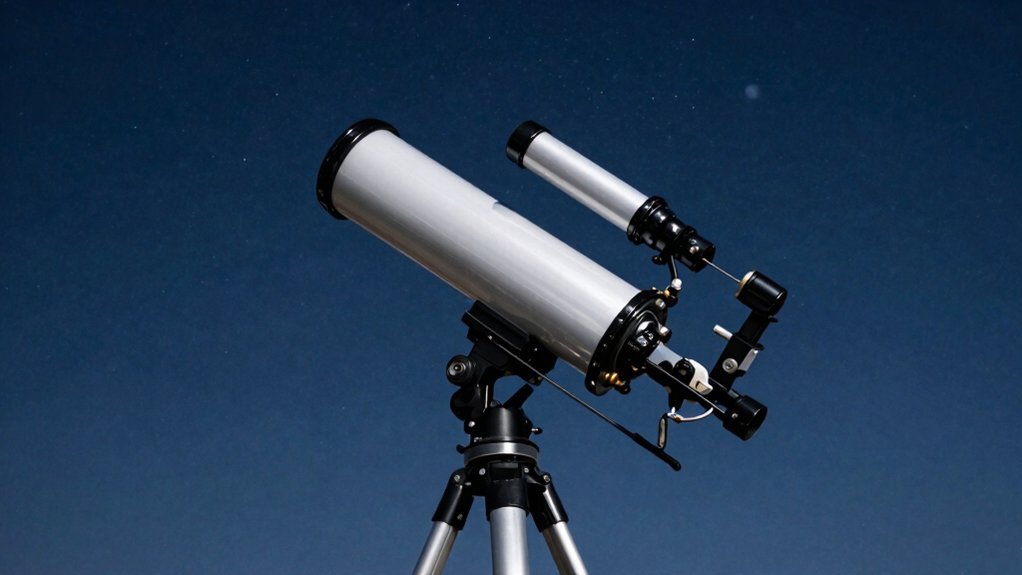
You might think telescopes just make things bigger, but they’re really light buckets. Their main job is gathering enough photons to turn faint cosmic whispers into clear images you can actually study. Obviously, a six-inch scope collects four times more light than a three-inch one, revealing details magnification alone misses. Now you see why aperture beats zoom every time for serious observation. Stick around to uncover how this extra light unveils the universe’s deepest secrets.
What Is the Primary Purpose of an Astronomical Telescope?
What Is the Primary Purpose of an Astronomical Telescope?
You’re probably wondering if a telescope’s main job is just making things look bigger. That’s a common guess, but magnification isn’t the whole story. You actually need brightness and clarity to see faint stars clearly.
Here’s the thing: telescopes gather light to form enlarged images for your study. This core function supports deep observation and detailed analysis of space. You gain real telescope advantages when your view becomes sharper and brighter.
Now, consider how specific observing techniques rely on this improved image quality. You can distinguish tiny details on planets that your eyes miss alone. The instrument acts as a powerful tool for scientific exploration, not just viewing. Telescopes also enable astronomers to observe various regions of the electromagnetic spectrum beyond visible light. Different optical designs offer unique light-gathering power to suit every stargazer’s specific needs. Choosing the right optical design ensures you maximize performance for your specific stargazing goals. The ability to resolve fine detail depends heavily on the aperture size of the instrument you select.
Obviously, better data helps you record and measure celestial objects accurately. Your primary goal shifts from simple looking to genuine understanding of the universe. Start uncovering how these tools reveal hidden cosmic secrets today.
How Do Telescopes Gather Light From Faint Objects?
Two key ideas explain how telescopes catch faint light from deep space. You need a big “light bucket” to grab photons your eye misses. Obviously, larger apertures gather way more light than small ones do.
Your telescope’s curved mirror or lens acts as the main light collector. It concentrates weak starlight into a bright, focused image you can actually see. This process turns invisible glimmers into clear pictures for your camera or eye.
Now, consider how this boosts your faint detection capabilities considerably. A six-inch scope collects four times more light than a three-inch model. That extra power reveals distant nebulae previously hidden in total darkness.
Better light collection means you see deeper into the universe tonight. You now understand why aperture size matters most for viewing dim objects. Next, you might wonder why magnification isn’t the most important factor. By leveraging current locations with precise insights, observers can optimize their viewing conditions to maximize the light gathered by their instruments. The fundamental light-gathering power of a telescope is directly proportional to the area of its primary optic, dictating exactly how much faint detail becomes visible. Successful observation also requires allowing your optics to reach thermal equilibrium with the outside air to prevent internal currents from blurring the image.
Why Does Aperture Size Beat Magnification?
You probably think zooming in makes everything better, but that’s a common trap. High magnification without enough light just spreads a dim image, making it blurry and useless.
Here’s the thing: aperture advantages drive real visibility by gathering photons for brighter, sharper views. Your telescope’s main job is collecting light, not just enlarging what you already see poorly.
Magnification limitations hit hard when you exceed fifty times per inch of aperture. A four-inch scope tops out near two hundred times before details vanish into darkness.
Obviously, bigger lenses reveal faint galaxies and crisp planetary features that small tubes miss. You need resolution to separate close stars, something zoom alone cannot create.
Focus on gathering light first, then scale up only when your optics support it. Different telescope designs utilize optical systems to manage this light collection efficiently before you scale up magnification. Understanding light-gathering power is essential because it determines the faintest objects you can observe regardless of how much you zoom. The focal ratio further influences the brightness of extended objects like nebulae by determining how quickly light is concentrated at the focal plane. Next, you’ll want to know how mirrors and lenses actually focus that starlight.
How Do Mirrors and Lenses Focus Starlight?
Everyone wonders how a simple piece of glass or metal actually grabs starlight from the dark. You see, lenses bend light through refraction, forcing parallel rays to meet at a specific focal point behind the glass. However, imperfect curves cause lens aberrations that blur your view if you don’t correct them carefully.
Mirrors work differently by reflecting incoming starlight off a concave surface toward a single focus. Modern mirror designs let engineers build huge collectors that gather far more faint light than any lens could. You get sharper images because mirrors avoid the color splitting issues that plague large glass lenses. Expert observers note that understanding optical aberrations is crucial for selecting the right instrument to minimize image distortion. While refractors use glass elements, reflectors rely on primary mirrors to collect light without introducing chromatic errors.
Both systems concentrate scattered photons into a tiny, bright image on the focal plane. You need this intense focus to see distant galaxies clearly with your eye or camera. Obviously, precise shaping guarantees those parallel rays land exactly where your detector waits. Remember that maintaining optical performance requires using gentle tips to clean your telescope optics safely without causing damage.
What Science Becomes Possible With Better Telescopes?
Once your optics focus that light, you’re ready to ask what new secrets better telescopes actually reveal. You finally tackle early universe exploration by spotting faint galaxies from billions of years ago. Obviously, seeing further back means understanding how everything began.
Now, exoplanet studies let you analyze alien atmospheres for signs of life directly. You separate tiny planets from their blinding stars with stunning clarity. Black hole investigations also sharpen, revealing structures previously blurred into nothingness.
All right, solar system mapping gives you detailed atlases of changing weather on distant moons. You watch volcanic eruptions unfold in real time from Earth. Finally, transient event detection catches exploding stars before they fade away.
Better tools transform smudges into structured targets you can actually measure. This clarity turns vague theories into concrete data you can trust. Selecting the right instrument based on optical performance ensures your specific scientific goals are met without unnecessary cost or complexity. Understanding light gathering power allows enthusiasts to detect fainter objects that define the limits of observable science. What cosmic mystery will you choose to solve next?