You’re stuck choosing between a Dobsonian’s huge, cheap aperture and an SCT’s compact, versatile design. Obviously, Dobsonians give you more light per dollar, like getting an 8-inch scope for $700 versus $1,500. SCTs shine for planets with crisp details, while Dobsonians dominate deep-sky hunting. If you value portability, the folded SCT path wins; if raw power matters most, grab the Dob. Your specific observing goals will soon make this choice crystal clear.
Schmidt-Cassegrain vs Dobsonian: Core Design Differences
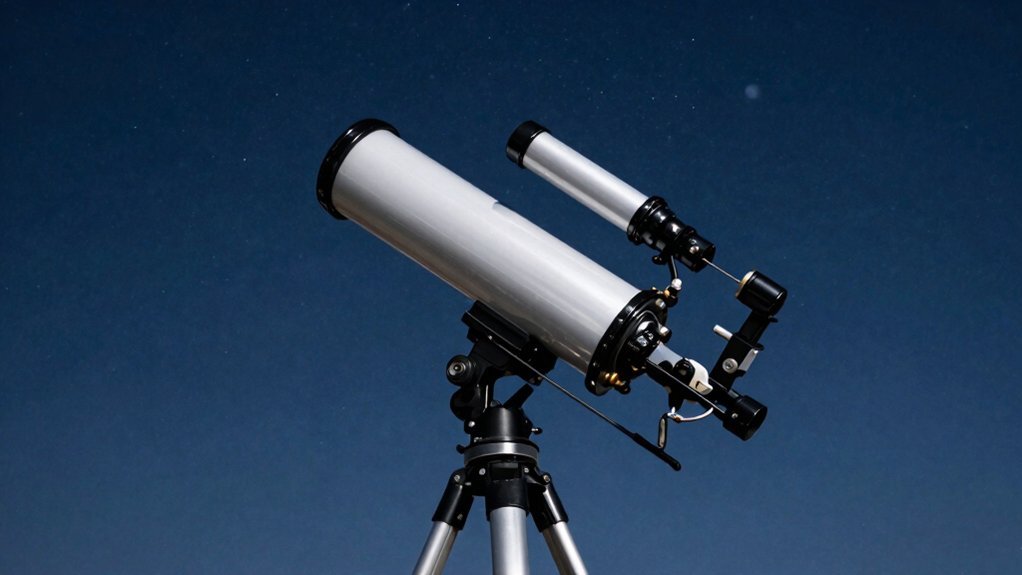
You’re probably wondering why these two telescopes look so different despite doing the same job. It comes down to their unique engineering choices. The Schmidt-Cassegrain packs a long focal length into a short tube using a folded optical path. You get a compact, closed system that seals out dust effectively.
Now, consider the Dobsonian. It uses a simple Newtonian reflector on a basic alt-azimuth mount. Light travels a straight optical path, making the tube length match the focal length. This open design cools faster but exposes mirrors to air currents.
Here’s the thing: design complexity differs wildly between them. SCTs integrate the secondary mirror into a corrector plate, avoiding diffraction spikes. Dobsonians use spider vanes, which create those classic star spikes but simplify collimation. You trade thermal speed for mechanical simplicity with the Dobsonian. While the SCT offers portability, the Newtonian reflector design of the Dobsonian provides significantly more aperture per dollar. Proper thermal equilibrium is often reached quicker in the open-tube Dobsonian compared to the sealed SCT, impacting image stability during early observation sessions. The compact nature of the SCT makes it ideal for observers who prioritize portable storage and easy transport to dark sky sites.
Which structural quirk matters most for your observing style?
How Aperture and Price Compare Between Telescope Types
Money talks, and it screams that Dobsonians deliver way more glass for your buck. You want serious aperture advantages without emptying your wallet? Search no further than the Dobsonian design. An 8-inch Dob costs around $700, while an equivalent Schmidt-Cassegrain hits $1500. That is a massive difference for your budget.
Here’s the thing: Newtonian optics and simple mounts drive this incredible cost effectiveness. You get substantially more light-gathering power for every dollar spent. Obviously, larger apertures reveal fainter objects, making Dobsonians the king of value. However, you do trade portability for that cheap glass. While Dobsonians excel in raw aperture per dollar, Schmidt-Cassegrain telescopes offer a more compact optical tube assembly that enhances portability for travelers willing to pay a premium. This compact design relies on folded optics to shorten the physical length of the telescope while maintaining a long focal length. Understanding the impact of light gathering power is crucial when deciding if the extra cost of a compact scope is worth the sacrifice in raw aperture size.
Which Telescope Offers Better Views for Deep Sky?
So, which scope actually shows you more of the universe? You want deep-sky views, and Dobsonian advantages clearly shine here. Their huge apertures gather far more light, making faint galaxies pop with incredible visual clarity. You’ll frame big nebulae easily thanks to their wide fields of view.
Now, consider SCT disadvantages for this specific goal. Their long focal lengths create narrow views that clip large objects. You struggle with targeting faintness because smaller apertures cost the same. Obviously, light grasp dictates what you see in the dark sky. Understanding the optical design reveals that the secondary mirror in an SCT causes a central obstruction that slightly reduces contrast compared to the unobstructed light path of a Newtonian Dobsonian. Since the primary mirror in a Dobsonian reflects light directly to the eyepiece without complex folding optics, it maintains superior light transmission efficiency for detecting faint celestial objects.
All right, here’s the bottom line for your research. If visual deep-sky observing is your main passion, grab a Dobsonian. You get more bang for your buck and brighter images tonight. Don’t let compactness fool you when hunting dim targets. Ready to explore how these scopes handle planets instead? Crucially, the focal ratio of a Dobsonian is typically much lower than an SCT, enabling those expansive views essential for large deep-sky objects.
Why SCTs Excel at Planetary Observation and Detail
The Schmidt Cassegrain really shines when you switch your focus from deep sky to planets. You need high magnification to see tiny features, and this scope’s long focal length delivers exactly that. Its f/10 ratio naturally boosts image scale without extra glass.
Now, consider the crisp images you get. The design minimizes aberrations, revealing subtle ring structures on Saturn clearly. High contrast separates Jupiter’s belts easily, making planetary detail pop against dark space. Obviously, steady air helps, but the optics maximize every good moment. This optical configuration is particularly well-suited for visual astronomy, especially when observing planets with high clarity. Even under less-than-perfect light pollution, the sealed tube design helps maintain thermal stability for sharper views. The compact folded optical path allows for a portable setup that still provides the long focal length necessary for high-power viewing. The corrector plate at the front effectively eliminates spherical aberration to ensure sharp focus across the entire field of view.
All right, tracking matters too. A go-to mount keeps targets centered for hours while you study fine points. You won’t fight the sky, letting you catch brief seeing windows perfectly. Plus, adding a Barlow lens pushes magnification even higher effortlessly.
Your takeaway? This telescope reveals solar system secrets through superior resolution and stability. Ready to see how size affects your setup next?
Portability Showdown: Compact SCTs vs Bulky Dobsonians
You’re probably wondering how a bulky tube fits in your tiny car compared to a compact one. SCTs use folded optics, shrinking their length considerably for easy storage. Dobsonians feature long, open tubes that often demand extra trunk space or disassembly. Obviously, the shorter SCT profile slips into tight spots much faster. Now, consider your actual hauling experience. SCTs deliver superior transport convenience because you grab one piece instead of two. Large Dobs split into heavy bases and awkward tubes, complicating your load. Setup efficiency favors the compact Schmidt Cassegrain when you arrive at dark skies. You simply unpack and align, skipping complex assembly steps required by bigger reflectors. Ultimately, if frequent travel matters most, the SCT’s small footprint wins hands down. Do you prioritize maximum aperture or genuine ease of movement? Think about your vehicle’s limits before deciding. Understanding optical design differences clarifies why these physical forms vary so drastically between the two telescope types. The folded light path inherent to SCTs is the specific engineering feature that allows their tubes to remain so short compared to the straight light path of Dobsonians. While portability is key, remember that mirror coating quality significantly impacts the light gathering ability and image contrast you will experience with either optical tube.
Can You Take Photos Without Motorized Tracking?
Can you really snap photos without a motor chasing the stars? Yes, but only for bright targets like the Moon or planets. You capture hundreds of quick frames to freeze motion before drift ruins them.
Deep-sky objects vanish instantly without tracking, blurring in under one second. Obviously, galaxies need motors, so forget long exposures on a manual Dobsonian.
For lunar imaging, your steady hand works fine with rapid video captures. Planetary photography also succeeds using short bursts that ignore field rotation entirely.
SCTs offer convenience here, yet Dobsonians still grab decent planet shots manually. You just accept a harder workflow for those fleeting clear moments. While high magnification views benefit from tracking capabilities, non-tracking sessions with Dobsonians can be frustrating due to the need for constant re-centering on celestial objects during sketching.
Stick to solar system bodies if you refuse motorized tracking gear. Deep-sky dreams require equatorial platforms or completely different telescope configurations right now. A practical step-by-step walkthrough ensures beginners master these fundamental techniques to get it right the first time. Unlike reflectors that may need frequent collimation, Schmidt Cassegrain telescopes maintain optical alignment well during transport, making them slightly more robust for impromptu imaging sessions. The closed tube design of an SCT also helps reduce air currents inside the optical path, leading to sharper images faster than open-tube Dobsonians.
Ready to decide if visual fun beats complex camera setups tonight?
Choosing Between Visual Observing and Astrophotography Goals
Why does your ideal telescope suddenly feel wrong once you mention cameras? Your goals dictate everything here. If you love visual observing, a Dobsonian delivers huge apertures for faint galaxies without breaking the bank. You get wide fields perfect for sweeping dark skies easily.
Now, consider astrophotography benefits. Schmidt-Cassegrains shine because their compact design handles tracking and long exposures far better. You need that stability to capture sharp planets or small nebulae effectively. Dobsonians struggle here without complex, expensive motor upgrades for field rotation.
All right, so pick the Dobsonian for pure, simple stargazing joy under the stars. Choose the Schmidt-Cassegrain if you plan to image targets or need portability. Obviously, mixing both goals favors the versatile SCT despite its smaller aperture. Which path matches your actual night-time habits best? Decide that before spending a dime.
Final Verdict: Aperture Value vs Optical Versatility
Confusion often clouds your final choice between raw power and flexibility. You want the best view without wasting hard-earned cash on features you’ll never use.
Dobsonians deliver massive aperture value, letting you see faint galaxies cheaply. They offer incredible optical performance for visual deep-sky hunting on a budget. However, SCTs provide superior versatility with compact designs perfect for travel. Your specific user preferences ultimately dictate which telescope truly wins this battle.
Choose the Dobsonian if you prioritize sheer light-gathering power above all else. Pick the SCT when you need a do-it-all scope for imaging too. Both excel differently, so match the tool to your actual observing habits. Don’t buy specs; buy the experience you actually crave most tonight. Which night sky target makes your heart race the very most right now? Understanding the historical context of these designs reveals why each evolved to serve such distinct astronomical needs. While Dobsonians rely on simple Newtonian optics, SCTs utilize a complex folded light path to achieve long focal lengths in short tubes.