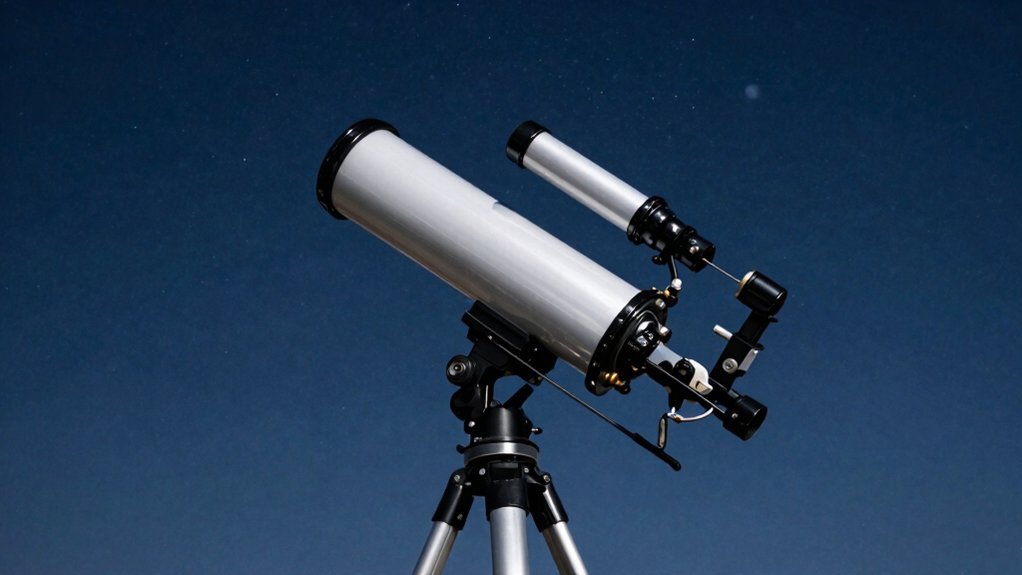
You’re wondering what actually counts as a small telescope, and honestly, it’s not about the brand name but that 50mm to 90mm aperture range. Now, here’s the thing: aperture gathers light like a bucket catches rain, so bigger lenses reveal fainter stars better than high magnification ever could. You’ll spot lunar craters and Jupiter’s moons easily with these portable scopes. Obviously, you’ll outgrow this setup eventually, but keep exploring to see exactly when that upgrade becomes necessary.
What Defines a Small Telescope Aperture?
Aperture is just the width of your telescope’s main light-gathering eye. You probably wonder where exactly small ends and medium begins. It’s confusing because definitions shift between casual hobbyists and pros.
For you, small usually means 50 mm to 90 mm for refractors. Reflectors under 4 inches also fit this cozy category. These aperture sizes define your instrument’s fundamental light collection capability. Obviously, a 50 mm lens gathers far less photons than a massive mirror.
Your specific telescope type dictates how we measure this critical diameter. Refractors use the front lens, while reflectors rely on the primary mirror. Don’t let fancy housing trick you; only the clear opening counts.
Small apertures prioritize portability and cost over deep-sky brightness. You’ll find 70 mm scopes perfect for quick backyard sessions. Remember, under 90 mm generally marks the small telescope threshold for amateurs. Now you know exactly what makes your scope small. Expert guidance suggests that clear expert-backed guidance helps enthusiasts maximize the potential of these compact instruments. To get the best views, understanding optical resolution limits ensures you select targets suitable for your instrument’s size. Effective use of these instruments relies heavily on proper collimation techniques to maintain sharp image quality despite their compact design.
Why Aperture Matters More Than Magnification
You’re probably wondering why that huge magnification number on the box doesn’t guarantee a better view. Here’s the thing: magnification only enlarges what your optics already resolve. Pushing power too high just makes dim, fuzzy blobs.
Aperture importance cannot be overstated because it defines your light grasp. Doubling that diameter collects four times more photons for brighter images. This extra light reveals faint galaxies that small lenses simply miss. The light gain with bigger apertures is exponential, not linear, meaning a 200 mm telescope gathers 16 times more light than a 50 mm one. Effective light gathering power is the fundamental metric that determines whether deep-sky objects appear as visible smudges or detailed structures. Different optical designs offer varying levels of image contrast which further impacts how clearly these faint details stand out against the sky background. Optical coatings also play a critical role by maximizing light transmission through the system to ensure every collected photon reaches your eye.
Remember, you can’t magnify detail that isn’t there to begin with. A 102mm scope tops out around 200x before things get too soft. Bigger apertures keep views sharp and usable at higher powers naturally.
Focus on gathering light first, and magnification becomes a useful tool later. Your next step involves choosing the right telescope type for your specific goals.
Which Small Telescope Types Fit Your Needs?
So, how do you pick the right small telescope from such a crowded field? You weigh refractor advantages like low maintenance against reflector considerations regarding collimation needs. Catadioptric features offer compact tubes perfect for high-magnification planetary work without bulk.
Now, a portable dobsonian delivers huge value if you prioritize stability over extreme travel readiness. Travel telescope benefits shine when you need quick setup and minimal weight for trips. Solar observing tips suggest dedicated small scopes for safe Hydrogen Alpha viewing specifically.
All right, the mini telescope range covers 30–60 mm apertures for casual lunar peeks. You choose based on whether portability or raw light-gathering power matters most to you. Obviously, your specific observing goals dictate which optical design fits your lifestyle best today. For those comparing options side by side, understanding the trade-offs between optics and performance is essential for making an informed purchase. Additionally, evaluating the focal ratio of your chosen instrument helps determine its suitability for wide-field star clusters versus detailed planetary observation. Beginners should also consider the mount stability provided by different tripod systems to ensure clear views without excessive vibration.
What Can You See With a Small Telescope?
A small telescope opens up a surprisingly detailed universe right from your backyard. You’ll love lunar observations, spotting craters and mountains along the shadowy terminator line. Bright planets reveal themselves too, offering glimpses of Saturn’s rings or Jupiter’s bands.
Now, don’t expect huge disks; you’ll see small bright orbs with distinct planetary details. You can track Jupiter’s four moons or spot Titan near Saturn easily. Double stars like Albireo show stunning color contrasts that naked eyes miss completely.
Star clusters appear as grainy groups, while nebulae look like faint, ghostly clouds. You might catch the Orion Nebula‘s greenish glow or fuzzy Messier galaxies in dark skies. Deep sky targets won’t match photos, but seeing them live feels magical. Obviously, steady air matters most for sharp views of these distant wonders. To get the best views, you need to understand observing conditions which significantly impact what is visible in the night sky.
You’ll find endless nights of exploration waiting just outside your door. Ready to pick your first target tonight?
Can Small Telescopes Handle Professional Work?
You might wonder if your backyard gear can do real science. Absolutely, modern detectors let small scopes handle serious research capabilities like finding exoplanets or tracking asteroids. You aren’t just looking; you’re contributing data that professionals actually use daily.
Here’s the thing: automated systems boost your observational efficiency considerably. They monitor variable stars for years, building archives huge telescopes can’t match due to tight schedules. You get stable, long-term results without constant manual effort. Contributions from these efforts are even recognized in scientific papers, emphasizing the importance of collective amateur efforts.
Obviously, faint deep-sky spectroscopy still struggles with limited light gathering. A tiny 50mm lens won’t cut it for high-magnification work on distant galaxies. But for follow-up surveys, your modest setup often outperforms giant observatories stuck with bad weather or booking delays. The fundamental limit of any instrument is defined by its aperture size, which dictates exactly how much light can be collected to reveal faint celestial details. Crucially, the telescope’s ability to distinguish fine details relies on its angular resolution, determined by the diameter of the primary lens or mirror.
Technology bridges the gap, turning simple mirrors into precise measurement tools. You can run reliable programs with minimal intervention, freeing up big iron for tougher targets. Your small telescope truly earns its place in professional astronomy today. To maximize these capabilities, enthusiasts should prioritize optical quality when selecting their initial equipment to ensure sharper images and better data collection.
Who Benefits Most From Small Telescopes?
Why do so many folks assume bigger always means better? You might think huge glass guarantees success, but that’s often wrong. Small scopes actually serve specific groups perfectly without the heavy lifting or massive costs.
Beginner astronomers gain the most because these instruments lower every single barrier to entry. You’ll set up quickly, store them easily, and start learning the sky immediately. A 70 mm lens gathers 100 times more light than your naked eye anyway. Choosing a design with high contrast ensures faint details remain visible even with modest aperture sizes.
Visual observing fans also love the portability for spontaneous backyard sessions. You can grab an 80 mm refractor and catch sharp lunar details in minutes. Wide fields help you scan star clusters without fighting complex mounts all night long.
Students and teachers benefit too since simple operation keeps focus on real science. Obviously, frequent short beats rare marathon sessions for building actual skills. Start small to master the basics before worrying about upgrades later. Understanding optical resolution limits helps users realize that compact apertures often provide sufficient detail for lunar and planetary viewing without the bulk of larger instruments. Even under less-than-perfect conditions, knowing the best viewing times ensures you maximize what your small telescope can reveal.
When to Upgrade From a Small Telescope?
How do you actually know when your little scope has hit its ceiling? You’ll spot specific upgrade triggers once you consistently reach maximum useful magnification. For a 4-inch scope, that’s roughly 200×; pushing beyond this just blurs the image.
Here’s the thing: telescope limitations often scream for more aperture if you crave fainter objects. If you need over 50 mm more light-gathering power, buy a new body. Don’t waste cash on tiny jumps when a big leap changes everything. This is because the light-gathering ability of your instrument directly dictates how many stars and deep-sky objects become visible to your eye.
Maybe your observing goals shifted entirely toward astrophotography or deep-sky hunting. Your current refractor might fight you instead of helping you capture those stunning shots. Obviously, forcing the wrong tool creates frustration rather than beautiful images.
Stop fighting your gear when it clearly blocks your progress. Ready to choose your next big step in stargazing? Understanding how different models compare across optics and performance can help you select the perfect match for your evolving needs, especially when evaluating which telescope options align with your specific budget and viewing preferences.