You’re wondering if 3I/ATLAS pops out at night, right? Obviously, your naked eye can’t spot this magnitude 11 glow. Even standard binoculars fail here, leaving you staring at nothing. You need a telescope with at least a 6-inch aperture to catch it. Aim low in the east before dawn for your best shot. Now, let’s get you set up with the right gear and timing so you don’t miss this fleeting visitor.
Can You See 3I/ATLAS Without a Telescope?
Can you really spot 3I/ATLAS without any gear? You simply cannot see this comet with your naked eyes. Its comet brightness sits at magnitude 10–11.5, far too dim for unaided viewing. Even ordinary binoculars fail to show it clearly against the dark sky.
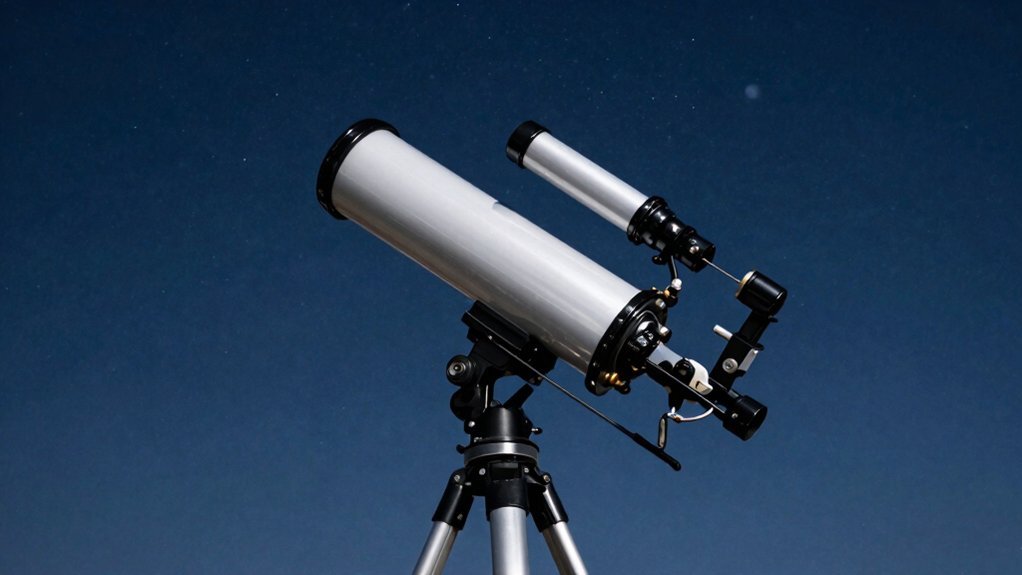
Here’s the thing: you need a telescope to catch this faint traveler. A 6–8 inch scope offers your best shot at seeing a blurry smudge. Dark, rural skies become essential when you apply proper observing techniques like averted vision. Smart apps help you aim, but optical power does the heavy lifting here. Understanding optical aperture is crucial because larger diameters gather significantly more light, making faint objects like this comet visible.
Obviously, trying without a telescope leads only to frustration and empty skies. You must accept that gear matters immensely for this specific cosmic visitor. Grab a telescope or join a local club to finally witness it yourself. Successful observation relies heavily on light pollution levels to ensure the faint comet stands out against the background sky. Since telescopes function by collecting and focusing light to magnify distant images, having sufficient light-gathering power is the deciding factor in detecting such dim celestial bodies.
When and Where to Look for 3I/ATLAS in Leo
Timing is everything when you hunt for 3I/ATLAS in Leo. You must look during pre-dawn hours before sunrise brightens the sky. The comet sits low in the east-northeast, rising after 11 PM.
Find Regulus, Leo’s brightest star, to anchor your search effectively. Look slightly lower left of it near the Sickle asterism pattern. Use apps like Sky Tonight to pinpoint exact coordinates quickly.
Follow these best viewing practices by choosing dark, rural locations tonight. An unobstructed eastern horizon matters immensely for spotting faint objects clearly. These observing tips guarantee you maximize your slim chances of success.
Clear nights between late December and early spring 2026 offer hope. You need minimal light pollution washing out the delicate cosmic glow. Start watching forty-five minutes before local sunrise for ideal darkness conditions. Expert observers recommend allowing your eyes at least twenty minutes to achieve full dark adaptation for detecting such faint celestial bodies.
Grab your star chart and head outside before dawn breaks soon. To further enhance your view, select a site with minimal light pollution to prevent the skyglow from obscuring the faint comet.
Understanding the current orbital trajectory helps predict exactly where the comet will appear relative to Leo’s stars each night.
Why Binoculars Cannot Reveal the Faint Comet
Even if you grab your best binoculars, you won’t see 3I/ATLAS because it’s simply too faint. You might expect magnitude 10 to pop right out, but that limit applies only to sharp stars. This comet spreads its dim light across a wide area, creating serious faintness challenges for your eyes.
Think of trying to spot a foggy cloud against a gray wall at dusk. That is exactly why diffuse targets like this one vanish in standard 10×50 binoculars. Your optics gather enough light for points, yet the coma’s low surface brightness hides it completely. Even perfect dark skies won’t save you here since the object itself lacks necessary contrast.
You need more light-gathering power than any handheld glass provides. Accept that binoculars fail this specific test and prepare to upgrade your gear soon. Unlike compact optics, choosing the right telescope types with larger apertures is essential to collect the photons required to make such faint, extended objects visible. When evaluating these instruments, remember that aperture size directly determines the amount of light collected, which is the critical factor for detecting low-contrast cometary comas. Historical records show that the invention of the telescope was the pivotal moment that finally allowed astronomers to resolve such faint, extended celestial bodies that were previously invisible to the naked eye or simple lenses.
What Telescope Aperture Do You Need for 3I/ATLAS?
Since binoculars leave you staring at empty sky, you’re wondering what size telescope actually works. You need substantial glass because this diffuse comet hides between magnitude 9.5 and 13.6. Most aperture recommendations suggest a 6-to-8-inch scope as your absolute minimum for visual detection.
Here’s the thing: smaller 3-inch telescopes might show a faint blur only under perfect dark skies. You really want an 8-inch instrument to reliably spot that ghostly smudge against the stars. If you crave detail like a bright central condensation, grab a 10-inch or larger tube.
Obviously, bigger apertures gather more light, making the vague blur pop with better contrast. Don’t expect miracles with tiny lenses since this target demands serious light-gathering power. Aim for at least 8 inches to save your observing session from frustration tonight. When comparing optical designs, a Newtonian reflector often provides the most cost-effective way to achieve this necessary aperture size. Now you know the gear needed, but how do you actually spot such a faint object? Understanding light-gathering power is essential because larger apertures collect more photons, allowing faint objects like comets to become visible against the night sky. The ability to resolve fine details in the coma also improves significantly when you utilize a telescope with greater resolving power.
How to Detect 3I/ATLAS Using Averted Vision and Apps
Although you’ve got the right telescope, staring directly at that faint smudge often leaves you seeing nothing but empty sky. You need averted vision techniques to catch magnitude 11.5–13.6 light. Look slightly sideways so sensitive retina cells detect that fuzzy patch. Dark skies are obviously essential for this trick to work well. Since ThreeI Atlas is expected to brighten only to magnitude 10 or 11, it remains invisible to the naked eye even under perfect conditions.
Now, let your phone guide the hunt with reliable comet observation apps. Load Stellarium or SkySafari and set your exact location and time. Find bright Regulus or Spica first, then hop slowly to the target zone. Keep magnification low initially to match the app’s wide star field view. Understanding how light gathering power works helps explain why larger apertures reveal fainter details that smaller instruments miss. Ensuring your optics have a clean optical surface prevents dust and smudges from further obscuring such dim objects. Different telescope designs offer varying levels of optical performance which can significantly impact your ability to resolve low-contrast objects against the night sky.
Don’t trust memory since the comet shifts position every single night. Confirm your star alignment before scanning carefully for that elusive, diffuse glow. Mastering this combination turns invisible specks into visible celestial wonders tonight. Ready to try finding it before dawn breaks?