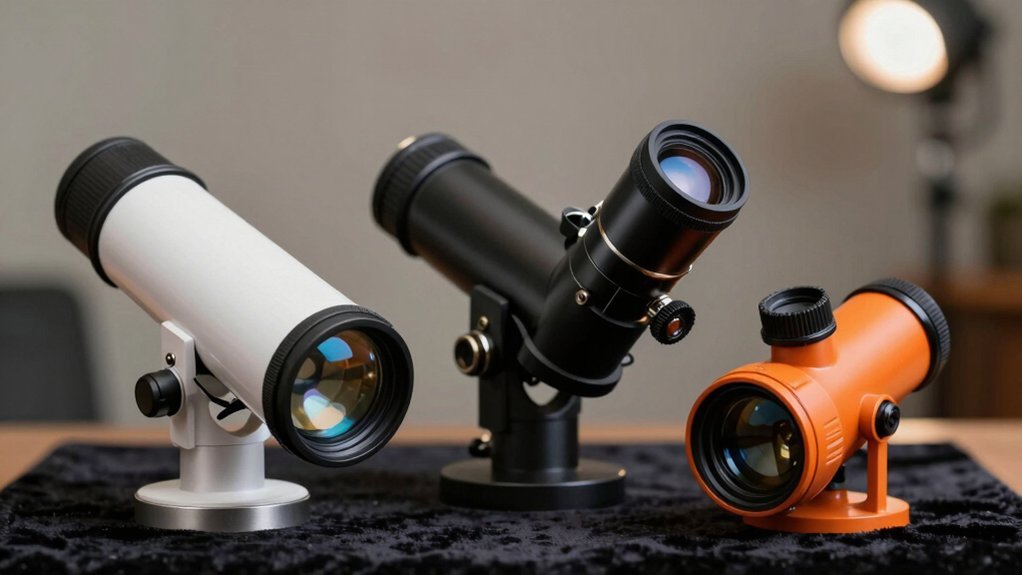
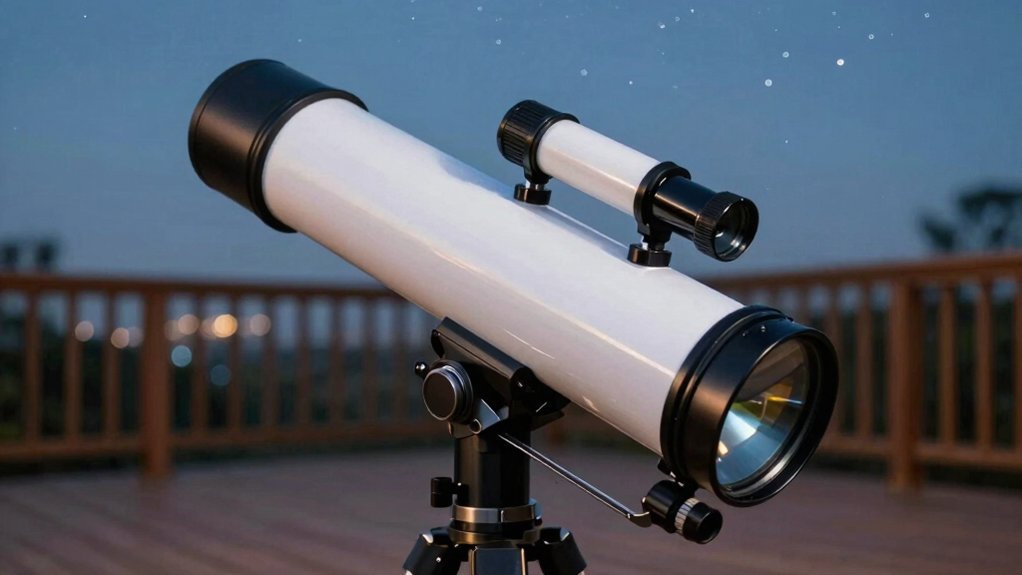
You’re wondering what a telescope actually is, and honestly, it’s just a light bucket that makes distant objects look bigger by bending or bouncing photons. Your eye needs more light to see faint stars, so a wider aperture gathers photons like a huge bucket catches rain. Mirrors now beat lenses because they avoid color fringing and support massive sizes without sagging. Stick around to uncover exactly how these tools reveal ancient galaxies right before your eyes.
What Is a Telescope and How Does It Work?
You’re wondering what a telescope actually is and how it pulls distant stars closer. It’s an optical instrument magnifying faraway objects by increasing their angular size. You see images through an eyepiece after an objective element gathers light.
Now, consider telescope history. Early models used lenses, but telescope evolution brought mirrors into the mix. Refractors bend light while reflectors bounce it to form clear pictures.
Here’s the thing: larger mirrors collect more light, revealing faint cosmic details you’d miss otherwise. This tool extends your vision beyond natural limits into the deep universe. Obviously, different designs serve specific observing needs based on portability and optical layout. Understanding light gathering power is essential because it determines the faintness of the objects you can detect.
Your takeaway? Telescopes transform invisible specks into visible wonders by concentrating radiation effectively. Next, you’ll want to understand exactly how these devices gather and focus that precious light. To get the best view, you must also consider the sky conditions needed for successful observation. For optimal results, enthusiasts should prioritize sites with minimal light pollution to maximize contrast and clarity.
How Do Telescopes Gather and Focus Light?
Imagine catching starlight in a giant bucket to see what’s really out there. You’re wondering how that actually works, right? Here’s the thing: your telescope’s aperture acts exactly like that bucket. A wider opening grabs more photons, letting you spot fainter objects deep in space. Obviously, light collection depends entirely on this surface area, not just the tube length. Different optical designs utilize specific configurations of lenses and mirrors to achieve this light gathering power effectively. Crucially, the amount of light captured increases with the square of the aperture diameter, making even small increases in size significant for viewing faint deep-sky objects. Reflector telescopes often provide a larger aperture size for the same cost compared to refractor models, allowing beginners to gather more light without breaking the budget.
Now, gathering rays isn’t enough; you need a sharp picture too. That’s where your focusing mechanism steps in to organize scattered beams. Curved mirrors or lenses bend incoming light until it converges at a single focal point. This distance, called focal length, determines where your image forms clearly. Without this precise convergence, you’d just see a blurry mess instead of distinct stars. The objective lens or mirror is the primary component responsible for collecting this light and directing it toward the focal point.
You now understand how size and shape create clear views. Next, you’ll want to know which specific design fits your stargazing goals best.
What Are the Three Main Types of Optical Telescopes?
You’ve got the light-gathering basics down, but now you’re staring at a menu of telescope types wondering which one actually fits your needs. Three main options exist: refractors, reflectors, and catadioptrics. Each uses different optics to bring distant stars closer to your eyes.
Refractors use lenses for sharp views. You’ll love their simplicity, yet large glass gets heavy fast. These refractor advantages shine for planetary viewing, though cost rises quickly with size. Reflectors use mirrors instead. They offer huge apertures cheaply, but open tubes collect dust. Those reflector disadvantages matter less if you prioritize deep-sky power over portability.
Catadioptric designs mix both lenses and mirrors. They fold light paths into compact tubes. You get great optical performance in a small package. Schmidt-Cassegrains exemplify this versatile hybrid approach perfectly. This hybrid design effectively eliminates chromatic aberration while maintaining a portable form factor ideal for travel.
Choose based on your specific observing goals and budget constraints. Now you know the core differences between these three distinct optical systems. Understanding optical aberrations helps explain why specific designs correct color fringing or spherical distortion better than others. Selecting the right aperture size directly impacts your ability to resolve faint details in deep-sky objects. Next, consider why modern giants prefer mirrors alone.
Why Do Large Modern Telescopes Prefer Mirrors?
Since you’re wondering why giants skip lenses, let’s clear that up right now. Large mirrors collect far more light than glass lenses ever could. You see, mirrors avoid chromatic aberration completely because reflection doesn’t split colors like refraction does. Glass lenses also absorb infrared light, but silvered mirrors reflect it perfectly for your observations.
Here’s the thing: manufacturing huge lenses is a nightmare compared to crafting mirrors. You only polish one side of a mirror, saving massive effort and money. Plus, you can support heavy mirrors from behind so gravity won’t sag them. Segmented mirrors let engineers build colossal surfaces from smaller hexagonal pieces easily. These mirror advantages enable apertures exceeding ten meters for stunning deep-space views. Obviously, scaling up with glass just isn’t practical for modern astronomy needs. When selecting equipment, understanding the benefits of reflecting telescopes helps stargazers choose the right tool for deep-sky observation. Additionally, the ability to achieve a much larger aperture allows these instruments to resolve finer details in distant celestial objects. For beginners starting their journey, learning about optical alignment ensures your instrument performs at its peak potential.
How Do Radio and X-Ray Telescopes Differ?
How exactly do these two telescope types differ when they hunt such opposite ends of the spectrum? You see, radio telescopes catch huge radio wavelengths right here on Earth. They use giant dishes to gather signals that pass easily through our atmosphere.
X-ray telescopes face a tougher challenge because x ray energy gets blocked by air. You must launch these instruments into space to catch those tiny, powerful photons. They bounce off mirrors at shallow angles instead of hitting them head-on. This design relies on glancing reflections to redirect high-energy photons that would otherwise pass through standard mirror surfaces. Since atmospheric absorption prevents these high-energy rays from reaching the ground, space-based observatories are the only option for X-ray astronomy. Unlike optical instruments that focus light directly, these specialized systems require grazing incidence optics to successfully capture high-energy radiation. This technological leap builds upon the revolutionary telescope legacy that transformed how we observe the cosmos.
Both systems turn invisible data into colorful images you can actually understand. Radio maps reveal hidden dust clouds while X-rays show explosive cosmic events. You get completely different views of the same universe depending on your tool.
Now you know why location and design matter so much for each type. Ready to explore what builds these amazing machines next?
Which Components Make Up a Telescope’s Structure?
A telescope isn’t just one piece of glass; it’s a team of parts working together. You might wonder how these pieces actually fit to create clear views of space. Let’s break down the essential structure you’ll encounter on any standard model.
Your optical components include the primary mirror or objective lens that gathers light inside the tube. The eyepiece then magnifies that focused image specifically for your eye to see clearly. Obviously, without these aligned elements, you’d see nothing but darkness in the night sky. Different designs utilize either refracting lenses or reflecting mirrors to collect and focus incoming light before it reaches your eye.
Focusing mechanisms like knobs move the eyepiece slightly to sharpen blurry stars instantly. Your mount and tripod hold everything steady while you track objects across the sky. A finderscope helps you aim accurately before you zoom in for detailed observation sessions. The stability provided by your mount and tripod is crucial for preventing image shake during high-magnification viewing. Proper alignment of these optical elements ensures maximum light gathering power for brighter and sharper celestial images.
Understanding these parts gives you confidence when handling any telescope setup out there. Now you’re ready to explore how aperture size changes what you see next.
How Does Aperture Increase Light-Gathering Power?
Aperture acts as your telescope’s light bucket, and you’re right to wonder why size matters so much. A wider opening grabs considerably more photons from those distant, faint stars.
Here’s the thing: light-gathering power scales with the square of the radius. Doubling your aperture diameter actually quadruples the collected light, making dim objects suddenly visible.
This boost directly improves your system’s light sensitivity, pushing faint details above your eye’s detection threshold. You’ll see spiral arms or nebula structures that smaller scopes simply miss.
Obviously, these aperture effects don’t change an object’s true brightness, but they make it appear brighter to you. The increased signal lowers the contrast needed to spot subtle features.
Remember, bigger apertures reveal more because they collect more data, not because they magnify better. Now you understand why diameter drives performance so remarkably.
For optimal viewing, experts recommend seeking out dark sky locations to maximize the contrast benefits provided by your larger aperture.
While a larger aperture gathers more light, the optical design of the telescope also plays a crucial role in how that light is focused for the viewer.
Ready to see how this light collection translates into sharp, clear images?
Why Is Resolving Power Vital for Detail?
Why does a bright image sometimes look frustratingly blurry? You might think more light guarantees sharpness, but resolving power actually separates close objects into distinct points. Without it, nearby features merge together, ruining your image clarity even when the view is bright.
Here’s the thing: fine detail depends on whether your scope beats diffraction blur. A larger aperture shrinks this blur, letting you see tiny lunar craters or split tight double stars. Obviously, magnification alone won’t help if the aperture can’t resolve those details first.
Atmospheric seeing often limits this observing precision before your telescope reaches its theoretical limit. You need enough aperture to distinguish edges on planetary bands or rings effectively. Remember, resolution defines the smallest detail you can actually see, not just how big it looks. Focus on aperture size for true detail, then worry about magnification later.
What Celestial Objects Can Telescopes Reveal?
Since you’re wondering what’s actually out there waiting for you, let’s clear up that confusion right now. You’ll spot Jupiter’s four moons and Saturn’s rings instantly. Mars even shows polar ice caps during good views.
Stars look like dots, but telescopes split double stars easily. You’ll see the Pleiades cluster burst with dozens of blue gems. Nebulae glow as ghostly clouds where new stars form today.
Galaxies appear as faint smudges, yet they hold billions of ancient stars. Recent telescope advancements let you view these distant worlds clearly. Your celestial observations reveal objects as they existed long ago. However, remember that without dark skies, light pollution creates a dome effect that severely limits your ability to see these dim galaxies and nebulae.
You truly reveal the universe’s hidden beauty with simple gear. Start scanning the sky tonight to find your first target.