You’re wondering why flat mirrors fail while curves succeed, and you’re absolutely right to ask. Flat surfaces scatter light, but a curved primary mirror forces those rays into a single, sharp pinpoint focus. This geometry gathers more light, making distant stars appear considerably brighter and clearer to your eye. Obviously, precision matters here, as even tiny errors blur the image. Stick around to see how specific shapes fix these optical flaws.
Why Must Telescope Mirrors Be Curved?
Since you’re wondering why flat mirrors won’t work, let’s clear that up right now. Flat glass just bounces light away without ever bringing it to a sharp focus. You need curvature to gather those distant star rays into one tiny, bright spot.
Think of a satellite dish catching signals; your mirror design works exactly the same way for light. If the curve misses by even a fraction of a wavelength, your optical performance suffers badly. Parabolic shapes fix this better than simple spheres do for precise viewing.
Obviously, lenses cause color errors that mirrors completely avoid while staying lighter too. You get clearer images because the curved surface maps distant objects perfectly onto your sensor. This specific geometry creates the focal length you need for actual observation. Just like any successful DIY endeavor, following a clear step-by-step build ensures you select the right materials and apply practical tips for a working result. Understanding how light reflection functions is essential for grasping why the primary mirror must possess this specific curved shape to form an image. Beginners who master the basics early on avoid common pitfalls and achieve success with their first optical projects.
How Does Curvature Create Brighter Images?
While a flat mirror just bounces light away, your curved primary mirror actively squeezes those scattered rays into one tight spot. You might wonder how this shape actually makes things brighter. It’s simple geometry working hard for you.
Now, think about brightness concentration. Your concave surface redirects wide bundles of incoming rays toward a common region. This action forces more light to arrive at the image location simultaneously. Instead of staying spread apart, parallel rays move inward. A smaller illuminated area means higher luminance per unit area. Obviously, packing energy into fewer square millimeters boosts image intensity considerably. Unlike spherical mirrors that fail to focus parallel rays to a single point, this design relies on a parabolic shape to ensure all gathered light converges effectively. By maximizing the light-gathering power, the telescope captures faint details from distant celestial objects that would otherwise remain invisible to the naked eye. The total amount of light collected depends directly on the aperture size of the instrument.
Here’s the thing: convex mirrors spread rays outward, making images dimmer. But your telescope uses a converging mirror to collect light efficiently. This creates a real focus where reflected rays meet. The tighter that focal region gets, the brighter your spot becomes. That is why astronomers choose these specific shapes for deep-space viewing. Expert observers note that maintaining optical alignment is crucial to ensuring the curved mirror performs this light-concentrating function without distortion.
Ready to see exactly how parallel light hits that focus?
How Do Curved Mirrors Focus Parallel Light?
The curved surface you’re looking at doesn’t just bounce light; it actively redirects every parallel ray toward a single spot. You might wonder how a simple curve achieves such precision without lenses. Here’s the thing: the surface tilts locally, changing the reflection angle for each incoming beam.
Obviously, the law of reflection still holds true everywhere on that glass. Because every point faces a slightly different direction, parallel rays from distant stars hit and bounce inward. This specific geometry drives light convergence right at the focal point. You see, mirror principles dictate that concave shapes gather energy while convex ones scatter it. Achieving this precise focus relies heavily on the optical geometry of the mirror’s shape to minimize distortion. Different telescope designs utilize these principles to balance performance and cost for various stargazing needs.
Your telescope uses this inward curve to turn faint, parallel starlight into a bright, concentrated image. The focal length equals half the radius of curvature in spherical designs. Now you understand why flat mirrors can’t focus distant objects effectively. Next, you’ll want to know why specific curves beat others for sharpness. Concave mirrors are essential here because they converge light rays towards the focal point, whereas convex mirrors would diverge them away. When maintaining these delicate surfaces, always remember that using proper cleaning tools prevents scratches that could permanently degrade your view.
Why Are Parabolic Mirrors Better Than Spherical?
You’re wondering why a simple curve isn’t good enough for your telescope. Spherical mirrors fail because marginal and paraxial rays miss the same focal point. This error, called spherical aberration, spreads your focus into a blurry region instead of a sharp dot.
Now, consider how parabolic shapes fix this mess. They force all parallel rays from distant stars to converge at one exact spot. You get a diffraction-limited image that maximizes optical quality for serious astronomy. Obviously, sharper focus matters most when viewing faint, faraway objects through large apertures. However, this precision relies on parallel incoming rays to maintain a single focal point without degradation. The geometry of the curve directly determines the focal length where the light ultimately converges to form an image. This design ensures that light gathering capacity is fully utilized without the image degradation caused by spherical errors. When selecting optics, remember that aperture size is often the most critical factor for a stargazer’s ability to see deep-sky objects clearly.
Here’s the thing: making parables costs more and takes greater skill than grinding spheres. Yet, high-performance telescopes demand this precision to avoid blurred views entirely. Don’t settle for simplicity if you crave crystal-clear images of the cosmos. Your next step involves understanding how this specific curve actually sets your focal length.
How Does Mirror Curve Set Focal Length?
How exactly does that curve decide your focal length? You might think the light source matters, but geometry actually sets the rules. Your mirror shape dictates where parallel rays converge after hitting the surface.
Here’s the thing: a steeper curve creates a shorter focal length because rays meet sooner. Conversely, a shallow curve pushes that meeting point farther away, lengthening your focal length. The math is simple, too, since focal length equals half the radius of curvature.
Obviously, this fixed distance determines where your image forms inside the tube. A specific mirror shape locks your focal plane into one precise spot. This geometry controls your magnification potential and overall instrument size directly. Crucially, this relationship defines the optical power of the system, determining how strongly the telescope bends light to form an image. Understanding this principle helps enthusiasts select the right telescope design for their specific observing goals. Additionally, the precise radius of curvature serves as the foundational measurement from which all other optical characteristics are derived.
Why Do Large Telescopes Use Mirrors Not Lenses?
Big glass lenses get heavy fast, so you’ll find mirrors in every major observatory. You need a large aperture to catch faint starlight, but thick glass crushes its own frame. Mirrors solve this because you support them from behind, keeping shape intact without massive weight.
Now, consider chromatic aberration. Lenses split white light into messy rainbows, ruining your view with colored fringes. Mirrors simply bounce light, avoiding this color separation entirely for crisp, clear images. Obviously, that helps optical quality since you only polish one surface instead of perfecting huge glass blocks.
Here’s the thing about light collection: mirrors reflect wavelengths that glass often absorbs, expanding what you see. Space engineering also favors these lighter designs, letting rockets carry bigger eyes into orbit. You get more versatility without the structural nightmare of giant lenses holding everything back. This design choice ensures that reflecting telescopes avoid the internal light loss common in large refractors. By eliminating the need for light to pass through thick glass, this setup significantly reduces internal light absorption.
Mirrors let you build bigger, sharper, and lighter telescopes than lenses ever could. When choosing the right telescope, understanding these structural advantages helps every stargazer select the best optics for their needs. Next, how does that perfect curve actually stop blurry images?
How Does Perfect Curvature Stop Optical Blur?
You just learned why mirrors beat lenses, but now you’re wondering how that perfect curve actually stops blurry images. Here’s the thing: a precise parabolic shape forces all parallel light rays to meet at one single focal point. Without this specific curve, your telescope suffers from spherical aberration, turning sharp stars into fuzzy blobs.
Obviously, tiny mistakes ruin everything. You need optical precision within a fraction of a light wave to avoid distortion. Even small curvature errors scatter light, creating that annoying haze around bright objects. Faster systems demand tighter tolerances because short focal lengths exaggerate every imperfection on the glass surface.
Now, imagine polishing until surface departures hit just 1/8 of a wave. That level of accuracy guarantees your image stays crisp rather than soft. Perfect curvature aligns the focal plane exactly where your detector expects it. Just as understanding realistic price ranges helps buyers budget for quality optics, knowing these tolerances ensures you invest in a system that delivers true performance. Different telescope designs utilize specific optical configurations to balance these strict curvature requirements against portability and cost. Next, you’ll want to know where secondary mirrors fit into this delicate design.
Where Do Secondary Mirrors Fit in Design?
Since you’ve nailed the primary curve, you’re probably wondering where that second mirror actually fits. It sits right in the light path to redirect beams toward your eyepiece.
In Newtonian designs, a flat mirror angles light out the side at 45 degrees. Cassegrain setups use a convex piece to fold light back through a hole. These secondary mirror functions shape how you view the stars.
Obviously, this mirror blocks some light, creating trade-offs for contrast and sharpness. You must balance size against obstruction to keep images crisp.
Different telescope designs place these mirrors uniquely to match your observing goals. Whether flat or curved, they make long focal lengths possible in short tubes.
You now see how placement dictates the whole system’s compactness. Next, consider how segmented mirrors handle massive scales without breaking.
How Do Segmented Mirrors Focus Space Light?
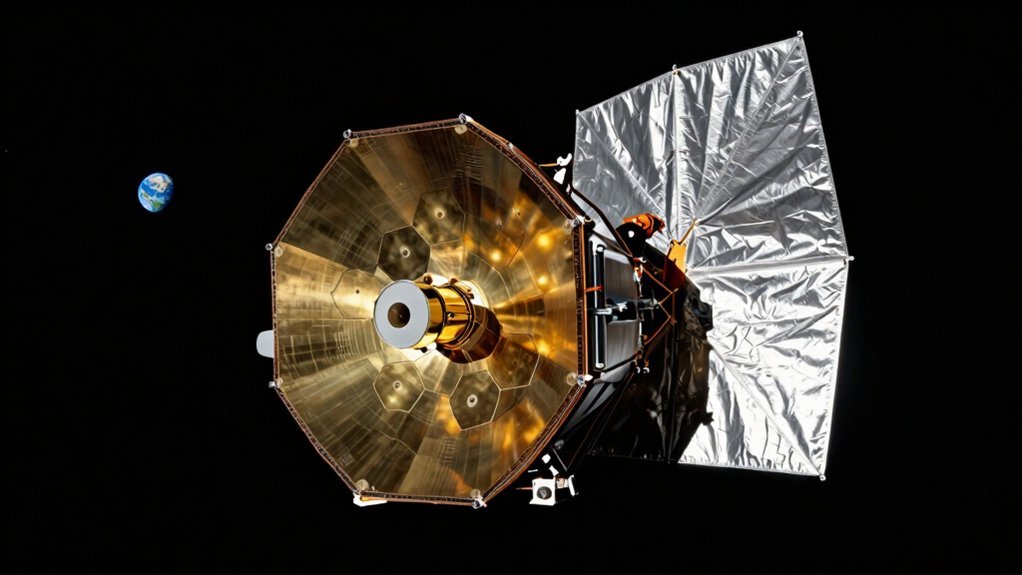
When you picture a giant space telescope, you might wonder how engineers launch a mirror that’s too big for any rocket. They use a clever segmented design, folding eighteen hexagonal pieces like origami. Each curved segment acts as part of one massive parent surface.
Now, consider how these pieces focus light together. Precise mirror alignment makes eighteen separate mirrors behave as a single 6.5-meter dish. Tiny actuators adjust each piece within nanometers to match the perfect parabolic shape. If they miss, your images blur instantly.
Here’s the thing: wavefront sensing checks every tilt and piston error constantly. You get sharp stars only when all light waves overlap perfectly in phase. This technology lets you see deeper into space than ever before.
Ultimately, segmentation solves the launch size problem without sacrificing optical power. Ready to explore how secondary mirrors refine this focused beam?