You’re wondering how one Italian astronomer’s 30x telescope shattered centuries of geocentric belief. Galileo Galilei built his own device in 1609 to see the cosmos directly, not just trust old books. He spotted Jupiter’s four moons and Venus’s full phases, proving Earth isn’t the universe’s center. Obviously, these observations flipped astronomy on its head. Keep exploring to see exactly how his lens choices revealed these game-changing details.
Who Was Galileo Galilei and Why Did He Build a Telescope?
Galileo Galilei, that Italian genius born in 1564, wasn’t just some random guy staring at stars. You might wonder why he bothered building a scope when others ignored the sky. His unique Galileo’s background in math and physics drove him to test ideas against real evidence.
He heard about the Dutch spyglass in 1609 and immediately crafted his own version. This wasn’t pure telescope invention from scratch, but rather a clever adaptation for viewing distant objects. He wanted to see the cosmos clearly, not just trust old authorities blindly. Understanding how light refraction works within glass lenses was essential for him to sharpen the image and reduce distortion in his early designs.
Now, you see he used lenses to magnify things up to thirty times stronger. His goal was investigating the universe directly, proving Earth wasn’t the only center of motion. Obviously, this approach changed everything we understand about our place in space today. This pivotal shift challenged the geocentric model that had dominated scientific thought for centuries. By gathering visual proof through his instrument, he demonstrated that empirical observation is the foundation of modern astronomical discovery.
How Did Galileo Improve the Telescope for Sky Watching?
Tweak those lenses, and you’ll see why Galileo turned a simple spyglass into a sky-scraper. You might wonder how he boosted that tiny Dutch toy to thirty times magnification. He didn’t just guess; he reworked lens power and spacing with serious precision.
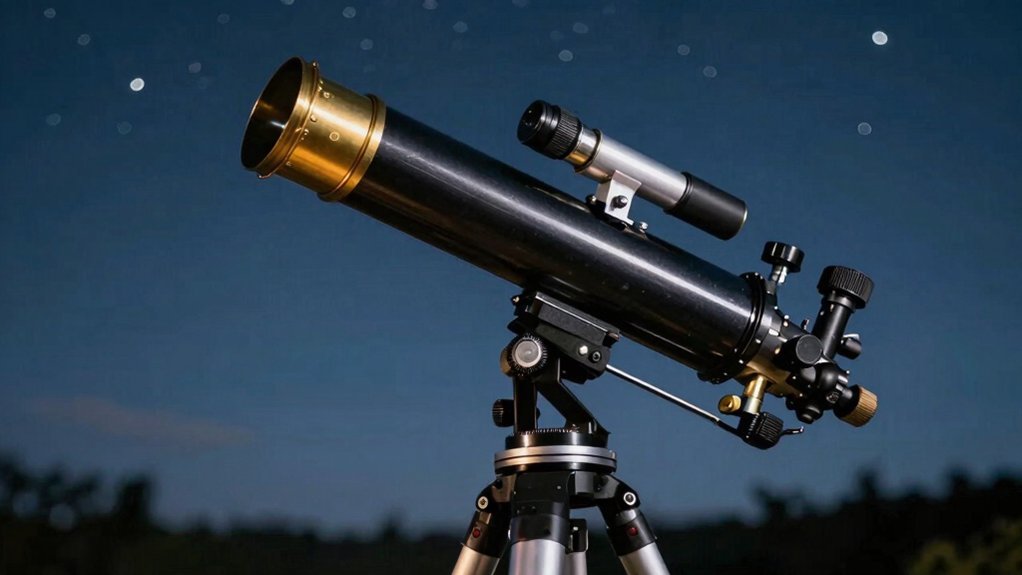
Now, consider his specific lens refinements. He paired a convex objective with a concave eyepiece to create upright images. This setup made tracking stars much easier for you than later inverted designs ever could. Obviously, better glass meant sharper views, yet chromatic aberration still plagued his early attempts. Unlike modern instruments that prioritize light-gathering power through larger apertures, Galileo’s design relied heavily on lens quality to maximize the limited light entering the narrow tube.
Here’s the thing about optical clarity: careful alignment reduced distortions considerably. You’d notice the field of view remained narrow, maybe half the Moon’s width. Despite this limit, stable mounting allowed systematic observation previously impossible for anyone. His groundbreaking work established the foundation for modern observational astronomy by shifting focus from theoretical debate to empirical evidence.
Galileo transformed a novelty into a rigorous scientific tool through relentless experimentation. Your next step involves seeing exactly what those clearer skies revealed to him. For modern observers, achieving similar clarity often depends on proper collimation techniques to ensure light travels correctly through the optical tube.
What Did Galileo Discover About the Moon and Milky Way?
You’ve probably wondered if those bright spots up there were actually perfect, smooth spheres. Galileo shattered that illusion instantly. He saw mountains, valleys, and pits, proving the Moon possessed rugged lunar topography just like Earth. Shadows along the edge revealed heights he could even measure. Obviously, heaven wasn’t flawless after all.
Now, look at the Milky Way. You might think it’s just a hazy cloud, but Galileo saw otherwise. His telescope resolved that haze into thousands of individual stars, revealing incredible stellar density. This revelation showed the universe held far more stars than anyone ever imagined. He proved careful observation beats old authority every time. Just as modern guides explain how light gathering power determines what details become visible, Galileo’s instrument collected enough light to separate those faint points. Understanding the role of optical resolution helps explain how his lens could distinguish individual stars within the dense galactic band where the naked eye sees only a blur.
These findings launched modern astronomy by showing the cosmos was physically complex. You now understand how he changed our view of the sky forever. Ready to see how Jupiter’s moons shook up everything else? His work established a telescope revolution that fundamentally altered humanity’s understanding of the universe.
How Did Jupiter’s Moons Challenge Earth-Centered Beliefs?
While you might assume everything circles Earth, Jupiter’s four moons proved that idea wrong instantly. You see, Galileo watched Io, Europa, Ganymede, and Callisto dance around Jupiter, not our planet. This shattered the old belief that Earth held every single orbit in the universe. His systematic tracking revealed they followed consistent paths, providing irrefutable evidence that contradicted centuries of geocentric doctrine.
Now, consider the moons’ implications for your understanding of cosmic motion. If a moving planet keeps its own satellites, then Earth can surely orbit the Sun too. Galileo’s observational evidence turned abstract philosophy into concrete fact by showing a miniature solar system. Successful observation of such details requires using steady mounting to prevent image shake during long viewing sessions. Understanding the specific optical resolution of your instrument is equally vital, as it determines the smallest details you can distinguish when separating close celestial objects like these moons from their parent planet. Selecting a telescope with sufficient aperture size ensures enough light gathering power to clearly resolve these faint satellites against the glare of the giant planet.
Here’s the thing: this didn’t kill geocentrism overnight, but it definitely undercut its core assumption. You realize that Earth isn’t the unique center of all celestial motion anymore. The burden of proof shifted heavily against the old Ptolemaic models forever.
Why Did Venus Phases Prove the Sun-Centered Model?
Since you’re wondering how Venus settled the debate, let’s look at what Galileo actually saw through his lens. He watched Venus cycle through every single phase, just like our Moon does. These critical Venus observations destroyed the old Earth-centered model immediately.
Here’s the thing: Ptolemy’s system predicted only crescent shapes for Venus forever. Obviously, that geometry failed because Venus orbits the Sun, not us. You see full phases only when Venus swings behind the Sun completely. This specific behavior serves as undeniable heliocentric evidence for everyone today.
Now, imagine standing on Earth watching an inner planet dance around a central star. That changing angle creates the full spectrum of light and shadow we recorded. The math simply works perfectly in a Sun-centered universe while failing elsewhere. You now hold the key fact that finally broke ancient astronomy forever. Understanding these optical principles is essential for selecting a telescope that can clearly resolve such planetary details today. Achieving this clarity requires choosing a scope with sufficient aperture size to gather enough light for sharp planetary views. Selecting the right magnification power ensures those delicate planetary features remain distinct rather than blurry. Ready to explore how Saturn’s rings confused everyone next?