You’re wondering which planet broke the naked-eye barrier, and Uranus is the clear answer William Herschel found in 1781. He initially mistook it for a comet because early telescopes lacked clarity, but its steady, tail-less disk proved otherwise. Now, you know math later used those same orbital quirks to predict Neptune’s existence. Stick around to see how a naming feud nearly changed history forever.
Uranus: The First Planet Found by Telescope
You’ve probably wondered which planet broke the ancient ceiling of our solar system. That world is Uranus, found by William Herschel on March 13, 1781. He initially thought it was a comet while surveying the night sky.
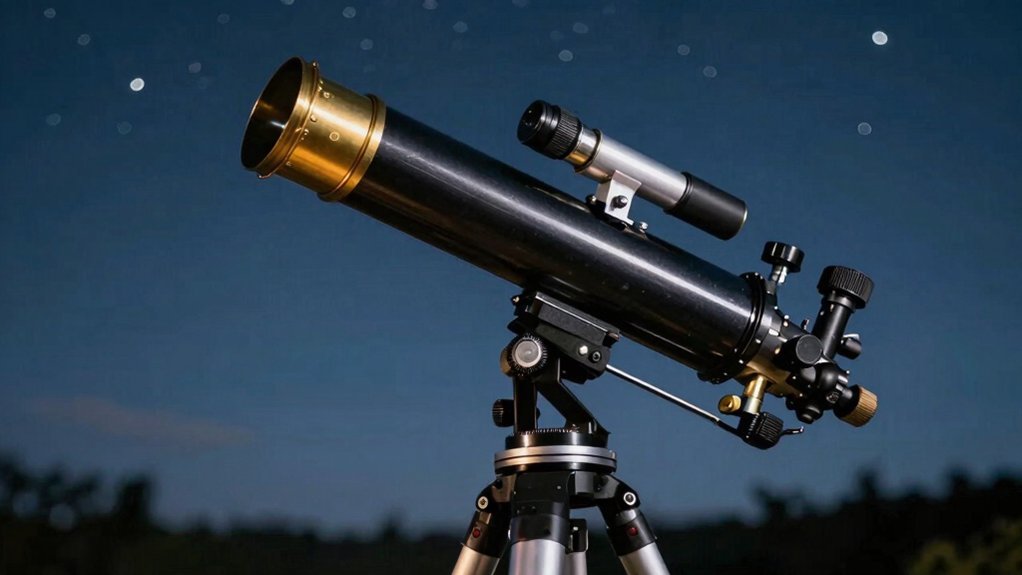
Now, here’s the thing: Uranus’ orbit proved it circled the Sun, not Earth. This revelation marked the first new planet identified in modern history. Its astronomical significance changed everything we knew about our cosmic neighborhood instantly. Telescopes achieve this by using optical lenses to gather and focus light, making faint objects like Uranus visible to the observer. For enthusiasts seeking similar deep-sky views, selecting equipment with high-quality optics is essential for maximizing clarity and light gathering power.
All right, so Herschel formally acknowledged it as a planet by 1783. You see, earlier observers missed its true nature completely. They just saw a dim star instead of a massive world.
Your takeaway? Telescopes finally let us expand beyond the classical five planets. Next, you might ask why naked-eye planets don’t count for this specific record. This discovery highlighted how revolutionary telescope technology allowed astronomers to finally see worlds that had remained hidden from human sight for millennia.
Why Naked-Eye Planets Exclude From This Record
Since you’re wondering why the five bright planets don’t hold this record, let’s clear that up immediately. Mercury, Venus, Mars, Jupiter, and Saturn boast naked eye visibility, so people saw them millennia ago. Ancient astronomers tracked these wandering stars long before telescopes even existed. You can’t claim a “first detection” for something everyone already knew.
Here’s the thing: real detection requires finding something genuinely new to human knowledge. The telescope didn’t reveal these five; it only sharpened our view of familiar friends. Uranus broke the barrier because no one spotted it without help. That specific moment of identification creates the actual historical milestone you are looking for today.
Obviously, seeing isn’t the same as scientifically detecting a new world. The record demands that telescopic observation revealed the planet’s true nature for the very first time. Now you understand why those bright dots don’t qualify for this specific title. Choosing the right telescope matters because different optical designs offer varying capabilities for spotting faint, distant objects like Uranus compared to bright planetary features. Expert guidance suggests that understanding optical designs is crucial for enthusiasts aiming to observe such distant celestial bodies. Selecting a device with sufficient light gathering power ensures you can detect faint, distant worlds that remain invisible to smaller instruments. Next, let’s explore how Herschel initially misidentified Uranus as a comet instead.
How Herschel Initially Misidentified Uranus as a Comet
Now, let’s tackle why Herschel called this new world a comet instead of a planet. You might wonder how such a huge mistake happened back in 1781. Honestly, nobody expected a seventh planet since everyone only knew six back then.
Herschel’s observations showed a faint disk moving slowly against the stars, which confused him greatly. He noted it lacked a tail yet still fit the era’s loose comet classification rules. Obviously, telescopic views of fuzzy, moving objects usually meant comets to astronomers of that time. Early refractors often suffered from chromatic aberration, which blurred the sharp edges needed to clearly distinguish a planetary disk from a cometary haze. The revolutionary design of his large reflecting telescope provided the light-gathering power necessary to detect such a distant object, even if its nature remained ambiguous.
You see, he even titled his Royal Society paper “Of a comet” because the data seemed clear. This initial label stuck simply because the object didn’t look like any known planet. His garden telescope revealed something strange, but context dictated his early conclusion entirely. Understanding the optical limitations of early instruments helps explain why distinguishing a distant planet from a comet was so difficult without modern clarity.
Which Observations Proved Uranus Was a Planet?
Two specific clues finally proved this wasn’t a comet. You’ll notice the round outline lacked any fuzzy tail entirely. Its steady celestial behavior simply didn’t match a typical icy visitor zooming by.
Now, watch how it moves slowly against those distant background stars. Repeated tracking over weeks revealed a path that curved gently, not sharply. This motion-based analysis suggested something far more stable than a fleeting comet.
Here’s the thing: Anders Johan Lexell’s orbital analysis showed a nearly circular route. You see, comets usually have long, stretched-out ellipses, but this object traveled differently. Its eighty-four-year period placed it way beyond Saturn, nineteen times Earth’s distance.
Other astronomers like Bode quickly confirmed these independent computations with their own telescopes. The broad scientific consensus formed within two years because the evidence was undeniable. You now understand exactly why scientists reclassified this faint disk as a true planet. Utilizing proper optical magnification allowed observers to distinguish the planetary disk from the point-like appearance of distant stars. Selecting the right telescope optics was crucial for early astronomers to resolve the disk shape that distinguished Uranus from a star. Different aperture sizes determine how much light a telescope gathers, which was essential for resolving such a faint, distant object clearly.
Why the Name Georgium Sidus Failed to Adopt
Although you might expect the finder to name the planet, William Herschel’s choice of “Georgium Sidus” actually caused a huge international headache. He honored King George III, but you can see why this sparked immediate cultural resistance across Europe. Astronomers hated breaking established naming conventions that demanded mythological figures instead of living rulers.
Johann Bode pushed hard for “Uranus,” matching the ancient Greek god pattern used by Mercury or Mars. You’d agree that honoring a sky god fits better than praising a British monarch on a star chart. Britain stubbornly kept using Herschel’s name until 1850, but the rest of the world moved on decades earlier.
This clash proved science needs global rules over national pride. Now you understand why we call it Uranus today. Ready to see how math later found Neptune? For those eager to continue their journey, mastering telescope basics is the next logical step in exploring the cosmos. Successful observation also requires understanding how optical clarity impacts your view of faint celestial objects. Just as selecting the right instrument matters, knowing how aperture size determines light gathering power is essential for spotting distant worlds.
How Mathematical Prediction Led to Neptune’s Discovery
Since Uranus kept missing its predicted spots, you probably wonder how astronomers identified the culprit without seeing it first. They didn’t guess; they used math. Urbain Le Verrier and John Couch Adams both performed complex mathematical calculations to pinpoint the invisible offender.
Here’s the thing: Uranus’s weird path signaled a gravitational perturbation from an unknown neighbor. You see, Newton’s laws demanded a cause for those orbital hiccups. Le Verrier sent his specific coordinates to Johann Galle in Berlin immediately.
Galle pointed his telescope at that exact spot on September 23, 1846. He located Neptune within just one degree of the prediction after only an hour! This triumph proved you could uncover worlds with pen and paper before ever looking through a lens. Math literally guided their eyes to the blue giant. Now you know calculation beat blind searching every time. Ready to explore how this changed astronomy forever? This milestone highlighted how revolutionary telescope technology combined with theory could unveil hidden cosmic giants. The success of this event cemented the status of the Berlin Observatory as a central hub for this new era of discovery. This achievement demonstrated that mathematical astronomy was just as powerful as optical instrumentation in expanding our understanding of the solar system.