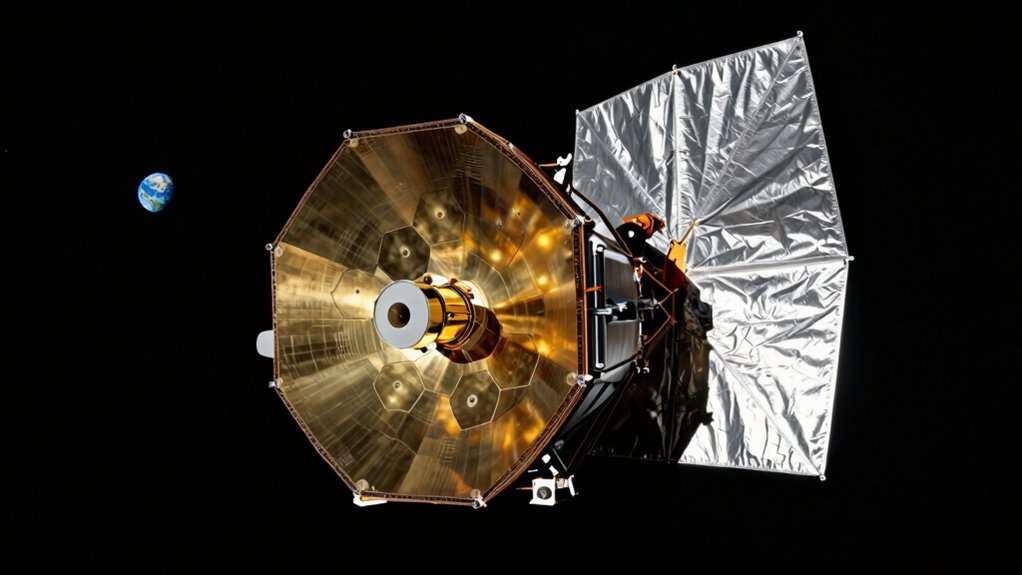
You’re wondering exactly what flaw blinded Hubble, and it boils down to a 1.3mm testing error that warped its primary mirror. Now, this tiny mistake caused spherical aberration, spreading 70% of light into fuzzy halos instead of sharp points. Obviously, the mirror’s edge was ground too flat, ruining those first famous photos. Here’s the thing: engineers fixed it with corrective optics, not a new mirror. You’ll see how they pulled off that miracle repair next.
What Was Hubble’s Spherical Aberration Flaw?
Spherical aberration sounds technical, but you’re really just asking why Hubble’s first pictures looked so blurry. You see, the primary mirror had a subtle shape error. Light hitting the outer edge focused at a different spot than light near the center. This mirror distortion created multiple focal points instead of one sharp image.
Now, imagine trying to read a book where every letter has a fuzzy halo. That’s exactly what happened to Hubble’s vision. The flaw reduced optical performance considerably, spreading 70% of light over 1.5 arcseconds. Obviously, this wasn’t the crisp view NASA promised you. Scientists spotted the identical blur pattern across different cameras quickly. They knew the main mirror was the culprit behind this mess.
Here’s the thing: the telescope still worked, just not as well as designed. You need to understand how a tiny testing error caused this huge problem next. The root cause was traced back to a null corrector device that was assembled incorrectly during the mirror’s manufacturing phase. This specific testing device was misaligned by 1.3 millimeters, leading to the mirror being ground to the wrong shape despite precise measurements. For telescope enthusiasts, understanding this history highlights why optical testing is the most critical step in building any high-performance instrument.
How a 1.3mm Testing Error Warped the Mirror
Now, imagine tracing a circle with a bent ruler. The machine polished the mirror perfectly flat on the edges, just not the right shape. You see, the outer edge became too flat by a huge margin. This specific offset created a template ten times worse than allowed tolerances.
All right, so the mirror reflects light to multiple focal points instead of one. You get a precise surface that is simply wrong. This single spacing mistake warped the entire primary mirror figure permanently. Obviously, no amount of focusing fixes a fundamentally flawed curve. Next, you need to understand why those first images looked so blurry. Unlike modern comparing telescopes which undergo rigorous verification to prevent such optical errors, Hubble’s flaw required a complex servicing mission to correct the spherical aberration. Achieving optical precision during manufacturing is critical because even microscopic deviations can render a telescope unable to resolve fine details in space. Just as observing conditions on Earth determine what a beginner can see in the night sky, the environment and setup of a telescope in space dictate its ability to capture clear images.
Why Did Hubble’s First Images Look So Blurry?
You’re wondering why those first Hubble photos looked so fuzzy despite being in space. The culprit was spherical aberration within the telescope optics. Light hitting the mirror’s edge focused differently than light from the center. Instead of one sharp point, stars became blurred disks.
Here’s the thing: both major cameras showed this same defect immediately. The primary mirror was simply too flat near its outer edge by a tiny margin. Yet, this small error ruined the overall image quality completely. You’d see a thin slab of focus rather than a crisp picture. Obviously, this internal blur defeated the advantage of being above Earth’s atmosphere. The flaw made many initial images nearly scientifically useless for detailed work. Even though some observations continued, the dream of perfect clarity vanished instantly. You now understand exactly why those famous pictures disappointed everyone initially. This specific distortion stemmed from a 2.2 micron error in the mirror curvature that shifted the focus point and hindered instrument performance. Understanding how light reflection works on curved surfaces reveals why such a minute deviation caused such catastrophic results for the entire optical system. Next, let’s reveal how engineers actually found this specific mirror mistake.
How Scientists Traced the Blur to the Primary Mirror
Pinpointing the culprit required you to look past the cameras themselves. You noticed both instruments showed identical blur, ruling out individual defects. Obviously, the shared optical path held the real answer.
Engineers ran deep mirror diagnostics and found spherical aberration ruining your view. Light rays missed the same focal point by a tiny margin. The outer edge sat 2.2 microns too flat, a huge error.
Your optical evaluation revealed a null corrector lens spaced wrong by 1.3 millimeters. This small mistake tricked polishers into grinding the perfect wrong shape. The mirror matched the flawed test, not the intended design.
You now understand how a washer-sized error blinded a giant telescope. The primary mirror’s incorrect curve caused every single blurry image you saw. Ready to see how engineers fixed this massive mistake? While comparing various telescope options helps stargazers avoid such issues, Hubble’s specific flaw stemmed from a manufacturing error rather than a design choice suited for different observers. Just as using the wrong cleaning products can damage optics, the incorrect testing equipment permanently altered Hubble’s primary mirror before it ever reached space. Unlike Hubble’s fixed hardware issues, beginners exploring the cosmos can often improve their view by simply seeking out dark skies to reduce light pollution.
How Corrective Optics Restored Hubble’s Vision
You might wonder how engineers fixed a flawed mirror they couldn’t replace. They didn’t swap the glass; instead, they installed corrective optics. Think of COSTAR as giant spectacles that redirected light perfectly.
Now, astronauts also swapped the main camera for WFPC2 during that 1993 mission. This new hardware contained its own built-in fixes for the blur. Obviously, these changes targeted specific instruments rather than the whole telescope structure.
Here’s the thing: image quality jumped from blurry halos to perfect focus instantly. You suddenly saw faint stars with clarity no ground telescope could match. The repair proved we could fix complex machines right in orbit. Understanding the differences between telescope types helps appreciate why Hubble’s specific optical design required such a unique in-space solution. Just as dark skies are essential for beginners to see faint objects clearly from Earth, Hubble required precise optical corrections to achieve its legendary clarity above the atmosphere. For enthusiasts planning their own observations, selecting the right aperture size is just as critical to gathering light as Hubble’s mirrors were to its initial success.