You’re wondering how a crude 3x spyglass suddenly became a 30x instrument that flipped the cosmos upside down, and it all starts with Galileo’s clever lens swap. He paired a convex objective with a concave eyepiece to bend light rays without crossing them, creating upright images you could actually recognize. This simple trick let you spot Jupiter’s moons and Venus’s phases, proving Earth isn’t the center of everything. Stick around to see exactly how he calculated that massive magnification boost.
How Galileo’s Telescope Design Differed From Predecessors
Although you might think Galileo invented the telescope, he actually refined a crude Dutch spyglass from 1608. You see, earlier models existed, but Galileo pushed magnification from a weak 3× up to an impressive 30×. This historical context matters because he didn’t change the basic principle, just the execution.
Here’s the thing: his optical refinement involved pairing a convex objective with a concave eyepiece perfectly. He placed the eyepiece before the focal point to create upright, virtual images for you. Unlike predecessors, his hollow tube design allowed systematic celestial observation rather than just casual terrestrial viewing. The timeline of this innovation began when he heard of the Dutch invention in 1608 and immediately set to work on his own version.
Obviously, trial-and-error spacing was essential since no diagrams guided his lens placement initially. You get a compact system that beats earlier spyglasses despite suffering from narrow fields of view. His specific adjustments turned a novelty into a serious scientific instrument for your own study. In this design, the concave eyepiece intercepts light rays before they converge to a focus, which prevents the image from inverting as it would in later telescope models.
Now you understand his unique improvements, so aren’t you curious how those specific lenses actually created upright images? Crucially, this setup relies on light refraction to bend rays through the glass elements and form the final image.
Why Did Convex and Concave Lenses Create Upright Images?
How exactly do those two different lenses keep your view upright? You might wonder why the sky doesn’t flip upside down. It all comes down to specific lens behavior and how light travels. Concave lenses spread rays out, so they never actually cross paths. Since the rays don’t intersect, your brain traces them back to an upright spot.
Convex lenses usually invert things, but not when objects sit close. If you place an object inside the focal point, the rays diverge again. This trick preserves the original image orientation without any flipping. Obviously, avoiding that ray crossover is the secret sauce here. For enthusiasts seeking clear views, mastering lens alignment ensures optimal performance without distortion.
You see a virtual picture because your eyes follow diverging lines backward. The top stays on top simply because the light paths never swap places. Understanding this difference helps you grasp why Galileo’s design worked so well for terrestrial viewing. Next, let’s explore how this unique arrangement forms those virtual images. Concave lenses create these upright views because they cause light to disperse outward rather than converge at a single point. This optical setup differs significantly from the Keplerian telescope design, which uses two convex lenses and produces an inverted image better suited for astronomy than terrestrial observation. Galileo’s revolutionary instrument relied on this specific combination to provide upright images that were essential for both celestial discovery and earthly observation.
How Did the Unique Lens Arrangement Form Virtual Images?
Since you’re wondering how those two lenses team up to create a virtual image, let’s break it down. The converging objective starts gathering light from distant stars immediately. It aims to form a real image, but it never gets the chance.
Here’s the thing: the diverging lens sits right inside that focal point. This placement turns the would-be real image into a virtual object instead. Obviously, the concave eyepiece intercepts those converging rays before they cross. It forces them to emerge parallel again, tricking your brain completely.
Now, your eye traces these parallel lines back to a source that isn’t there. You see an upright, magnified picture floating in space rather than on a screen. This clever setup keeps the whole telescope surprisingly short and manageable for you. The final image remains virtual because no light actually meets at that spot. This design relies on negative focal length to ensure the eyepiece diverges the light rays effectively. By avoiding the inversion typical of other optical systems, this configuration provides an upright image that is easier for terrestrial observation.
Ready to see exactly how much bigger things look through this unique design?
How to Calculate Magnification Using Objective and Eyepiece Focal Lengths
Two simple numbers reveal exactly how much bigger your view gets. You probably wonder how to turn those lens specs into actual power. Just grab the objective focal length and the eyepiece focal length. Divide the first number by the second one for your answer.
This quick magnification calculation gives you a clear ratio like 50x. A shorter eyepiece focal length instantly boosts your view considerably. Conversely, a longer telescope tube also increases power with the same glass. Obviously, mismatched units here will ruin your entire math problem instantly.
Keep both measurements in millimeters to guarantee your results stay accurate. You can even swap eyepieces to change power without buying new gear. Remember that huge numbers don’t always mean clearer images though. Aperture limits your useful view more than raw math ever could. Now you know exactly how to predict your telescope’s performance before looking. The tool divides focal lengths to determine the final magnification of celestial objects.
What Did Galileo’s Original Handheld Telescope Actually Look Like?
You’ve mastered the math, but you’re probably wondering what that 21x power actually looked like in Galileo’s hand. Imagine holding a long, narrow wooden tube made from joined strips rather than sleek metal. It felt crude yet functional, resembling an early spyglass more than a polished scientific device.
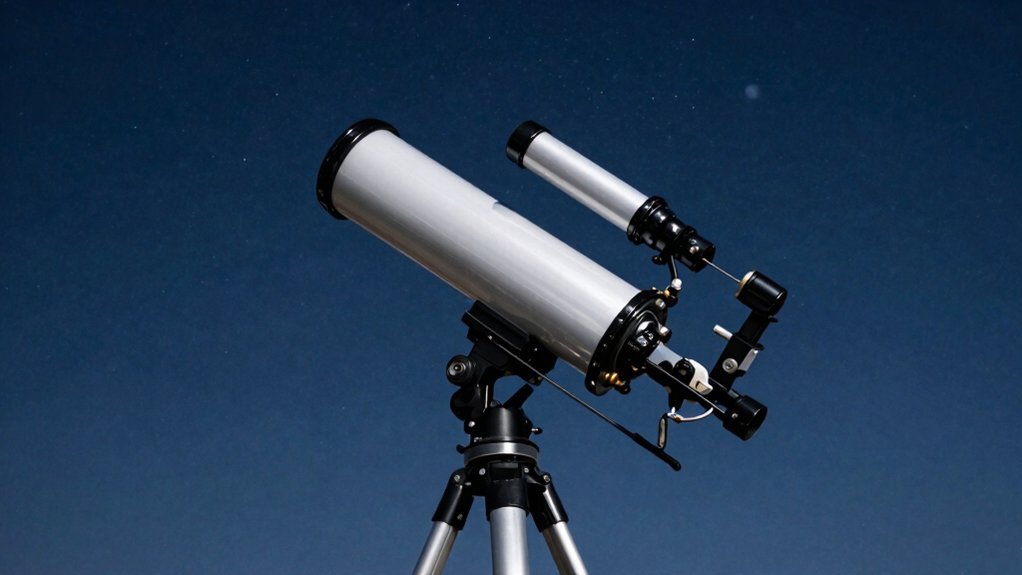
Now, peek inside to see the optical innovations driving its historical significance. A convex objective lens faced outward while a concave eyepiece sat in a small adjustable tube for focusing. This simple refracting system delivered an upright image through a narrow field of view. Unlike modern instruments that prioritize light gathering for deep-sky observation, Galileo’s design relied on high magnification to reveal details on the Moon and planets despite its limited aperture. In contrast, today’s astronomers often select specific telescope types based on whether they need wide fields for nebulae or high contrast for planetary surfaces.
You’d find the experience akin to looking through a small window at the end of a long straw. The 37 mm objective often stopped down to sharpen those blurry edges. Obviously, steady viewing required real effort given the awkward handheld design.
This utilitarian tube proved that groundbreaking revelations don’t need fancy packaging, establishing a revolutionary legacy that transformed astronomy forever. Next, let’s explore exactly what Galileo saw when he pointed this humble instrument skyward.
Which Celestial Discoveries Proved the Telescope’s Power?
When you point that crude tube skyward, you don’t just see brighter dots; you unveil a chaotic universe that defies ancient perfection. You spot rugged lunar craters and towering mountains, proving the Moon isn’t a smooth, perfect sphere. Obviously, this shatters the old belief in unchanging heavens immediately.
Next, you watch Venus cycle through full planetary phases, just like our own Moon. This geometry proves Venus orbits the Sun, not Earth, crushing the geocentric model. You also spot four tiny moons dancing around Jupiter, showing not everything circles us.
The Milky Way suddenly explodes into countless individual stars, expanding your view of the universe’s true scale. Even the Sun shows rotating spots, proving it changes too. These revelations didn’t just add details; they rewrote cosmic history forever. Your simple lens just toppled centuries of dogma in a single night. Now, you understand why this tool changed everything. What happens when we build something even stronger? While Galileo’s refractor started it all, modern stargazers must weigh optics and performance against cost to choose the right telescope for their specific needs. Unlike Galileo’s limited lens, today’s enthusiasts can select from various designs where choosing the right telescope ensures optimal views based on individual goals and budget. Understanding the fundamental difference between refractor and reflector designs is essential for selecting an instrument that matches your observational priorities.
How Does Galileo’s Refractor Compare to Today’s Astronomical Tools?
How exactly does that crude tube stack up against today’s giant light buckets? You quickly notice Galilean limitations when comparing his 3x magnification to modern advancements. His lenses created fuzzy images with colorful fringes, while today’s optics deliver razor-sharp clarity.
You see, his narrow field of view restricts sky observation considerably. Modern telescopes gather vastly more light, revealing fainter, deeper cosmic secrets. Adaptive optics now correct atmospheric blur, a feat his simple glass could never achieve. While Galileo relied on convex and concave lenses, modern stargazers often choose between refractor vs reflector designs to minimize optical errors and maximize light gathering.
Obviously, his design suits opera glasses better than professional research today. You rely on massive reflectors for precision imaging and spectroscopy now. The old spyglass started the journey, but current tools go infinitely further. You must also consider that choosing the right aperture size determines how much detail you can resolve in distant objects. Evaluating these factors helps you find your perfect stargazing match based on specific observing goals and budget constraints.
You now understand why astronomers swapped simple lenses for complex mirrors. Ready to explore how those mirrors actually collect starlight?