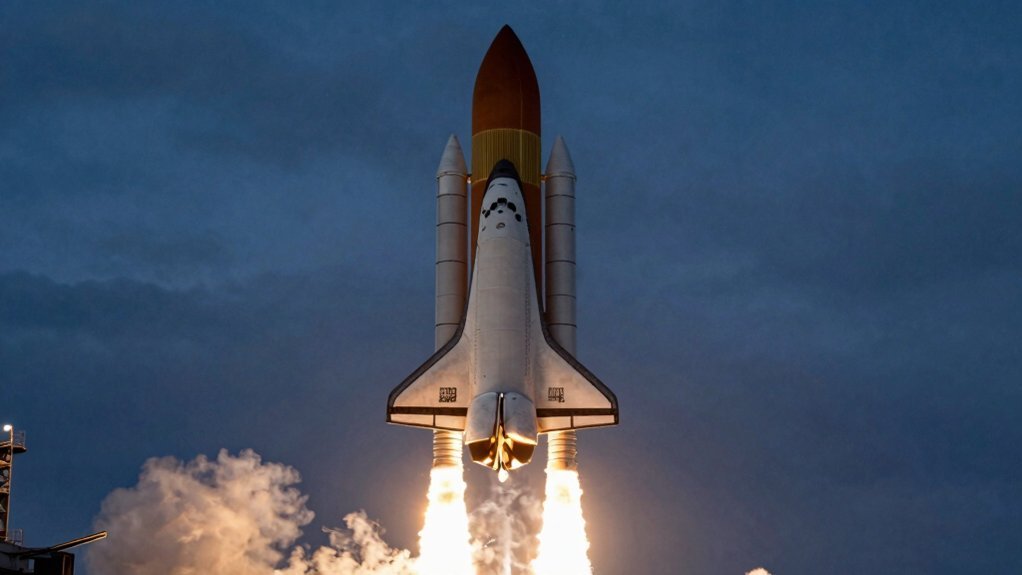
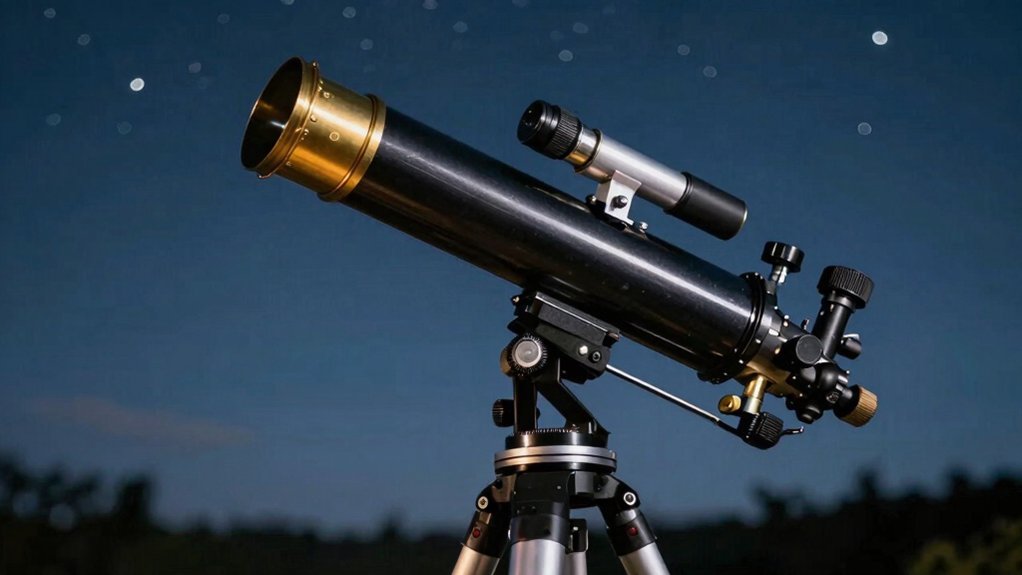
You’re wondering what the largest telescope is, and honestly, it depends on whether you mean current giants or future ones. Right now, the Gran Telescopio Canarias holds the title with its massive 10.4-meter segmented mirror scanning for black holes. Soon, Chile’s Extremely Large Telescope will dwarf it with a staggering 39-meter aperture to reveal exoplanets. Stick around to uncover exactly how these engineering marvels change everything we understand about the cosmos.
The Gran Telescopio Canarias: World’s Largest Operating Optical Telescope
All right, you’re probably wondering which telescope actually holds the title for biggest. It’s the Gran Telescopio Canarias, sitting high on La Palma. This Spanish-led giant boasts a massive 10.4-meter primary mirror made of 36 hexagonal segments.
You’ll find its location offers huge observational advantages due to exceptional climate and geography. Since 2007, it has scanned the skies for black holes and early galaxies. Its segmented design acts like four million human eyes working together perfectly. Understanding how light gathering power scales with aperture size explains why this massive instrument can detect such faint cosmic signals.
Telescope history marks its 2009 routine start as a major leap for optical astronomy. You get a light-collecting area nearing 76 square meters to spot incredibly faint objects. Obviously, this scale lets you see deeper into the universe than ever before.
Now you know exactly which instrument currently reigns supreme in optical power. Ready to see how space-based giants stack up against this ground-based monster?
While ground-based giants like this excel in sheer size, comparing telescope optics reveals that different designs offer unique advantages in performance and cost for every stargazer’s specific needs. Unlike these professional observatories, amateur astronomers often prioritize optical performance alongside budget constraints when selecting their first instrument.
How the James Webb Space Telescope Compares to Ground-Based Giants
Since you’re wondering how a space telescope stacks up against massive ground giants, you’ve hit on the perfect question. JWST advantages shine in infrared sensitivity, spotting faint, distant galaxies that Earth’s atmosphere blocks. Its cold, 6.5-meter mirror sees dust-hidden stars clearly.
Ground telescope benefits include larger mirrors and flexible upgrades for sharp, wide surveys. You get better spectroscopy at shorter wavelengths from Earth. These observational capabilities truly complement each other. By eliminating atmospheric distortion entirely, space-based instruments achieve superior angular resolution compared to even the largest terrestrial observatories without adaptive optics. This revolutionary shift allowed astronomers to peer back to the epoch of reionization with unprecedented clarity, revealing galaxies formed just after the Big Bang.
Think of them as complementing technologies driving new astronomical revelations. One peers through cosmic dust; the other scans vast skies quickly. You need both views to understand the universe fully.
Now you see why size isn’t the only factor. Choosing the right optical design ensures your specific research goals align with the instrument’s capabilities, whether targeting deep infrared fields or high-resolution visible light imaging. Which target would you study first with these powerful tools?
The Extremely Large Telescope: The Future of Optical Astronomy
When you wonder what comes next after JWST, you’re asking exactly the right question. The Extremely Large Telescope, built by ESO in Chile, answers that call directly. Its massive 39-meter primary mirror collects far more light than any current ground-based giant.
Now, imagine 798 hexagonal segments working together as one giant eye in the Atacama Desert. This design enables unprecedented clarity for your viewing pleasure. You’ll see images fifteen times sharper than Hubble thanks to its advanced adaptive optics system. Understanding how a primary mirror gathers light helps explain why this size difference is so critical for deep-space observation.
Here’s the thing: this telescope targets exoplanets, dark matter, and the universe’s first galaxies. Such power guarantees groundbreaking astronomical revelations within our lifetime. You can expect real answers about water on distant worlds soon.
Obviously, this giant changes everything we understand about visible and infrared astronomy. Get ready for a new era of cosmic understanding starting in the late 2020s. While the ELT dominates future ground-based observation, selecting the right instrument today still depends on comparing optics and performance to match your specific stargazing goals. Just as professional observatories prioritize light-gathering capacity, amateur astronomers must weigh aperture size against portability when choosing their own equipment.
When Will the Giant Magellan Telescope Begin Operations?
How soon will you actually see data from the Giant Magellan Telescope? You might feel confused by shifting dates, but that uncertainty is normal. The operation timeline currently targets initial science in the late 2020s using just four mirrors. Full capacity with all seven mirrors won’t happen until the early 2030s.
Here’s the thing: mirror assembly drives this entire schedule more than anything else. You’ll see early results once engineers finish installing those first few giant segments. Obviously, funding delays have pushed previous estimates from 2021 to today’s later targets.
Don’t expect everything at once; they’ll add mirrors gradually as construction progresses. Your wait for complete data ends around 2030, though partial views arrive sooner. This staged approach lets astronomers start learning while builders keep working nearby. Ready to explore why they build it this way? Once the optics are operational, astronomers must eventually learn safely clean telescope optics to maintain image quality without causing damage. Unlike smaller instruments where choosing the right telescope depends on personal budget and goals, a facility of this magnitude requires decades of coordinated engineering before it can serve the scientific community. Just as amateur stargazers rely on stable telescope mounts to prevent shaky images, the Giant Magellan Telescope demands an incredibly rigid structure to support its massive weight and ensure precise alignment.
Why Segmented Mirrors Enable Massive Telescope Apertures
You’re probably wondering why builders don’t just cast one giant mirror for these massive scopes. Honestly, a single piece over eight meters becomes impossibly heavy and expensive to support. You’d struggle to transport or even manufacture such a fragile, massive slab without cracking it.
Here’s the thing: segmented mirrors solve this by splitting the primary surface into smaller, manageable hexagons. You get huge light-gathering power without the nightmare of a monolithic structure. Engineers actively align these pieces using actuators to maintain perfect optical performance despite gaps. This engineering breakthrough was pivotal in the legacy of revolutionary telescopes that redefined our ability to observe the cosmos.
Now, think of it like a tiled floor acting as one smooth sheet. This approach lets you build apertures far larger than any rocket could carry whole. You also reduce risk since damaging one segment doesn’t ruin the entire telescope. Ultimately, segmentation enables sizes previously impossible for humanity to construct or launch. Ready to see how this compares to radio dishes? While monolithic designs struggle with weight, choosing the right telescope often depends on whether you prioritize portability or maximum light collection for your specific stargazing needs. Understanding the optical resolution limits is also crucial when evaluating why larger apertures provide sharper images of distant celestial objects.
Key Differences Between Optical and Radio Telescope Sizes
You might wonder why a 10-meter optical giant doesn’t beat a massive radio dish in every size chart. Here’s the thing: telescope measurements depend entirely on what light you catch. Optical scopes count mirror diameter to gather visible photons, while radio dishes measure huge collecting areas for long waves.
Obviously, comparing them directly confuses everyone. A 100-meter radio dish isn’t sharper than a 10-meter optical mirror because wavelengths differ wildly. Your observational capabilities hinge on matching the tool to the signal, not just chasing big numbers. Radio arrays span miles yet lack the fine detail of smaller optical giants. While optical telescopes like the Grand Telescopio Canarias utilize segmented mirrors to reach apertures of 10.4 meters, radio instruments achieve vast sizes through different engineering principles suited to their specific wavelengths. When selecting equipment, understanding how optics and performance vary between these technologies ensures you choose the right instrument for your specific stargazing goals. Crucially, the angular resolution of any telescope is fundamentally limited by the wavelength of light it observes relative to its aperture size. Mastering the skies requires recognizing that light gathering power is the primary function of aperture size regardless of the telescope type.
Next-Generation Projects Set to Redefine Telescope Records
Three massive ground-based giants are about to shatter every optical size record you’ve seen. The ELT boasts a 39.3-meter mirror made of 798 hexagonal segments, while TMT and GMT follow closely. You’ll witness unprecedented next generation observations as these behemoths seek faint cosmic signals.
Now, look upward at space concepts like HabEx and the Roman Telescope launching in 2026. Roman offers a field of view 100 times larger than Hubble’s, revolutionizing how you survey the sky. These projects drastically boost telescope sensitivity, letting you spot exoplanets or dark energy details previously hidden.
Obviously, bigger mirrors mean clearer pictures, but fluidic tech might soon push space apertures to 50 meters. Imagine a liquid mirror gathering light far beyond today’s limits while you plan your own stargazing sessions. The future promises sharper vision for everyone exploring the cosmos tonight, especially when utilizing adaptive optics to correct atmospheric distortion in real time.
You now understand which projects will redefine our cosmic view next. Which specific revelation excites you most? As you prepare for these advancements, consulting expert-backed guidance ensures you select the right equipment to maximize your own viewing experience today.