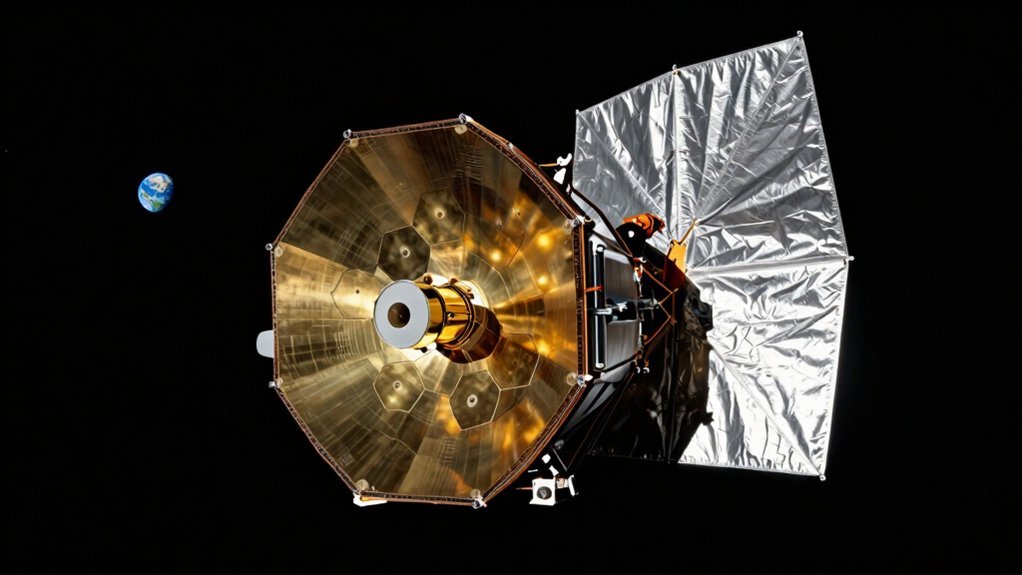
You wondered what Webb saw that the Event Horizon Telescope missed. Webb didn’t capture a shadow; it tracked chaotic infrared flares lasting 100 minutes near Sagittarius A*. You’ll find 500,000 stars in Sagittarius C, where magnetic threads organize massive star formation. These observations reveal how magnetic reconnection triggers sudden brightness spikes tenfold in just ten minutes. Now you grasp the dynamic environment our black hole creates. Keep exploring to see how these clues reshape galaxy evolution models.
What Did Webb Actually See Near the Black Hole?
Confusion about what Webb actually saw is totally normal. You didn’t see a black hole silhouette but rather infrared light from its chaotic environment. Webb captured a point of light at 2.1 and 4.8 microns that brightened randomly.
Now, understand these infrared observations revealed constant flaring activity over a full year. You witnessed unpredictable bursts showing the region is far more active than expected. Scientists link small flickers to turbulence and larger flares to magnetic field collisions.
Here’s the thing: you observed multiple disturbance scales driving these complex black hole dynamics. The data show hot gas and dust creating a time-lapse of variability near the center. Obviously, the physical processes remain not fully understood despite this detailed glimpse.
You now know Webb tracked rapid brightness changes through dust that blocks visible light. This clarity on the accretion environment sets the stage for counting nearby stars next. Since infrared waves can penetrate cosmic dust better than visible light, this capability relies on wavelength selection to reveal hidden celestial structures. Just as choosing the right optics is critical for stargazers, selecting specific infrared bands allows astronomers to peer through obscuring material using optical performance to maximize image clarity.
How Many Stars Did Webb Find in Sagittarius C?
You’re probably wondering exactly how many stars Webb spotted in that crowded patch of sky. The telescope revealed an estimated 500,000 stars within the full image field of Sagittarius C. This massive star count covers a region spanning roughly 50 light-years near our galaxy’s center.
Now, look closer at the bright clusters where active star formation truly shines. Webb identified two huge protostars, each weighing over 20 times our sun’s mass. These giants power bright outflows while hidden deep inside dense gas and dust clouds. To get the clearest view of such distant objects, enthusiasts know that choosing a telescope with excellent light gathering capability is essential for revealing faint details hidden in the cosmic dark. Selecting a model with the appropriate aperture size ensures you can collect enough photons to visualize these faint stellar nurseries effectively.
Obviously, seeing half a million stars changes how you view this chaotic neighborhood. You now understand why astronomers call this area a major factory for massive new suns. The data proves extreme environments still birth heavy stars despite strong magnetic forces working against them.
To capture such detail in crowded fields, the telescope relies on angular resolution to distinguish individual points of light that would otherwise blur together.
Next, you might ask why the central black hole flares so constantly in infrared light.
Why Does Sagittarius A* Flare Constantly in Infrared?
Obviously, this isn’t a steady beam. It’s a chaotic mix of background glow and sudden hotspots. Flares last roughly 100 minutes, brightening tenfold in just ten.
Here’s the thing: turbulence keeps electrons accelerating continuously. Small flickers mean minor flow shifts, while big bursts signal violent magnetic reconnection events nearby.
You’re watching a compact region churn with energy. The signal changes because the plasma never settles down for long.
Understanding how light gathering works reveals why detecting these faint infrared shifts requires such advanced optical systems. For enthusiasts observing similar dynamic celestial events, maximizing aperture size is crucial to capturing sufficient detail in low-light conditions. Just as beginner astronomers need clear skies to reduce interference, scientists require precise data to distinguish these flares from the background glow.
Ready to explore what actually triggers these massive eruptions next?
What Triggers the Massive Flares Around the Black Hole?
You’ve seen the chaotic flickers, but what actually flips the switch for those massive eruptions? Scientists debate several flare mechanisms driving these intense bursts near Sagittarius A*.
Magnetic disruptions often top the list, where colliding field lines snap and release huge energy instantly. Turbulence effects also compress hot plasma, creating smaller, frequent sparks within the swirling accretion disk. Sometimes, sudden material infall from passing stars feeds the fire, spiking brightness dramatically.
Rare tidal disruptions might tear asteroids apart, generating extreme X-ray spikes before debris vanishes forever. Observational challenges remain since distinguishing these triggers requires incredibly precise, rapid data collection across multiple wavelengths. These eruptions are driven by magnetic storms in hot turbulent gas that produce the detected flares. Mastering the basics of data analysis allows researchers to filter out noise and identify these fleeting signals with greater confidence.
You’re realizing multiple causes likely exist rather than one single culprit for every bright flash. Understanding these distinct triggers helps astronomers build better models of our galaxy’s hungry heart. Next, let’s explore how invisible magnetic filaments shape the stars born nearby.
How Do Magnetic Filaments Affect Star Formation?
How exactly do invisible magnetic threads dictate where new stars ignite? You might wonder why gas doesn’t just collapse everywhere. Strong magnetic influences confine plasma into tight filaments, organizing chaotic clouds into structured channels. These threads act like cosmic rails, guiding material flow while resisting gravity’s pull.
Now, consider how filament dynamics change based on orientation. Fields parallel to a filament stabilize it, reducing fragmentation into small stars. Perpendicular fields often slow global collapse, delaying star birth considerably. You see, magnetism regulates rather than blocks formation entirely.
Here’s the thing: stronger fields create broader networks but limit dense core hubs. This control decides if you get many tiny stars or fewer massive ones. Webb data confirms these forces suppress collapse even on small scales near Sagittarius C.
Ultimately, magnetic fields delay and redirect where clusters eventually form. Just as choosing wisely depends on understanding optical limitations, interpreting these cosmic structures requires recognizing how specific forces shape the data we observe. Mastering your first web page requires similar attention to structural details before publishing content. Much like analyzing realistic price ranges helps buyers navigate costs, understanding these magnetic constraints clarifies why star formation varies across different galactic regions. Next, you’ll want to see how Webb complements other telescopes.
How Does Webb Complement the Event Horizon Telescope?
While the Event Horizon Telescope snaps the black hole’s shadow, you might wonder how Webb fits into that picture. Obviously, they don’t do the same job. Webb delivers vital infrared insights that radio waves simply miss, revealing hidden dust and gas.
Here’s the thing: timing synergy makes this pairing powerful. You see, Sagittarius A* flares unpredictably, blurring radio images. Webb tracks these brightness spikes continuously from space. This data helps scientists separate real structure from temporary glitches during reconstruction.
Think of it like fixing a blurry photo using a timestamped log of movements. Webb doesn’t image the event horizon itself, but it cleans up the EHT’s view markedly. You get a sharper, more accurate model of the chaotic environment. This collaboration answers different questions about the same mysterious object. Now you understand why both telescopes are essential. Ready to explore what those specific flares reveal?
What Do These Flares Tell Us About Galaxy Evolution?
Now, consider the flare significance regarding galaxy evolution. Magnetic reconnection drives bright eruptions daily, injecting massive energy into the inner region. This process regulates nearby matter just like a cosmic thermostat controlling temperature.
Here’s the thing: black hole dynamics in our quiet Milky Way mirror those in distant quasars. JWST’s mid-infrared data traces electron behavior, connecting small flickers to huge galactic changes. You now understand how these outbursts influence broader galactic dynamics and evolution across the universe. Following a practical step-by-step walkthrough helps beginners grasp these complex astronomical concepts correctly the first time. Mastering telescope alignment ensures observers can accurately track these rapid fluctuations without losing critical data during observation sessions.