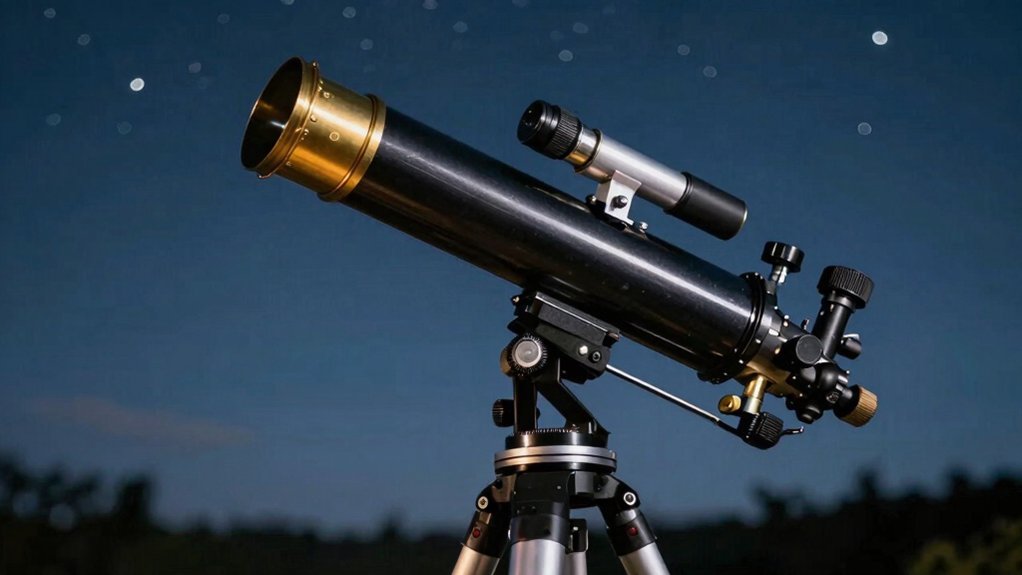
You’re wondering why binoculars fail on distant details, right? A spotting scope is fundamentally a compact telescope giving you 20x to 60x magnification for sharp land views. Obviously, you’ll need a tripod since handholding blurs everything at that power. Unlike astronomical telescopes, these show images right-side up for tracking wildlife easily. Now you know the basics, but choosing the right eyepiece changes everything. Keep exploring to find your perfect match.
What Is a Spotting Scope?
Confusion between binoculars and telescopes stops many beginners cold. You’re wondering where this compact optic fits in your gear. Think of it as a small, portable telescope built specifically for land. Unlike astronomical scopes, you use this monocular device for daytime viewing. It delivers high magnification, typically ranging from 20x up to 60x.
Now, consider its unique features like zoom eyepieces and tripod mounts. These elements stabilize your view when tracking distant wildlife or targets. You need that stability because shake worsens notably at higher powers. The design bridges the gap between handheld binoculars and large telescopes perfectly. Crucially, most spotting scopes utilize refractive optics to bend light through lenses for sharp, terrestrial images. Expert guides recommend checking the field of view to ensure you can track moving subjects effectively without losing context.
All right, let’s look at practical applications like hunting, birding, and shooting. You verify shot placement or spot game far beyond normal vision range. This tool gives you clearer detail than ordinary binoculars ever could. You now understand it is fundamentally a ground-use telescope for precision. Ready to see who relies on these powerful optics most? Crucially, the optical system relies on light gathering to produce bright, detailed images even at extreme distances.
Who Uses Spotting Scopes Most?
So, who actually relies on these powerful optics the most? You’ll find birdwatchers scanning shorelines at 40x magnification daily. They use angled scopes to spot distant plumage that binoculars miss. Applying solid birdwatching tips helps you identify species without disturbing them.
Hunters also depend on these tools for effective field work. You need high magnification to assess herds from ridges safely. Integrating specific hunting strategies lets you confirm shot placement or read bullet holes. Stability matters immensely when you are tracking game in open terrain.
Target shooters and law enforcement officers utilize scopes for precision too. Marksmen score distant targets while police inspect suspicious packages securely. Naturalists simply enjoy viewing wildlife details during casual camping trips. Obviously, anyone needing clear long-range vision benefits from this gear. Unlike astronomy which requires dark sky conditions to reveal faint celestial objects, spotting scopes excel in daylight terrestrial observation. These instruments typically feature a straight or angled eyepiece design to accommodate different viewing positions in the field.
You now see which groups maximize these optical advantages. Consider your own outdoor needs before choosing a model. While modern users rely on portable gear, the history of telescopes reveals how pivotal events in optical development enabled today’s high-magnification capabilities.
Spotting Scopes vs. Astronomical Telescopes
That age-old question about swapping gear for stargazing pops up often. You wonder if your birding scope works for planets. Obviously, intended use drives the real difference here. Spotting scopes excel at terrestrial viewing like hunting or surveillance. Astronomical telescopes target faint stars and distant galaxies instead.
Now, consider spotting scopes advantages regarding portability and ease. They stay lighter and simpler for quick field setup. Conversely, astronomical telescopes disadvantages include heavy bulk and complex assembly. You struggle to transport large tubes for casual looks. Telescopes also offer narrow fields, making moving targets hard. Effective telescope use requires understanding that optical resolution determines the clarity of fine details visible at long distances.
Spotting scopes deliver wide views perfect for landscapes and animals. Telescopes gather more light but demand steady, dark skies. Don’t force a square peg into a round hole. Choose the tool matching your specific viewing environment today. Crucially, spotting scopes utilize erect images to ensure objects appear right-side up for terrestrial observation, whereas astronomical telescopes often present inverted views that are irrelevant for deep-sky study. When evaluating your options side by side, remember that optical performance varies significantly between these tools based on their specific design goals for terrestrial versus celestial observation.
Choosing the Right Magnification and Zoom
You’ve picked your scope type, but now you’re staring at magnification numbers wondering what they actually mean. Don’t assume higher power always equals better views. Excessive magnification often makes images dimmer and blurrier when optics can’t support it.
Here’s the thing: useful magnification limits depend heavily on your aperture size. A common rule suggests capping power at fifty times your aperture in inches. Daytime viewing usually stays under sixty times for sharpest clarity.
Your eyepiece selection dictates flexibility here. Shorter focal lengths create higher power, while longer ones offer wider fields. Consider a zoom eyepiece to swap magnifications instantly without changing glass. One quality optic beats many cheap ones every time. Expert guides recommend prioritizing optical clarity over raw power to ensure crisp, detailed observations even at lower magnifications.
Start with moderate power around fifty times for balanced detail. Remember, atmospheric conditions often dictate your real-world maximum more than specs do. Understanding how optics and performance interact ensures you select a telescope that truly suits your specific stargazing needs. Now, how will you keep that steady image stable?
Why You Need a Tripod for Stability
Since even tiny hand tremors turn into violent shaking at 20x magnification, you can’t hold a spotting scope steady by hand. You need a solid base to see anything clearly.
Here’s the thing: stability importance cannot be overstated when viewing distant wildlife or stars. A tripod eliminates blur caused by wind or your own breathing. Obviously, shaky images frustrate you and ruin fine detail observation.
Now, consider the real tripod benefits beyond just stopping shakes. Adjustable legs let you find comfortable heights on uneven ground. Heavy tripods dampen vibrations better than light ones, keeping your view sharp. Secure mounting also protects your expensive optics from accidental drops.
You’ll notice focusing becomes effortless once vibration disappears completely. Proper setup on firm ground guarantees maximum steadiness every single time. Don’t skip this essential gear if you want usable high-power views. Just as gentle methods are required to clean telescope optics without causing damage, proper support is essential to maintain their alignment and performance. Selecting a sturdy tripod ensures your equipment remains stable even in challenging outdoor conditions. Understanding the impact of light pollution is also crucial, as artificial skyglow can significantly reduce the visibility of faint celestial objects even when your gear is perfectly stable. Next, you must decide between straight or angled eyepieces for comfort.
Straight or Angled Eyepiece: Which to Pick?
How do you pick between straight and angled eyepieces when both look so similar? You might think one offers better images, but optical performance stays identical across both styles. The real difference lies in eyepiece ergonomics and how you physically interact with the scope during use.
Straight scopes let you point directly at your subject, making rapid target acquisition much easier for tracking moving birds. However, angled models often save your neck during long sessions since you can view comfortably from various heights without adjusting the tripod. Obviously, straight designs need taller tripods to reach your eye level, while angled ones work well with shorter, lighter stands. Notably, the price remains consistent for the same model regardless of whether you choose a straight or angled design. This ergonomic choice is just as critical as selecting the right optical design for your specific astronomy goals. Just as clear viewing conditions are essential for spotting faint celestial objects, the right eyepiece angle ensures you can maintain comfort while waiting for the perfect moment to observe. Different telescope types offer unique advantages that align with specific viewing environments and user preferences.
Choose straight for quick aiming or vehicle mounts, but pick angled for shared use and looking up at cliffs. Your specific viewing habits should drive this final decision before you mount anything.
Is a Spotting Scope Right for You?
Now that you’ve sorted out the eyepiece style, you’re probably wondering if you even need a spotting scope at all.
If you birdwatch across vast lakes or hunt from a fixed blind, this tool delivers unmatched clarity. You gain huge features benefits like 45x magnification that binoculars simply cannot match for distant, static subjects.
However, you must mount it on a tripod since handheld use shakes too much for clear viewing. It isn’t ideal for scanning fast-moving targets or hiking light, so consider your specific needs carefully first.
You also need basic maintenance tips to keep lenses clean and dry after every muddy outdoor adventure. Entry models start around $200, making this a serious investment for dedicated observers only. Crafting a stable foundation with the right tripod ensures your view remains steady even in windy conditions.
Does your hobby demand seeing fine details from far away while staying perfectly still? If yes, this scope fits your routine perfectly.
For those prioritizing optical precision over portability, understanding angular magnification helps clarify why these instruments excel at resolving distant static subjects compared to standard binoculars.
Successful observation also relies on choosing the right optical coatings to maximize light transmission and image brightness in low-light conditions.