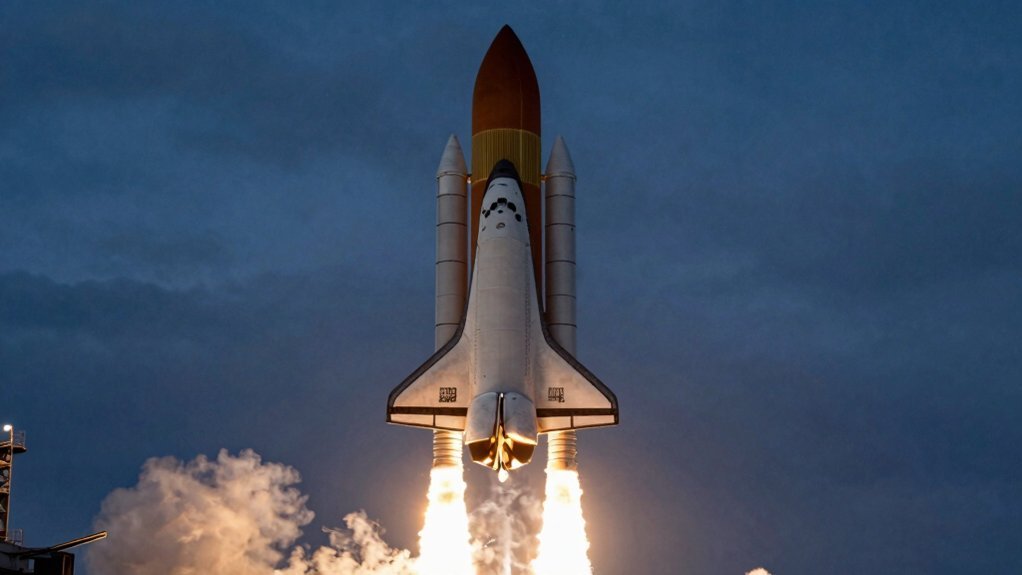
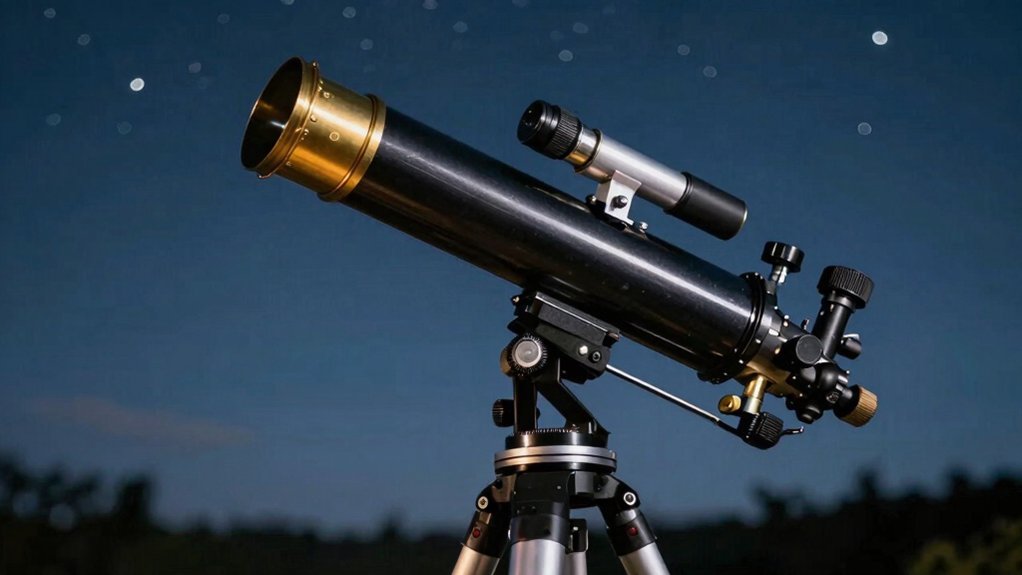
You’re wondering what a telescope actually is and why it matters in history. It’s an instrument that gathers light far beyond your eye’s limit, using lenses or mirrors to focus images. Hans Lippershey filed the first patent in 1608, but Galileo truly changed your worldview by proving Earth isn’t the center. Obviously, these tools evolved from simple glass tubes to complex space observatories capturing invisible light. Stick around to see how optical flaws drove centuries of brilliant innovation.
What Is a Telescope and How Does It Work?
Wondering what a telescope actually is and how it pulls distant stars closer? You’re asking the perfect question because understanding this changes everything. A telescope acts as an afocal converter, making infinity look like infinity again. It gathers far more light than your eye ever could alone.
Here’s the thing: telescope mechanics rely on bending or reflecting those parallel rays. The objective lens or mirror concentrates incoming light into a single focal point. This process of light collection makes faint objects suddenly appear bright and clear. Your eyepiece then magnifies that focused image specifically for your viewing pleasure.
Obviously, bigger apertures collect more photons, revealing incredible detail you’d otherwise miss. Refractors use lenses while reflectors bounce light off curved mirrors effectively. Both designs aim to increase the angle entering your eye greatly. Now you know exactly how these instruments bridge the vast cosmic distance. Ready to explore who first built such amazing devices? The fundamental limit of what you can see is determined by the aperture size which dictates both light gathering power and resolution. Selecting the correct magnification level ensures that the image remains bright and sharp rather than becoming dim and blurry. For optimal viewing conditions, enthusiasts should always allow their equipment to undergo thermal equilibrium with the outside air to prevent internal air currents from distorting the image.
Who Invented the First Telescope in History?
So, who actually built that first glass tube pointing at the stars? You probably assume one genius did it alone, but history disagrees. Hans Lippershey filed the earliest known patent in 1608, claiming he could see distant things clearly.
Here’s the thing: officials denied Lippershey’s patents because other Dutch makers already knew the trick. Jacob Metius applied too, proving these early developments happened simultaneously across the Netherlands. You can’t pinpoint a single inventor with absolute certainty today. These early devices utilized a convex objective lens paired with a concave eyepiece to magnify distant objects, a design distinct from later astronomical improvements.
Obviously, Galileo didn’t invent it either; he just improved the Dutch design later. He made it famous by studying stars, not by creating the original device. The real story involves shared lens-making skills spreading quickly through one specific region.
You should remember Lippershey holds the strongest claim simply due to his surviving 1608 paperwork. This pivotal moment marked the beginning of revolutionary telescope astronomy that would forever change how humanity views the cosmos. The rapid spread of these optical instruments across Europe laid the foundation for modern astronomy by enabling unprecedented celestial observations. Now that you know the messy origin, aren’t you curious how those first lenses actually worked?
How Do Refractor and Reflector Telescopes Differ?
How exactly do these two telescope types split the light differently? You see, their optical design dictates everything. Refractors use lenses to bend light directly, while reflectors bounce it off mirrors. This fundamental difference shapes your entire experience.
Refractor advantages include sharp image quality without central obstruction. However, a cost comparison shows large lenses get expensive fast. Reflectors offer bigger apertures cheaply but bring maintenance challenges like collimation. You must align those mirrors often. Also, reflector disadvantages include diffraction spikes from the secondary mirror support. Different telescope mounts provide the stability needed to track celestial objects smoothly across the sky, which is crucial for both visual observation and astrophotography.
Your light path differs too; refractors stay straight, reflectors fold. Observing strengths vary by target. Pick refractors for crisp planets. Choose reflectors for faint deep-sky objects. Obviously, your budget and patience matter most here. Which optical path suits your specific viewing goals best? Understanding optical design principles is essential for selecting the right instrument for your astronomical interests. For those prioritizing portability and ease of setup, compact travel telescopes often provide the best balance between performance and convenience.
Why Did Galileo’s Telescope Change Our Worldview?
Although you might think telescopes just magnify distant stars, Galileo’s device actually shattered ancient beliefs about your place in the universe. You saw Jupiter’s moons orbiting a planet, proving Earth isn’t the sole center of everything. This observational revolution turned the heliocentric paradigm from math into visible fact. In 1610, his meticulous records of Jupiter’s moons provided the first direct evidence that heavenly bodies could orbit something other than Earth.
Now, look at the Moon’s rough surface or the Sun’s changing spots. These flaws destroyed the idea of perfect, unchangeable heavens forever. Galileo’s influence forced you to accept cosmic humility, realizing Earth is just one ordinary planet. The Milky Way revealed countless hidden stars, expanding your known universe immensely. The revolutionary design of the optical telescope enabled these groundbreaking discoveries by gathering more light than the human eye alone. Modern instruments still rely on this fundamental principle of light gathering power to reveal faint objects invisible to earlier observers. This legacy of scientific inquiry continues to drive astronomers to challenge established dogmas with empirical data.
Science shifted from trusting old traditions to demanding fresh, hard evidence today. You now understand that physical laws govern both Earth and the distant stars equally. This massive worldview shift started with one simple lens pointing skyward. Ready to see how those early optical flaws drove future innovation?
How Did Optical Flaws Drive Telescope Innovation?
You’re probably wondering why early telescopes looked so blurry even with powerful lenses. Spherical aberration scattered light because edges focused differently than centers, ruining sharpness. Hubble’s mirror suffered this badly, with errors ten times larger than allowed tolerances.
Chromatic aberration then split colors in refractors, creating fuzzy rainbow fringes around stars. You needed achromatic optics to force those wavelengths into a single focus point. Coma distorted off-axis views into comet shapes, demanding new correctors for wide fields.
Field curvature bent images onto curves, clashing with flat camera sensors you use today. Engineers developed field flatteners to fix this mismatch for crisp edge-to-edge photos. Obviously, these flaws drove every major shift in optical design history.
Aberration correction became the core goal, turning defects into innovation drivers. Now you see how imperfections forced smarter, sharper telescope evolution. Mastering these optical basics ensures you understand the foundation before selecting equipment. When selecting equipment, understanding how optical performance varies across different telescope types helps stargazers match the right instrument to their specific viewing needs and budget. Different designs like reflectors and refractors offer unique advantages in light gathering that directly impact what celestial objects you can observe clearly.
How Did Telescopes Expand Beyond Visible Light?
Since visible light covers just a tiny slice of the spectrum, you’re missing most of the universe’s story if you stop there. You need to explore the entire electromagnetic spectrum to catch every cosmic signal lurking in space. Different wavelengths reveal unique physics that optical lenses simply cannot show you.
Now, infrared telescopes let you peer through thick dust clouds to see newborn stars. Ultraviolet instruments track hot, young stars while X-rays expose violent black hole jets. Earth’s atmosphere blocks many of these rays, so scientists launch specialized telescopes into space.
You realize single detectors can’t capture everything, so astronomers built specific tools for each band. This shift reveals hidden structures like cold gas or million-degree plasma invisible to your eyes. Obviously, seeing the full picture requires looking beyond what human vision allows. Understanding electromagnetic radiation types is essential because each band interacts differently with matter, requiring distinct mirror coatings and detector technologies to function effectively. Selecting the right telescope aperture ensures your instrument gathers enough light to detect these faint, non-visible signals effectively. Your next step involves understanding why these tools matter culturally today.
Why Do Telescopes Remain Culturally Significant Today?
That shiny tube in your backyard isn’t just glass; it’s a cultural icon representing our deepest curiosity. You see cultural symbolism everywhere, from memes to music, because telescopes turn abstract cosmic questions into visible evidence. They aren’t just toys; they function as powerful educational tools that make astronomy accessible to students globally.
Now, consider the massive billions governments spend on orbiting scopes, signaling immense scientific prestige and national commitment to revelation. You join a long lineage of amateur participation, linking your backyard stargazing to centuries of shared human exploration. This accessibility keeps the telescope a shared public object rather than an elite device reserved for few. Modern enthusiasts often prioritize optical quality to ensure crisp views, bridging the gap between historical discovery and current observational standards.
Artistic influence flows freely as stunning images inspire literature, philosophy, and modern storytelling about our place in space. Public engagement thrives because observatories use these instruments to connect audiences directly with real-time cosmic revelations. You hold a piece of history that still drives innovation today. Understanding how light gathering power works allows you to appreciate why larger apertures reveal fainter details, deepening your connection to the cosmos. Mastering the basics ensures you can align your finder correctly, helping beginners get it right the first time. What will you explore next?