You probably expect a giant glowing ball, but stars stay tiny points even in powerful scopes. Their immense distance shrinks them to unresolvable dots, unlike nearby planets that show disks. You’ll see colors like blue or red if the star is bright enough for your eyes to detect. Larger apertures gather more light, making faint stars pop without enlarging their size. Keep exploring to uncover why some stars reveal hidden surface details.
Why Do Stars Look Like Tiny Points of Light?
Every star you see is a giant, yet they all look like tiny dots. You wonder why these massive suns shrink into mere specks in your sky. Distance crushes their apparent size down to fractions of an arcsecond. Your eye simply cannot resolve such fine detail at those light-years away.
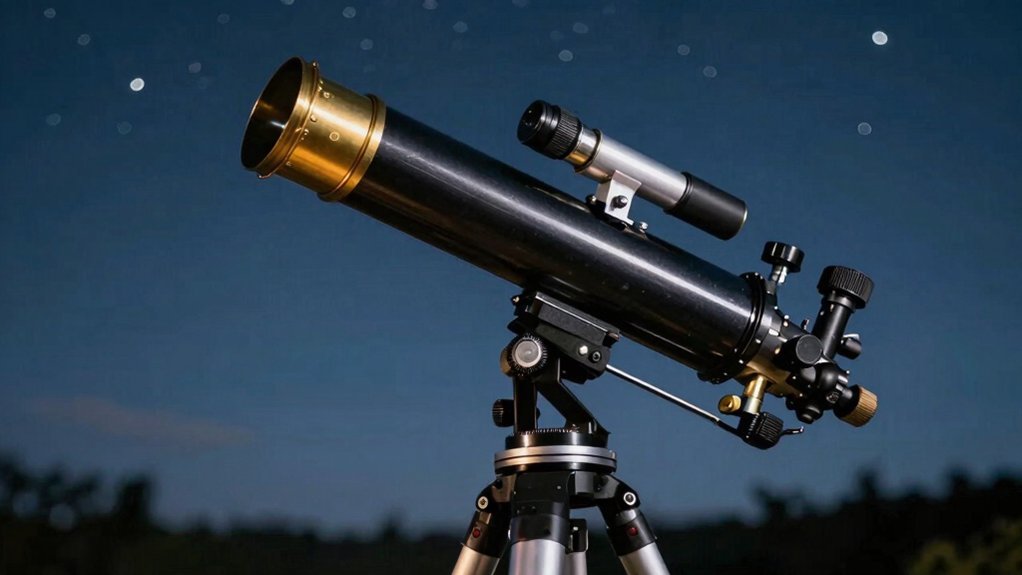
Here’s the thing: observational limitations mean your retina registers them as single bright spots. Even telescopes struggle because angular resolution dictates how much detail optics can reveal. Most stars remain unresolved points because their angular diameter stays too small. Atmosphere adds twinkling, but distance creates the point source itself. A telescope’s aperture size directly influences its ability to gather light and theoretically improve resolution, though atmospheric turbulence often remains the limiting factor for ground-based viewing. Different optical designs, such as refractor telescopes, utilize lenses to bend light, yet they face the same physical constraints regarding stellar angular diameter as other types. To get the best view, you should find a location with dark sky conditions to minimize light pollution that washes out faint stellar details.
Obviously, planets differ since they sit closer and show tiny disks. Stars stay distant, so their light lands in nearly the same retinal region. You see a shimmering point, not a glowing ball of gas. Accept that physics limits your view of stellar surfaces today. Now you understand why distance dominates appearance over actual size. Ready to explore what colors hide within that starlight?
What Colors Can You See in Starlight?
Although stars look white at first glance, you’re actually missing a hidden rainbow because your eyes struggle in the dark. Your cone cells need serious light to detect star color, so dim points often appear gray or white. Brightness levels dictate everything; faint stars simply don’t trigger your color vision effectively.
Now, hotter stars glow blue-white, while cooler ones shine orange or red. You’ll spot these hues best on bright targets like Betelgeuse or Antares. A telescope gathers more light, turning previously white specks into tinted gems. However, don’t expect saturated neon; real starlight offers subtle, delicate tints instead. The optical quality of your lenses and mirrors also plays a vital role in ensuring these faint colors remain distinct rather than blurred by aberrations.
Here’s the thing: apparent brightness matters more than magnification for seeing color. You need enough photons hitting your retina to distinguish those warm or cool tones. Focus on the brightest stars first for the most rewarding visual experience.
Selecting the right telescope based on aperture size is crucial because larger optics gather significantly more light to reveal these subtle stellar colors. Understanding light gathering power ensures you choose an instrument capable of making faint stellar hues visible to the human eye.
Ready to see how your gear changes what you spot? Next, let’s explore how telescope size affects star brightness.
How Does Telescope Size Affect Star Brightness?
Since you’re wondering why bigger scopes reveal fainter stars, let’s clear up that aperture confusion right now. Your telescope’s aperture controls its light gathering power directly. Doubling that width collects four times more starlight, making dim points suddenly pop. Obviously, aperture effects dominate here because stars act as tiny point sources.
Magnification doesn’t create extra photons; it just spreads what you already have. An 8-inch scope makes stars roughly 850 times brighter than your naked eye sees. That huge jump lets you spot magnitude 14 stars easily. Small tubes miss these faint gems completely.
You’ll find bigger mirrors lower your detection threshold considerably. Focus on collecting area, not focal ratios, for maximum stellar brilliance. Just as crafting your own web page requires a clear step-by-step build to ensure success, understanding these optical principles provides a solid foundation for your observing sessions. Remember that light gathering power is the specific metric determining how many photons reach your eye from distant celestial objects. Ready to see how those bright points differ from fuzzy planets?
Why Don’t Stars Look Like Planets in a Telescope?
When you crank up the magnification, you might expect stars to bloom into disks like planets do. Obviously, that doesn’t happen because stars sit incredibly far away. Their tiny angular size prevents your telescope from resolving any actual surface details.
Here’s the thing: planets are much closer, so they subtend a larger angle in your sky. You see them as small disks with visible edges or atmospheric bands. Stars, however, remain unresolved point sources regardless of your optics. This limitation defines stellar resolution for every amateur astronomer today.
Atmospheric turbulence makes these pinpoint lights twinkle wildly compared to steady planets. You’ll notice bright stars show only color tints, never continents or clouds. The core difference lies entirely in distance and apparent scale. To get the best view of these distant points, ensure your equipment has reached thermal equilibrium before beginning your observation session. Selecting the right aperture size is also crucial, as larger openings gather more light to make those pinpoint stars appear brighter and more distinct against the dark sky. Understanding light gathering power explains why bigger telescopes reveal fainter stars without changing their point-like appearance.
What Causes Diffraction Spikes and Optical Artifacts?
Now, you might wonder why those bright stars suddenly grow dramatic rays when you look through your scope. Those spikes aren’t real; they’re optical artifacts created by your telescope’s own structure. Light bends around sharp edges like spider vanes holding the secondary mirror.
This bending causes diffraction effects that stretch starlight into visible lines. You see optical interference where light waves overlap and reinforce each other. A four-vane spider creates four distinct spikes, while hexagonal mirrors produce six. The severity of these patterns also depends on the central obstruction size relative to the primary mirror diameter.
Obviously, brighter stars show these patterns more clearly against the dark sky. Refractors often lack these spikes since they don’t use support struts. Your scope’s design directly dictates the specific starburst shape you observe. Understanding light pollution levels is also crucial, as excessive skyglow can wash out these delicate details and reduce the contrast needed to see them clearly. Additionally, selecting the right telescope aperture ensures you gather enough light to distinguish these fine diffraction patterns from background noise.
Can You Ever See a Star’s Surface Detail?
Can you actually spot surface details on a distant star? Honestly, you usually see tiny points of light, not textured disks. Even huge telescopes struggle because stars sit incredibly far away. Your view stays steady, showing color shifts like blue or red, but no real surface.
Now, resolving a star needs angular resolution far beyond ordinary gear. You’d need a telescope capturing mere milliarcseconds to see spots. Most stars remain unresolved dots despite your strongest magnification efforts.
Here’s the thing: only advanced techniques like interferometry reveal actual features on giants like Betelgeuse. Standard stellar imaging simply cannot show those details for you. Optical flaws often mimic markings, tricking your eye into seeing false patterns.
Obviously, the Sun is the only star where you easily view surface activity. For every other star, expect colored points, not landscapes. True surface views require specialized systems, not your backyard scope. Keep exploring, but know this limit before expecting more. Understanding optical performance helps explain why even high-end consumer telescopes cannot overcome the diffraction limits required to resolve stellar disks. Ultimately, the aperture size of your instrument dictates the theoretical limit of detail you can resolve, which is why stellar disks remain invisible to amateur equipment. The fundamental barrier preventing these views is the diffraction limit, a physical constraint determined by the wavelength of light and the diameter of the telescope’s primary mirror.
How Do You Focus for the Sharpest Star Views?
Why does your star still look like a fuzzy blob even after you twist the knob? You probably missed the exact spot where light converges perfectly. Start by centering a bright star, then turn your focuser knob slowly.
Make tiny adjustments until that blurred circle shrinks into a tiny pinpoint. Obviously, rushing this step ruins your view instantly. Mastering these focus techniques requires patience and steady hands at night.
Watch for specific visual cues like symmetrical diffraction patterns collapsing inward. A Bahtinov mask helps align spikes for absolute precision every single time. Remember, atmospheric turbulence might force you to refocus repeatedly during your session. Sturdy tripods reduce wobble during focusing to ensure smoother adjustments. High-quality optics with superior light transmission ensure that the pinpoint star remains bright and distinct even at high magnifications. Following a practical step-by-step walkthrough helps beginners avoid common focusing mistakes and get it right the first time. Allowing your telescope to reach thermal equilibrium before observing prevents internal air currents from distorting the star image.
Your goal is simply the smallest possible dot in the eyepiece. Once sharp, lock everything down tight before observing further details. Now you’re ready to see stars as nature truly intended them.