You’re wondering what a telescope really means beyond just a tube with lenses, and that’s exactly the right question to ask. It’s a light bucket gathering photons through big mirrors or lenses to brighten faint stars you can’t see alone. Now, it also detects invisible rays like X-rays, while the verb form means compressing things smoothly. Obviously, bigger apertures reveal deeper cosmic secrets than your eyes ever could. Keep exploring to see how these tools reveal the universe’s hidden layers.
What Is a Telescope and How Does It Work?
Telescopes are simply light buckets that make the invisible visible. You probably wonder how these gadgets actually reveal distant stars without magic. They gather faint photons and focus them so your eyes see clearly.
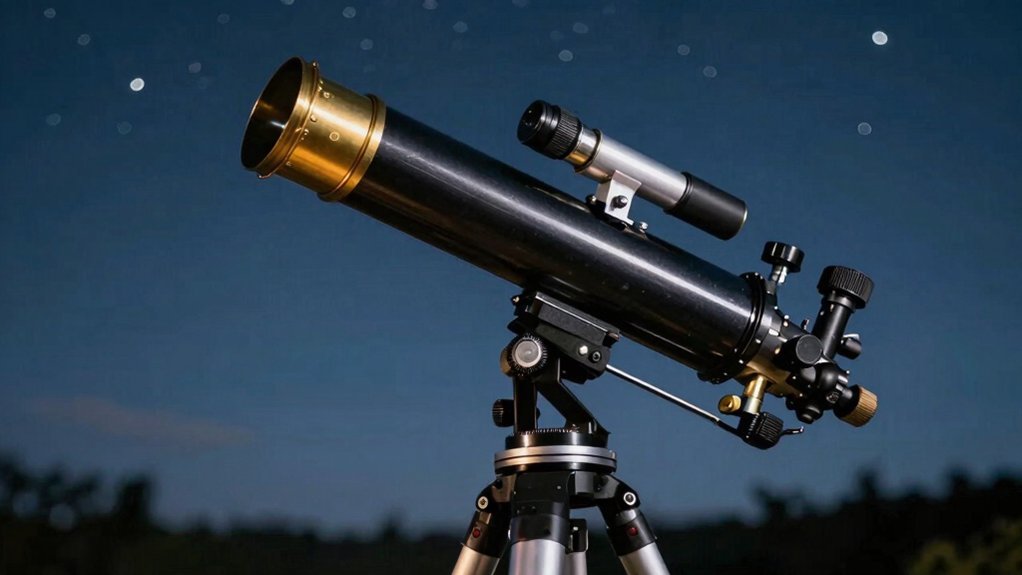
Different telescope types handle this job uniquely using lenses or mirrors. Refractors bend light through glass, while reflectors bounce it off curved surfaces. Both designs rely on massive light collection to brighten dim cosmic objects.
Now, the objective element grabs incoming rays and sends them to a focal point. Your eyepiece then magnifies that concentrated image, making tiny details pop instantly. Obviously, bigger mirrors collect more light, letting you spot fainter galaxies easily. This fundamental ability to resolve fine detail is known as angular resolution.
Here’s the thing: performance depends entirely on how well the system focuses energy. You get sharper views when the optics align perfectly at the focal plane. Modern instruments like JWST utilize gold-coated beryllium mirrors to effectively reflect infrared light for observing the oldest objects in the universe. Before heading out, remember that dark sky conditions are essential for seeing the faintest wonders the night sky has to offer. Atmospheric turbulence can distort these views, a phenomenon astronomers call seeing.
Start exploring specific designs next to find which tool fits your stargazing goals.
Where Did the Word Telescope Originate?
Now, let’s jump into the Historical Context of its actual birth. Giovanni Demisiani coined “telescope” on April 14, 1611, during a banquet honoring Galileo’s new instrument. Federico Cesi likely asked for this name at the Accademia dei Lincei gathering that day. Early forms like *telescopio* circulated in Italian before English adopted it mid-century. You see how scholars built this term specifically for viewing distant objects clearly. This descriptive name stuck because it perfectly explained the device’s core function immediately. The event highlighted the revolutionary telescope as a milestone that transformed scientific observation forever. This gathering of the Accademia dei Lincei solidified the instrument’s role in advancing natural philosophy through rigorous study. Understanding this history helps stargazers appreciate how optical performance remains the central factor when choosing the right instrument today.
How Do Lenses and Mirrors Gather Light?
While you might think magnification is the main goal, gathering light is what actually lets you see faint stars. You need more photons than your eyes alone can catch to spot distant cosmic wonders.
Now, consider how lenses work. A convex lens uses lens refraction to bend incoming light rays as they pass through glass. This bending action forces parallel rays to converge sharply at a specific focal point inside the tube.
Here’s the thing about mirrors though. A concave mirror relies on mirror reflection to bounce light inward instead of letting it pass through. The angle of incidence equals the angle of reflection, directing everything to one spot. In reflecting telescopes, this design allows for a larger aperture size to greatly impact light-gathering ability compared to refracting models.
Obviously, bigger optics collect more light. Your telescope concentrates those gathered photons into a tiny, bright image you can finally observe clearly. This focused intensity makes the invisible visible for your viewing pleasure tonight. Understanding these optical principles is essential for mastering the skies. Chromatic aberration often occurs in refractors when different colors fail to focus at the same focal point. Selecting the correct optical design ensures your instrument minimizes such distortions while maximizing clarity for deep-sky observation.
Why Do Telescopes Make Faint Objects Brighter?
Since your eyes miss most photons, you’re wondering how a tube of glass makes faint stars pop. Your pupil is tiny, so it catches very few light particles from distant galaxies. A telescope’s large mirror grabs way more photons than your eye ever could alone.
Here’s the thing: light gathering power depends entirely on that big opening size. You collect thousands more photons, concentrating them into a sharp, bright image for your brain. This boost lets you spot faint objects that remain completely invisible to your naked eye.
Obviously, magnification alone won’t help if you haven’t gathered enough light first. You need that strong signal before you can enlarge the view effectively. The telescope doesn’t create new light; it just funnels existing starlight directly to you.
You now see why bigger apertures reveal deeper space secrets instantly. When evaluating different models, the optics quality significantly impacts how clearly those gathered photons are focused for observation. Understanding aperture diameter is crucial because it directly determines the total amount of light your instrument can capture from the cosmos. Ready to explore what else lies beyond visible colors?
Which Non-Visible Radiations Can Telescopes Detect?
Why stop at colors your eyes can actually see? You miss most cosmic action because human vision captures only a tiny slice. Telescopes reveal the rest, revealing hidden universe layers you cannot normally perceive.
Radio waves trace huge gas clouds while infrared radiation pierces thick dust to show baby stars. Ultraviolet radiation exposes hot, energetic stars that glow fiercely beyond visible limits.
X rays gamma rays reveal violent explosions and black holes eating matter nearby. Earth’s atmosphere blocks these high-energy signals, so space telescopes must catch them for you.
Each wavelength tells a unique story about temperature, density, and cosmic violence occurring right now. You gain a complete picture only by combining all these invisible light sources together. Obviously, seeing everything requires more than just glass lenses reflecting standard visible light patterns. Different detection methods are essential because signal interactions with matter vary across the electromagnetic spectrum. Effective observation relies on understanding how electromagnetic radiation behaves across these diverse frequencies. Choosing the right instrument depends on matching telescope optics to the specific wavelength you intend to study. Scientists often utilize reflecting mirrors in these specialized instruments to gather and focus non-visible wavelengths that would otherwise be absorbed or distorted by traditional lenses.
Ready to explore how scientists actually build these incredible non-visible light detectors next?
Can Telescope Be Used as a Verb for Compression?
You might wonder how a giant lens relates to squeezing text. It actually does, because you can use “telescope” as a verb. Standard dictionaries define this action clearly as compressing or condensing something markedly.
Here’s the thing: telescope usage often describes parts sliding into one another smoothly. Think of collapsing an old-fashioned spyglass quickly with your own two hands. The compression definition covers both shortening text and physically shrinking objects efficiently.
Obviously, this isn’t just slang; mainstream English accepts it fully today. You might say a long meeting telescoped into a brief, ten-minute chat. Or perhaps your travel plans telescoped due to sudden, unexpected bad weather conditions.
Now you know the word works for ideas and physical items alike. This dual meaning helps you describe complex shortening processes simply. Just as buyers must practice smart spending to navigate costs effectively, using this verb helps you efficiently condense complex ideas or physical spaces. When selecting equipment, understanding optical performance ensures you choose the right tool for your specific viewing goals. Enthusiasts should also prioritize light gathering capability to observe faint celestial objects with greater clarity. Ready to see how this tool reveals cosmic secrets next?
How Do Telescopes Unlock Secrets of the Universe?
How exactly does a simple tube disclose cosmic secrets you can’t see with your own eyes? You might think magnification matters most, but light gathering truly drives exploration. Larger apertures collect millions more photons, making faint galaxies suddenly pop into view. By collecting and bending light rays to a single focal point, these devices gather and focus light to create detailed images that reveal features otherwise hidden in darkness.
Now, consider that light travels slowly across vast space. When you observe distant stars, you actually look back through cosmic history. That ancient glow shows you the universe as it existed billions of years ago.
Different wavelengths uncover hidden layers too. Infrared eyes spot baby stars, while radio waves trace primordial gas clouds. You map compositions, track black holes, and even study dark energy shaping everything. Optical instruments specifically rely on visible light spectrum detection to render the colorful nebulae and star clusters most familiar to amateur astronomers. Choosing the right instrument involves comparing optical performance alongside cost to ensure the tool matches your specific stargazing goals.
Ultimately, these instruments act as time machines revealing our origins. You hold the key to understanding where we came from. Just as buyers must evaluate realistic price ranges to fit their financial constraints, astronomers select tools based on specific capabilities rather than just cost. Ready to explore what distinguishes these tools from everyday binoculars next?
What Distinguishes Telescopes From Binoculars?
That question about binoculars versus telescopes hits the mark because the difference isn’t just size. You look through one eyepiece on a telescope, forcing monocular vision. Binoculars let you use both eyes, feeling much more natural immediately. Obviously, holding heavy gear tires your arms fast without a sturdy mount.
Here’s the thing: telescope advantages include massive light gathering for faint, distant planets. You swap eyepieces to crank up magnification for incredible, sharp detail. However, binocular disadvantages involve limited power and smaller apertures for deep sky objects. They shine when you need wide fields to scan star clusters quickly. You grab them for instant views without complex setup or alignment delays.
Telescopes demand patience and space, while binoculars offer pure portability and speed. You choose based on whether you want fine detail or broad context. Now, do you prioritize deep space power or easy, handheld convenience?