You’re wondering if light should bend through glass or bounce off mirrors for the clearest view. Refractors use lenses for sharp, upright images perfect for planets, while reflectors use mirrors to gather more light cheaply for deep space. Obviously, big lenses cost double after four inches, but mirrors need frequent alignment. Now you see why your target matters most. Stick around to unveil exactly which scope matches your specific stargazing goals.
How Do Refractor and Reflector Telescopes Work?
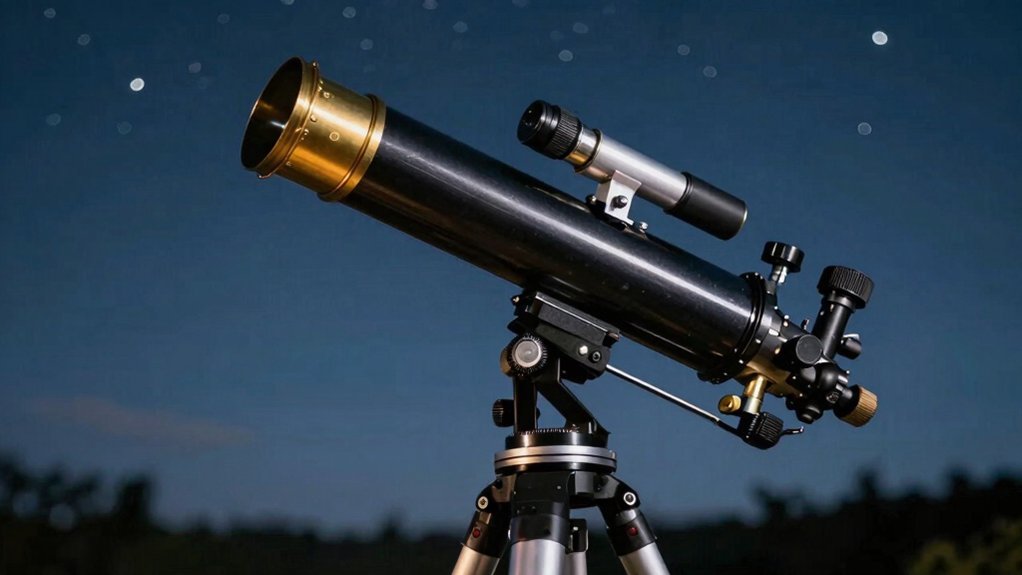
Confusion about lenses versus mirrors? You’re asking the right question. Refractors use an objective lens to bend light straight to your eye. This lens technology creates upright images perfect for land viewing. The tube stays long because light travels its full length. Refractors are also known as a dial trick telescope in some historical contexts.
Now, reflectors grab light with a primary mirror instead. Mirror efficiency lets you build huge apertures without heavy glass. Light bounces to a secondary mirror then hits your eyepiece. You often see inverted views, but that’s fine for stars.
Both designs gather far more light than your naked eye. A larger lens or mirror simply reveals more detail instantly. The eyepiece just magnifies the focused image you already have. To get the best view of these details, you need to find a location with minimal light pollution.
You now know how each tool forms your view. Which path fits your night sky goals best?
Understanding the specific optical path of each design helps clarify why reflectors can achieve larger sizes more economically than refractors. Chromatic aberration is a common issue in refractors where different colors focus at different points, causing color fringing around bright objects.
What Are the Key Differences in Light Paths?
Since you’re wondering how light actually travels inside these tubes, you’ve hit on the core difference. In a refractor, light passes straight through an objective lens using transmission. This creates a direct, linear light path from front to back.
Now, look at reflectors. Here, light hits a curved primary mirror at the tube’s base. The beam bounces off this mirror and folds toward a secondary one. This reflection redirects the image out the side of the tube.
Obviously, these distinct optical elements define your viewing experience. Refractors rely on glass bending light, while reflectors use mirrors bouncing it. You get a simple straight shot versus a cleverly folded route. The refracting design ensures the real inverted image forms at the focal plane before the eyepiece magnifies it for clarity.
This folded optical path allows reflectors to achieve a much longer focal length within a compact and portable tube assembly. By eliminating the need for heavy glass lenses that absorb some light, reflectors often provide superior light gathering power for observing faint deep-sky objects. Additionally, the closed tube design of refractors helps protect the optics from air currents that can degrade image stability in open truss systems.
The key takeaway? One goes through, the other bounces around. Which path suits your stargazing style best?
Which Telescope Type Offers Better Image Quality?
So, which scope actually delivers the sharper view you’re craving? Reflectors avoid color fringing entirely since mirrors bounce all light wavelengths equally. You get pure image clarity without those annoying purple halos ruining your night sky observations.
Refractors offer unbeatable contrast for planets because they lack central obstructions blocking your light path. High-end models deliver stunning optical performance on bright targets like the Moon or Mars. Obviously, cheap lenses still struggle with color issues that mirrors simply ignore completely.
Your final choice depends on whether you prioritize color purity or maximum contrast for specific targets. Both designs excel when you invest in premium glass and precise alignment techniques. Now you understand exactly how each design impacts your actual viewing experience tonight. Understanding optical aberrations helps you anticipate potential image distortions inherent to each specific telescope design before making a purchase.
How Does Aperture Impact Cost for Each Design?
You’ve got the image quality sorted, but now you’re wondering why big lenses cost a fortune compared to mirrors. Here’s the thing: aperture scaling hits refractors hard because grinding huge glass lenses is incredibly difficult. Once you pass four inches, prices skyrocket, often doubling what you’d pay for a reflector.
Reflectors offer amazing cost efficiency since mirrors only need one polished surface. You can grab a ten-inch Newtonian for under a thousand bucks easily. Obviously, larger mirrors still get pricier, but they scale much slower than lenses do. Small refractors compete well at three inches, yet reflectors dominate the medium and large markets. However, as aperture increases, the need for a more robust mount to minimize vibrations adds significant expense to refractor setups that is less pronounced in comparable reflectors.
Don’t forget that bigger tubes need sturdier mounts, adding hidden costs to your total setup. Ultimately, mirrors give you the most light per dollar spent without breaking the bank. Ready to see how these different designs hold up over time?
What Maintenance Do Reflectors Versus Refractors Need?
Two main headaches separate these designs, and you’re probably wondering which one steals your weekend. Reflectors demand frequent mirror collimation to keep images sharp after every bump or transport. You’ll need a laser tool for this precise alignment task regularly.
Refractors skip that hassle entirely since they use fixed lenses instead of mirrors. Your optical maintenance focuses mostly on gentle cleaning and checking mechanical parts. Obviously, fewer elements mean less time tweaking alignment for your viewing sessions.
Both types need careful dust removal before any wet cleaning to avoid scratches. Store your scope in a dry place to protect coatings from moisture damage. You should also lubricate mount gears and tighten loose bolts on both designs. When cleaning is necessary, always use safe cleaning methods to prevent damaging the delicate optical coatings. For stubborn spots on glass surfaces, apply distilled water with a soft brush rather than harsh solvents that could strip coatings. Historical records show that early telescope events often highlighted the durability differences between these optical systems during field observations.
Reflectors require more hands-on care, while refractors offer a simpler, set-and-forget experience. Which level of upkeep fits your observing style better?
Why Are Refractors Best for Planetary Viewing?
Since you’re wondering why refractors dominate planetary views, it all comes down to contrast. You see fine details because these scopes lack central obstructions that scatter light. This design boosts your contrast sensitivity, revealing subtle belts on Jupiter instantly.
Now, consider optical stability. Refractors reach thermal equilibrium quickly, so you don’t wait hours for clear images. Their closed tubes block air currents that usually blur high-power views. You also skip frequent collimation adjustments needed for reflectors, saving valuable observing time.
Obviously, sharpness matters most when atmosphere turbulence limits resolution. A smaller, unobstructed aperture often beats a larger, obstructed one here. You get crisp lunar craters and defined Martian polar caps without diffraction spikes ruining the view.
Choose a refractor when you prioritize steady, high-contrast views of bright objects. This optical design is particularly effective for those with a limited observation budget who still demand high performance. Unlike reflectors, refractors avoid secondary mirror obstruction which further preserves image clarity on bright targets. The sealed optical tube assembly prevents internal dust accumulation that can degrade image quality over time by reducing light transmission. Ready to explore when bigger mirrors actually make more sense for other targets?
When Should You Choose a Reflector for Deep Sky?
All right, let’s tackle when that big mirror actually makes sense for your deep-sky hunting. You need maximum light-gathering power on a limited budget to see faint galaxies. Reflectors deliver superior deep sky efficiency because mirrors cost far less than large lenses. Your aperture preference should lean toward size here, as bigger openings reveal dim nebulae clearly.
Obviously, faint star clusters demand low magnification and wide fields of view. A reflector provides sharp, contrasty images at a fraction of a refractor’s price. You accept periodic collimation and dust cleaning to gain this incredible light collection ability. Large apertures improve resolution, helping you spot fine structures in extended objects easily. Reflectors are specifically ideal for observing faint deep-sky objects such as galaxies and nebulae due to their ability to support larger apertures for better light gathering. Unlike refractors, reflectors avoid chromatic aberration entirely since mirrors reflect all wavelengths of light to the same focal point. For optimal performance under dark skies, ensure your setup includes proper collimation to align the optical elements perfectly. While refractors often offer sharper contrast for planets, the open tube design of most reflectors allows them to cool down faster to ambient temperature, reducing thermal currents that can blur deep-sky details.
Choose this path when seeing fainter objects matters more than compactness or zero maintenance. Your wallet stretches further with mirrors, revealing views expensive refractors simply cannot match. Now, how do you decide which specific type fits your overall observing goals?
How to Choose Between a Reflector and Refractor?
Now that you see the trade-offs, you’re probably wondering which scope actually fits your night sky goals. Start by defining your observing goals clearly. Do you crave sharp lunar details or faint galaxy glows? Refractors deliver crisp planetary views with zero maintenance headaches. Reflectors gather massive light for deep-sky wonders but need occasional mirror alignment.
Consider telescope portability next. Large refractors get heavy and expensive fast, while reflectors offer big apertures in compact tubes. You’ll carry a six-inch reflector easier than a comparable lens-based scope. Budget matters too; mirrors cost less per inch of light-gathering power. While refractors use glass lenses to bend light, reflectors utilize a curved primary mirror to gather and focus images without the color fringing seen in cheaper lens systems. For those concerned about long-term expenses, reflectors generally provide a lower cost per inch of aperture compared to high-quality refractors.
Pick a refractor for simple, sharp setups. Choose a reflector if you prioritize aperture and faint objects. Which target excites you most tonight? That answer decides your perfect telescope match immediately. Remember that understanding optical aberrations helps you anticipate image quality differences between the two designs before you buy.