You’re wondering how a 27,000-pound telescope reshaped cosmic history. Hubble orbits Earth at 17,000 mph, completing a lap every 95 minutes to stay above atmospheric blur. Astronauts fixed its blurry vision five times, enabling over 1.7 million observations of 55,000 unique objects. This work unveiled the universe is 13.8 billion years old and expanding faster than expected. Keep exploring to reveal exactly how these findings redefine your place in the cosmos.
What Are the Hubble Space Telescope’s Key Specifications?
You’re probably wondering how a telescope the size of a school bus stays steady enough to spot faint galaxies. It’s huge, measuring 43.5 feet long and weighing nearly 27,000 pounds after upgrades. Yet, its mirror system locks onto targets with incredible precision using that massive 94.5-inch primary mirror.
Now, consider where it floats. Hubble circles Earth at about 300 miles up, tilting 28.5 degrees relative to the equator. These specific orbital parameters keep it above most atmospheric interference while allowing regular servicing visits. Obviously, staying in low-Earth orbit helps scientists fix issues without bringing it home. Understanding the impact of atmospheric distortion clarifies why this altitude is critical for capturing clear images of distant celestial objects.
Here’s the thing: reaction wheels and gyroscopes maintain its rock-solid pointing stability despite moving at 17,500 mph. You get sharp images because this design balances size, weight, and location perfectly. Ready to see exactly how fast it completes those orbits? Unlike ground-based options discussed in choosing the right telescope, Hubble’s location eliminates atmospheric distortion entirely. While Hubble excels in space, amateur astronomers often start their journey by selecting between reflector telescope designs based on their specific viewing goals and budget constraints.
How Fast Does Hubble Orbit Earth and Why?
All right, you’re probably wondering how something so heavy zips around Earth without falling down. It’s all about that incredible Hubble orbit keeping it aloft. You see, gravity pulls the telescope down constantly, but its sideways motion saves it.
Hubble travels at a blistering orbital speed of roughly 17,000 miles per hour. That’s about five miles every single second! This rapid pace guarantees the telescope falls around Earth’s curve instead of straight down. Obviously, moving this fast keeps it in a perpetual state of free fall.
You’ll find Hubble completes one full lap in just 95 minutes. That means it circles our planet fifteen times daily, zooming between sunlight and shadow. This specific altitude and velocity combination lets you enjoy clear views above our thick atmosphere. Without such high speed, the telescope would quickly burn up re-entering the air. Now you understand why speed matters so much for staying up there. Understanding how orbital mechanics function is essential for choosing and using any telescope effectively, as it dictates stability and viewing conditions. Just as precise alignment is critical for ground-based instruments, maintaining the correct orbital velocity ensures the telescope remains stable enough to capture sharp images without atmospheric distortion. While Hubble relies on its speed to stay aloft, ground-based observers must consider atmospheric turbulence when selecting a location to minimize image distortion caused by air currents.
Why Was Hubble Serviced by Astronauts Five Times?
Now you might wonder why astronauts visited Hubble five separate times instead of just once. NASA designed Hubble specifically for on-orbit servicing because technology improves faster than fixed telescopes age. You see, modular components allowed crews to swap worn parts directly in space.
The first blurry images made immediate astronaut repairs urgent during that initial 1993 visit. Later, hardware wear from the hostile space environment demanded repeated maintenance visits over the years. Each of the five servicing missions solved different problems, from fixing gyroscopes to installing new instruments. These upgrades kept Hubble scientifically current long past its original fifteen-year life expectation.
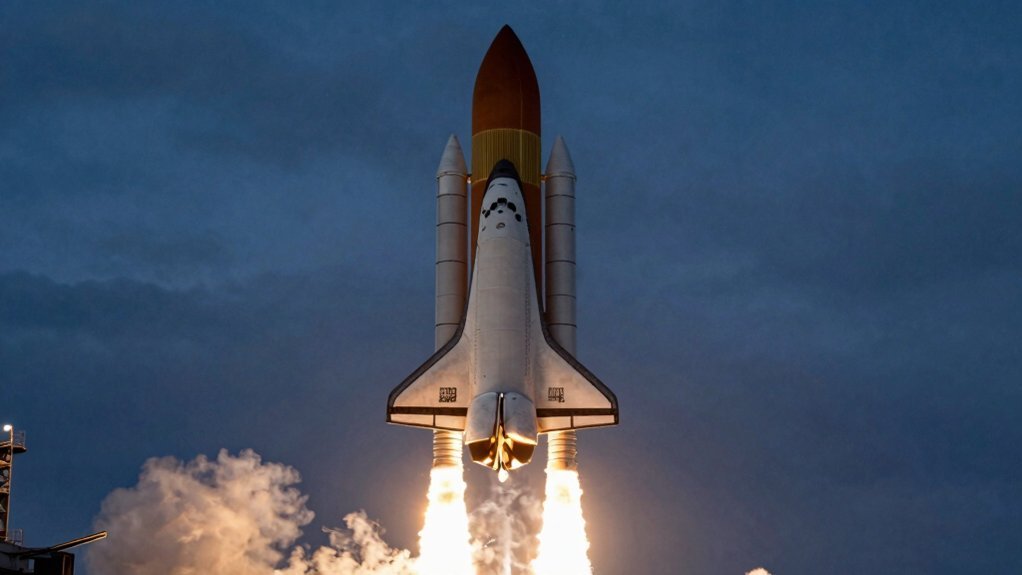
Obviously, sixteen astronauts completed twenty-three spacewalks totaling over 165 hours to guarantee success. The Shuttle retirement eventually ended these unique opportunities for direct human intervention in orbit. You now understand how these critical visits transformed a flawed project into a legendary observatory. Next, consider how many actual observations this repaired telescope has completed since launch. Just as stargazers must weigh optics and cost when choosing the right telescope, engineers balanced performance and upgradability to ensure Hubble’s longevity. Understanding that modular components enable such vital in-space repairs highlights why this design choice was so crucial for the telescope’s extended mission. Effective telescope use also relies on understanding how optical resolution determines the clarity of distant celestial objects viewed through the lens.
How Many Scientific Observations Has Hubble Completed?
Ever wonder exactly how many times Hubble has pointed its lenses at the stars? You might guess a few thousand, but the real number shocks everyone. Since 1990, Hubble has completed more than 1.7 million scientific observations targeting over 55,000 unique celestial objects.
Here’s the thing: those aren’t just random snapshots. Scientists use specific observation methods to study everything from nearby planets to distant galaxies. Each pointing generates massive datasets requiring rigorous data analysis by researchers worldwide. Obviously, this steady accumulation created a treasure trove for astronomy. While professional instruments gather vast data, beginners can also start their journey by learning to identify bright stars and planets with just their eyes or simple binoculars under dark sky conditions. Choosing the right gear often starts by comparing telescope options based on optics, performance, and cost to match your specific stargazing goals.
You see, over 27,000 astronomers have utilized this data to publish thousands of papers. The telescope transmits about 150 gigabits of raw science data every single week. That relentless pace explains why the count keeps climbing decades later. This enduring impact solidifies the revolutionary telescope as a cornerstone of modern astronomical history.
What Major Cosmic Discoveries Did Hubble Enable?
You might think counting observations is impressive, but those numbers only matter because of what they unveiled. Hubble’s Deep Field images showed you thousands of ancient galaxies, clarifying early galaxy formation. You now see how these structures assembled over billions of years.
Here’s the thing: Hubble measured cosmic expansion precisely, proving the universe is 13.8 billion years old. Supernova data even showed this expansion accelerating, a revelation that won the 2011 Nobel Prize. This acceleration points directly to dark energy acting like a cosmic gas pedal.
You also learned that supermassive black holes sit in nearly every galaxy’s core. Hubble confirmed their existence by tracking stellar motions near galactic centers. Plus, you saw planets forming inside dust disks and detected exoplanet atmospheres. These findings transformed theoretical ideas into concrete facts about our cosmos. Your understanding of the universe just got markedly sharper. Hubble also captured iconic images of the Pillars of Creation, revealing the intricate processes within star-forming regions. By gathering light from distant objects, the telescope’s primary mirror allows astronomers to observe faint details that would otherwise remain invisible to human eyes. The corrective optics installed during a servicing mission fixed the initial spherical aberration, ensuring the telescope could achieve its full scientific potential. While Hubble excels at deep space observation, selecting the right instrument for your own viewing depends on comparing optics and performance against your specific stargazing goals and budget.
How Has Hubble Changed Our Understanding of the Universe?
Three massive shifts in perspective define how Hubble rewired your cosmic worldview. You once thought the universe was static, but deep fields proved it teems with hundreds of billions of galaxies. Now, you see cosmic history unfolding over 13.8 billion years, not just a frozen moment.
Here’s the thing: expansion isn’t slowing down; it’s actually accelerating wildly. Hubble’s supernova data forced you to accept dark energy as a dominant, mysterious force driving this speed-up. Obviously, this flipped the standard model from steady growth to frantic acceleration on its head.
Finally, you now know supermassive black holes anchor almost every galaxy, linking their growth directly to stellar evolution. These revelations transformed your view from a simple, quiet cosmos to a dynamic, evolving machine full of hidden engines. You’ve moved from guessing to knowing the universe’s true, wild nature. This revolutionary instrument turned abstract theories into visual proof that reshaped modern astronomy. By capturing light across ultraviolet, visible, and near-infrared spectra, Hubble provided unprecedented clarity that ground-based telescopes could never achieve. Just as enthusiasts benefit from expert-backed guidance to maximize their viewing experience, Hubble’s precise operations relied on rigorous calibration to maintain its scientific edge. What mystery should we tackle next?