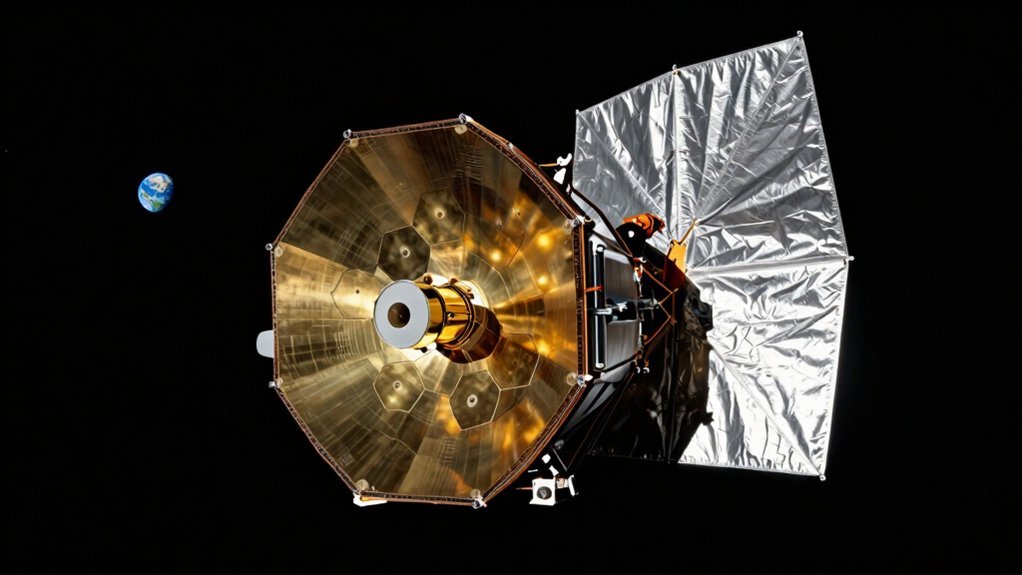
You’re wondering just how far Hubble can actually see, and the answer stretches your mind to 13.4 billion light-years away. That’s GN-z11, a galaxy whose light traveled eons to reach us. Now, cosmic expansion means it’s actually 32 billion light-years distant today. Hubble captures this ancient glow using infrared sensors to pierce cosmic dust. Obviously, looking farther means peering deeper into time itself. Keep exploring to reveal exactly what blocks our view beyond this limit.
How Far Can Hubble Actually See in Light Years?
How far can you actually see with Hubble? You might wonder if there’s a hard edge, but Hubble observations reveal distant galaxies billions of light-years away. The record holder, GN-z11, sits about 13.4 billion light-years distant based on light travel distance.
Here’s the thing: cosmic expansion stretches space while light travels, making current distances much larger than they appear. You’re seeing ancient light, not where those galaxies sit right now in the present universe. Obviously, this distinction matters when you read different numbers in various articles online. Just as choosing the right telescope depends on your specific stargazing goals, interpreting Hubble’s range requires understanding the specific metrics used. Successful observation also relies on optical clarity to distinguish faint cosmic objects from background noise. Effective use of such instruments demands precise mount stability to prevent image blur during the long exposures required for deep space viewing.
All right, so Hubble peers over 13 billion light-years back into time itself. You get a clear view of the early cosmos thanks to long exposures collecting faint photons. Remember that “how far” depends entirely on which distance metric you choose to trust today. Now you understand why simple answers fail here. Hubble has made over 1.3 million observations that help astronomers measure these vast cosmic scales using techniques like redshift. Next, let’s explore what looking back in time really means for your understanding.
What Does Looking Back in Time Mean?
Since light travels at a finite speed, you’re actually seeing distant objects as they were in the past. You might wonder how a telescope acts like a time machine. It’s simple physics, not magic. Every image Hubble captures represents an observational delay caused by the vast distances light must cross.
When you view a galaxy billions of light-years away, you witness its ancient history. That specific light journey took eons to finally reach your eyes today. Obviously, the farther the object sits, the older the snapshot becomes. Hubble reveals galaxies from over ten billion years ago, showing us the early Universe. Expert observers know that achieving such views requires optimal viewing conditions to minimize atmospheric interference and maximize clarity. Selecting a telescope with a larger aperture size allows for greater light gathering power, which is essential for resolving these faint, ancient cosmic structures. Understanding how optical systems magnify images helps clarify why specific instruments are better suited for deep-space observation than others.
You aren’t seeing these cosmic neighbors as they exist right now. Instead, you observe their past states preserved in arriving photons. This lookback time lets you reconstruct cosmic history piece by piece. By peering into the edges of the visible universe, Hubble has captured images dating back to when the cosmos was only half a billion years old. Ready to unearth which specific galaxy holds the ultimate distance record?
Which Galaxy Holds the Hubble Distance Record?
You’re wondering which specific galaxy holds that ultimate distance record we just hinted at. Meet GN-z11, sitting in Ursa Major. Its light traveled 13.4 billion years to reach your eyes today. You see it as it existed merely 400 million years after the Big Bang.
Now, consider the specific GN z11 characteristics that made this revelation possible. This galaxy shines surprisingly bright, allowing Hubble to spot it despite extreme distance. Hubble measured its redshift at a massive 11.1, shattering previous records easily. For enthusiasts aiming to understand such distant objects, mastering optical alignment is crucial for maximizing the clarity of any telescope observation.
Here’s the thing about Hubble limitations though. This observation pushed the telescope right to its absolute technical edge. Scientists knew only a newer instrument could go further. You now hold the key fact: GN-z11 remains Hubble’s farthest confirmed galaxy ever identified. Keep this specific record in mind as we explore why distances shift. Understanding your current location in the cosmos helps contextualize just how vast the 13.4 billion light-year journey of GN-z11 truly is. While Hubble achieved this feat with specialized optics, selecting the right telescope options for personal stargazing depends on balancing performance, cost, and individual viewing goals.
Why Is That Galaxy Actually Farther Away Now?
Why does that galaxy seem so much farther away today than when its light started? You’re wondering how space itself stretches while photons travel. Cosmic expansion adds new distance between us and the source constantly. That galaxy wasn’t moving fast; space just grew underneath it.
Here’s the thing: redshift significance tells you exactly how much stretching occurred. Astronomers use this clue for accurate distance measurement instead of guessing. A galaxy 13.1 billion light-years away in travel time sits 32 billion light-years away now. Obviously, simple math doesn’t work here because universe scale changes. The Hubble constant measures this expansion rate to determine how rapidly the gap widens over cosmic distances.
Don’t confuse this rapid recession with normal galaxy motion through space. The gap widens because more space appears, not because the object flies away. You now understand why “farther away now” means current proper distance. Large optical mirrors are essential for collecting the faint photons that have traveled across this expanding void. Selecting a telescope with high light-gathering power ensures you can detect these ancient signals against the dark sky. Understanding aperture size is critical because it directly dictates the resolution and brightness of distant celestial objects you observe. Ready to see how telescopes actually catch such faint, ancient signals?
How Does Hubble Gather Enough Light to See?
That 2.4-meter primary mirror acts like a massive bucket catching rain. You see, it grabs 40,000 times more light than your eye ever could. This huge aperture drives incredible light gathering efficiency by intercepting photons before they scatter away.
Now, focused optics bring those rays to a sharp point using supreme optical precision. You rely on long exposure techniques to let faint signals build up over time. This photon accumulation turns invisible glimmers into clear, detailed images you can actually study. The effectiveness of this process depends heavily on the telescope’s angular resolution, which determines how finely it can distinguish between two close objects.
Here’s the thing: sensitive detectors provide major sensitivity enhancement for those weak cosmic whispers. You also gain from wavelength diversity, capturing ultraviolet to near-infrared light that ground telescopes miss. Broad coverage guarantees you don’t lose valuable data from distant, ancient stars. Unlike the James Webb Telescope, which uses gold-coated beryllium mirrors specifically optimized for infrared detection, Hubble’s design prioritizes a broader spectral range including visible and ultraviolet light. The ability to observe above the atmosphere prevents atmospheric distortion from blurring these faint signals. While ground-based options struggle with light pollution, Hubble’s location ensures optical clarity remains uncompromised for deep space observation.
Obviously, combining these tools lets you peer deeper than ever before. Next, you might wonder why space itself makes this possible at all.
Why Is Space Better Than Ground Telescopes?
You’ve seen how Hubble gathers light, but you’re probably wondering why launching it into space was worth the trouble. Earth’s atmosphere creates atmospheric turbulence that blurs your view, making stars twinkle annoyingly. Space avoids this mess plus light pollution from cities, giving you crystal-clear images.
Now, consider wavelength blocking. The air stops ultraviolet light completely, yet Hubble sees it all easily. You gain incredible observing stability without weather interruptions or day-night cycles ruining your long exposures. Obviously, ground telescope advantages exist, like building massive mirrors cheaply on Earth. Scientists even use adaptive optics to fix some blur, but they can’t match space’s perfect darkness. While ground-based observatories utilize adaptive optics to mitigate atmospheric interference, they still cannot observe the full spectrum of wavelengths blocked by the atmosphere that space telescopes access freely. Choosing the right telescope often depends on whether you prioritize optical clarity over the ability to construct larger, more affordable mirrors on the ground. By operating above the atmosphere, Hubble achieves a level of angular resolution that allows it to distinguish fine details impossible to resolve from the surface. This unobstructed view enables the detection of faint cosmic objects that would otherwise remain invisible to instruments confined within our turbulent sky.
Here’s the thing: space offers a steady, dark platform that ground sites simply cannot replicate. You get access to hidden cosmic details otherwise lost forever in our noisy sky. Ready to see which specific wavelengths reveal the faintest objects next?
Which Wavelengths Reveal the Faintest Objects?
How exactly do you spot galaxies that are a billion times fainter than your naked eye can see? You need near-infrared light because distant galaxies stretch their glow into longer wavelengths as space expands. Visible light misses these ancient, redshifted targets completely.
Here’s the thing: Hubble’s WFC3 instrument captures near infrared advantages perfectly. It sees objects from 13 billion years ago that optical cameras simply ignore. While UV sensors excel at hot stars, they fail on these faint cosmic ghosts.
All right, consider how broad imaging across multiple spectra helps scientists map the deep universe. You get detailed views in visible light, but infrared reveals the true frontier. This specific window lets you witness galaxies 1,000 million times dimmer than your eyes allow. To ensure accuracy when analyzing such complex data, following a step-by-step walkthrough is essential for beginners to interpret spectral findings correctly. Understanding the optical resolution limits of different telescope designs further clarifies why specific instruments are required to distinguish these faint, distant sources from background noise.
What Stops Hubble From Seeing Further?
Even though you’re peering billions of years back, you can’t see past the universe’s opaque baby phase. Light simply couldn’t travel freely during those first 300,000 years. This creates a hard wall called the surface of last scattering.
Now, consider how long galaxy formation actually takes. Stars needed hundreds of millions of years to ignite before Hubble could spot them. Dust and gas also hide many early objects from your view. These factors combine to create significant observational barriers for your telescope.
Obviously, Hubble’s 2.4-meter mirror has limits too. It can’t catch every faint photon traveling through space. You hit a boundary around 13.4 billion light-years away with GN-z11. The universe just wasn’t bright enough earlier than that for you to see. So, you’ve reached the edge of visible history for now. What happens when we try to look even deeper?
How Do Deep Field Images Show Distance?
Since you’re wondering how a flat picture reveals vast distances, you’ve actually hit on the core trick of deep field astronomy. You see light traveling for billions of years, showing galaxies as they existed long ago. Hubble stares at one spot for days, gathering faint photons that finally become visible.
Now, consider redshift implications. The universe stretches light from distant objects, shifting colors toward the red end. Sometimes this stretch pushes light completely out of visible range. That’s where infrared observations step in to catch those stretched waves. You detect galaxies appearing tiny and faint because they sit so far back in time.
These images act like cosmic history books, not simple snapshots. You look deeper by combining thousands of exposures to find over five thousand galaxies. Each color and shape tells you exactly how far away that ancient light traveled. Ready to explore just how far back we truly see?
How Far Back Can We Truly Observe?
You’ve grasped how redshift stretches light, but now you’re wondering just how far back that view actually goes. Here’s the thing: Hubble itself has no intrinsic range limit. Instead, cosmic opacity sets your observable limits. You can’t see past the early universe’s foggy barrier from 300,000 years after the Big Bang.
All right, let’s talk numbers. Hubble spotted galaxy GN-z11 as it existed 13.4 billion years ago. That’s roughly 400 million years post-Big Bang. You are looking at objects from 96% of the way back to time zero. Obviously, stars needed time to form before becoming visible targets.