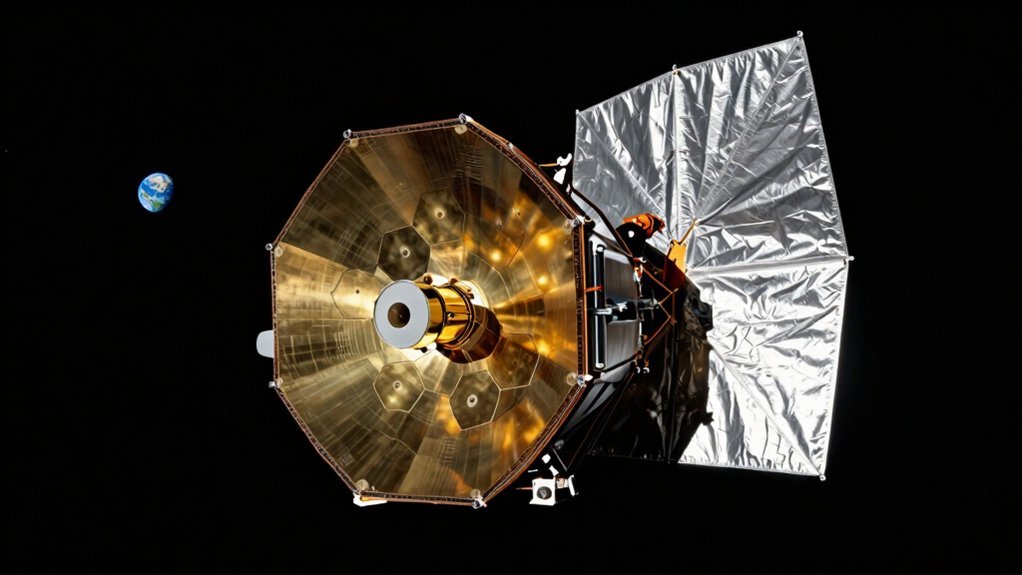
You’re wondering which part actually sends light to your eye, and it’s the secondary mirror making that final turn. Your primary mirror gathers faint starlight first, but the secondary sits at a 45-degree angle to redirect that beam sideways into your eyepiece. Obviously, without this vital reflection, you’d be staring straight down the tube blocking the view. Stick around to see how different mirror shapes change what you observe.
Which Mirror Reflects Light to the Eyepiece?
Ever wonder which mirror actually sends that starlight into your eyepiece? You’re looking at the secondary mirror, that small flat piece hanging inside your tube. It’s the unsung hero of your optical design, catching light just before it focuses.
Now, envision this mirror sitting at a precise 45-degree angle near the top. It grabs that converging beam from the big primary mirror below and whips it sideways. This clever redirection sends the image straight out the side of the tube to your eye.
Obviously, without this little diagonal, you’d have to climb inside the telescope to see anything! The secondary mirror doesn’t gather light itself; it simply delivers the focused picture to your focuser. So, while the big mirror does the heavy lifting, this small one makes viewing possible. This specific optical alignment ensures the light path remains efficient for clear observation. In reflector designs, this setup creates a compact optical path that allows for longer focal lengths within a shorter tube. This configuration was pivotal in the revolutionary telescope designs that shaped modern astronomy by making large apertures more practical. Ready to see how that big primary mirror actually catches the light in the first place?
How Does the Primary Mirror Gather Incoming Light?
You just learned how the secondary mirror redirects light, but where does that beam actually start? It begins right at the primary mirror, your telescope’s main light bucket. This concave surface acts as the core light gathering mechanism, intercepting countless photons from faint stars. Obviously, a larger mirror area collects more light, making dim objects appear brighter to your eye. Now, consider the focusing process. The curved figure reflects parallel incoming rays toward a single focal point. This concentration creates the prime focus, where the image first forms before magnification. Your primary mirror determines exactly how much detail you can eventually see in the night sky. Without this initial collection and concentration, no amount of eyepiece power would reveal those distant galaxies. You need that bright, focused image to proceed further down the optical path. Expert guidance suggests that understanding light-gathering power is crucial for selecting the right instrument for deep-sky observation. When comparing different models, optics performance varies significantly based on the quality of this primary surface. The precision of the mirror’s curvature directly impacts the image resolution you achieve during observation. Next, you might wonder why we even need to redirect that focused beam elsewhere.
Why Does the Secondary Mirror Redirect the Beam?
Since the primary mirror focuses light straight back up the tube, you’d block the view if you tried to look there directly. That’s exactly why your telescope needs that smaller secondary mirror inside. It solves a huge problem by moving the image out of your way.
Here’s the thing: this clever optical design uses beam redirection to send light sideways. In a Newtonian scope, the mirror sits at a precise 45-degree angle. It intercepts the converging cone and bounces it right into your eyepiece. Without this trick, you’d have to cram your head inside the tube itself. Obviously, that wouldn’t work well for anyone trying to see distant stars clearly.
This simple deflection makes the whole instrument usable and compact for you. You get a clear view without obstructing incoming light. Now you understand why that little mirror matters so much. But does its shape change how it works?
Understanding the specific optical path helps you appreciate how different telescope designs manage light efficiency and image quality. Proper alignment of these components ensures optimal light gathering capability for clearer observations. Additionally, maintaining the correct focal length is essential because it determines the magnification power and field of view available to the observer.
Is Your Secondary Mirror Flat or Curved?
That little mirror’s shape actually changes how your telescope handles light. You might wonder if yours bends rays or just bounces them. Here’s the thing: Newtonians use a flat diagonal tilted at 45 degrees. This simple piece steers your beam sideways without adding any focusing power.
Now, consider curved secondary designs found in Schmidt-Cassegrains. Those convex mirrors actually extend your light path considerably. They do more work than simple beam steering alone. Obviously, flat mirror advantages include easier manufacturing and simpler alignment for you. Your Newtonian relies on that precise forty-five-degree angle to work right. When evaluating optics performance, it becomes clear that the choice between flat and curved secondaries fundamentally dictates the instrument’s physical size and cost. Unlike refractors that rely on lens systems to gather light, reflectors utilize these specific mirror configurations to achieve their optical goals. Selecting the right telescope options ultimately depends on whether you prioritize portability or advanced optical correction for deep-sky viewing.
Where Is the Eyepiece Located on a Newtonian?
Where exactly does your eyepiece sit on a Newtonian? You’ll find it mounted on the side, not the back. This unique placement happens because a flat secondary mirror intercepts light near the tube’s top. It redirects that converging beam ninety degrees outward directly into your focuser.
Here’s the thing: this specific optical design creates excellent eyepiece accessibility for you. You view images right where the light cone tightens at the focal plane. Obviously, looking through the side feels different than peering through a rear port. The focuser sits perpendicular to the main tube, holding your eyepiece steady. You simply slide it in to catch the reflected image clearly.
This side-mounted arrangement defines the Newtonian reflector experience completely. You get an easy-to-reach observing position without complex internal routing. Now you know precisely where to look when setting up your scope. Ready to explore how other designs manage their own light paths differently?
How Do Cassegrain Telescopes Route the Light?
While you might expect light to travel straight through, a Cassegrain telescope actually folds its path back on itself. You see, incoming starlight hits your large concave primary mirror first. This mirror bounces the beam forward toward a small convex secondary mirror. That secondary component then reflects everything back down through a central hole in your primary.
This clever optical design creates a compact tube despite having a long focal length. Your light path travels twice the physical length of the instrument before reaching your eye. Obviously, this folding trick makes heavy equipment much easier to handle on dark nights. The secondary mirror specifically directs those final rays to your eyepiece at the rear. Just like any successful build your own project, understanding these core mechanics ensures a working result. Much like web page layout, the arrangement of these optical elements determines the overall balance and usability of the final design.
You now understand exactly how these mirrors collaborate to deliver sharp images efficiently. This specific arrangement is a key factor when choosing the right telescope for your stargazing needs. Next, you’ll want to know how the focuser sharpens that delivered picture for viewing.
What Does the Focuser Do for the Image?
Since you’ve got the light routed, you’re probably wondering why the view still looks fuzzy. The focuser function simply moves your eyepiece along the optical axis until light converges perfectly. It doesn’t magnify anything; that job belongs to your lenses or mirrors alone.
Now, think of it like tuning a radio dial for static-free sound. Small adjustments shift the focal plane directly onto your eye or camera sensor. This precise alignment transforms blurred disks into sharp, twinkling point sources instantly. Without this step, even the best optics deliver disappointing, soft results every single time. A high-quality unit acts as a precision component to prevent image shift and wobble that hinder smooth telescope use.
Here’s the thing: proper focus maximizes image clarity by compensating for different equipment and eyesight. You physically slide the eyepiece holder or sometimes move the primary mirror itself. Motorized versions just automate this essential mechanical dance for smoother operation during long sessions. Achieving this sharpness relies heavily on maintaining correct optical alignment throughout the entire light path. Different telescope designs utilize specific focal length characteristics that determine how far the focuser must travel to reach convergence. Even under ideal viewing conditions, atmospheric turbulence can limit the sharpness you achieve regardless of your focuser’s precision.
Ultimately, you need sharp focus to see fine planetary details clearly. Ready to learn how different focuser types affect your viewing experience?