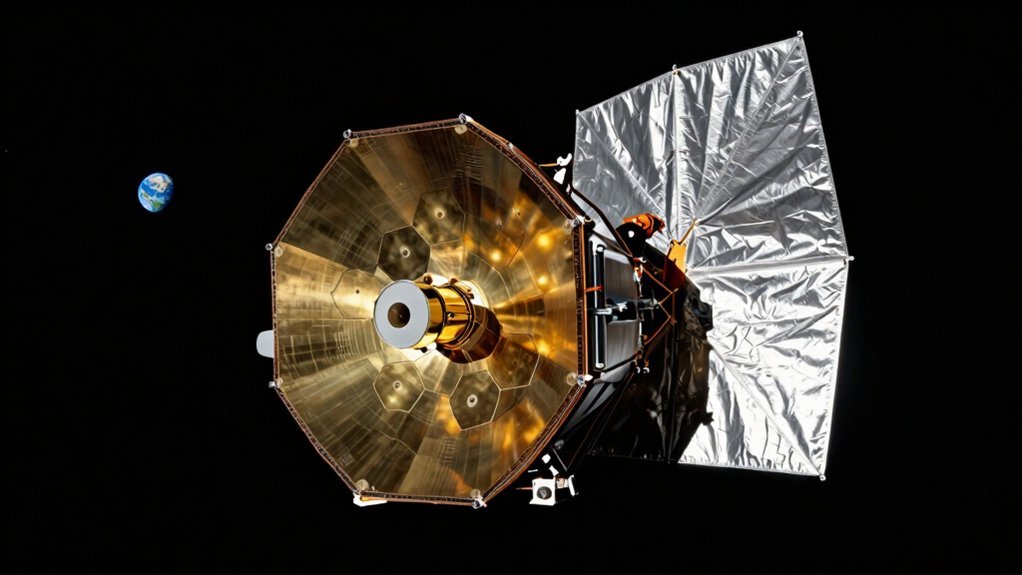
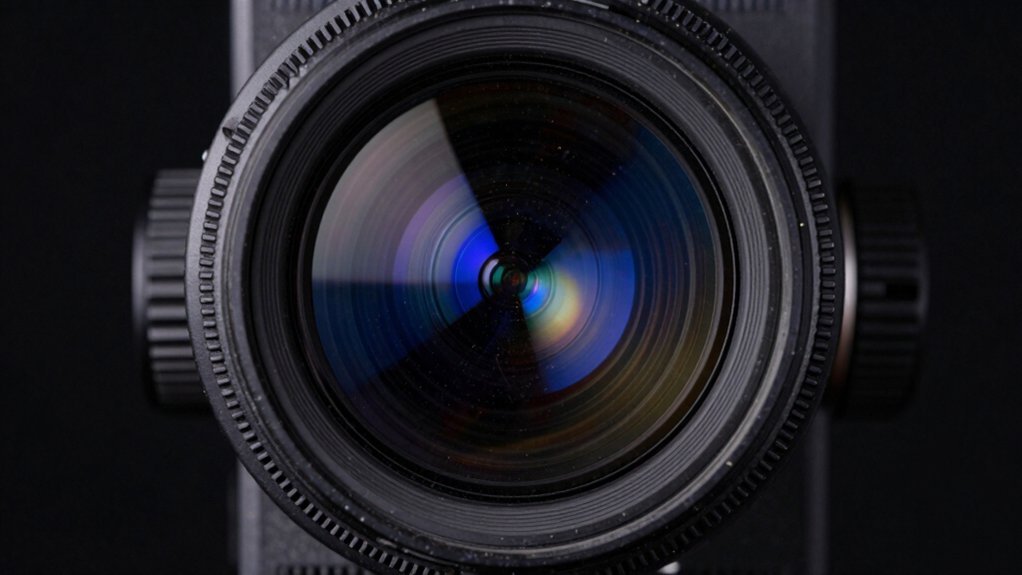
You’re wondering why radio dishes dwarf optical scopes, and you’ve hit on the key issue. Radio waves are huge compared to light, so you need massive apertures to sharpen blurry images. Since celestial signals arrive incredibly weak, doubling your dish diameter quadruples the power you catch. Luckily, rough mesh surfaces work fine here, unlike fragile optical mirrors. Stick around to see how engineers link these giants into one virtual eye.
Why Must Radio Telescopes Be Larger Than Optical Ones?
Since you’re wondering why radio dishes dwarf optical telescopes, you’ve hit on the core physics of light. Visible light waves are tiny, roughly one ten-millionth of a meter long. Radio waves stretch out, sometimes reaching meters or even kilometers in length. This massive gap dictates everything about your telescope’s design.
Here’s the thing: angular resolution depends directly on wavelength divided by aperture size. Longer waves naturally blur details unless you build a huge dish. A small radio antenna simply can’t separate close stars like an optical scope does. Diffraction spreads those long signals too much for clear pictures.
Obviously, you need a giant collector to match optical sharpness. That physical rule forces engineers to construct enormous metal bowls instead of compact mirrors. Surface precision matters less here, letting you scale up easily. You’re fighting wave physics, not just engineering limits. Next, consider how weak signals demand these massive collecting areas. To make these abstract concepts easier to grasp, visual diagrams often illustrate wave diffraction patterns alongside real-world telescope comparisons. Understanding the relationship between signal strength and dish area further clarifies why size is non-negotiable for detecting faint cosmic emissions. While optical instruments rely on glass mirrors to focus short wavelengths, radio dishes function effectively with mesh surfaces because the long wavelengths cannot pass through the gaps.
How Do Weak Signals Demand Massive Collecting Areas?
You’ve grasped why size fixes blurry images, but faint signals demand even more from your dish. Celestial objects send weak emissions that hit Earth with incredibly low intensity. A small antenna simply misses too much of this precious energy.
Here’s the thing: your collecting area directly dictates your signal strength. Doubling your dish’s diameter quadruples the captured power, lifting faint whispers above the noise floor. Without massive surfaces, receiver noise swallows distant galaxies before you can analyze them.
Obviously, bigger dishes intercept more radio waves before they vanish. The Square Kilometre Array targets one square kilometer of area to boost sensitivity fifty times over. You need that sheer volume to gather enough total energy for useful processing. Understanding the historical context of such projects reveals how decades of development were required to achieve these massive scales. Effective observation also relies on radio interference mitigation to ensure that human-made signals do not drown out the cosmic data collected by these vast arrays. While optical telescopes focus on resolving fine details through large mirrors, radio astronomy prioritizes gathering sufficient signal strength to detect these incredibly faint cosmic emissions.
Why Do Longer Wavelengths Require Wider Apertures?
While you might think bigger dishes only catch fainter signals, they actually fix a blur caused by long waves. You see, radio waves stretch meters long, unlike tiny light waves. This size difference creates massive diffraction limits that smear your image badly.
Here’s the thing: angular resolution depends directly on the wavelength divided by aperture size. If you keep the dish small, those long waves spread out wildly. You’d see one giant blob instead of distinct stars or galaxies. Obviously, you need a huge diameter to shrink that spreading angle back down.
Doubling the wavelength means doubling your dish size just to maintain the same sharpness. That is why radio telescopes look so gigantic compared to optical ones. They fight physics, not just weakness. You simply cannot get clear pictures without massive scales. Unlike optical instruments where aperture size primarily determines light-gathering power and cost, radio astronomy demands enormous scales fundamentally to overcome the laws of diffraction. This fundamental constraint means that achieving high resolution requires a larger aperture to compensate for the extensive length of radio waves compared to visible light.
Why Can Radio Dishes Use Rougher Surfaces?
Precision sounds non-negotiable, doesn’t it? You’d think every telescope needs a perfectly smooth mirror to work correctly. But here’s the thing: radio waves are huge compared to light waves.
Your optical mirror must be smooth within a micrometer, or you lose focus instantly. Radio dishes tolerate surface irregularities because of simple wavelength dependence. If bumps stay smaller than the wave, the signal ignores them completely. A centimeter-wave dish handles dents that would ruin visible light optics.
You can even build reflectors from wire mesh. The holes vanish to long radio waves, acting like solid metal. This trick slashes weight and wind resistance dramatically. Engineers swap expensive polishing for sturdy structural designs instead.
Roughness only matters when it approaches the wavelength size. Your large dish stays efficient despite coarse panels. This forgiveness lets you build gigantic collectors cheaply. Next, consider how we link these massive dishes together virtually. Understanding surface accuracy requirements reveals why optical instruments demand flawless glass while radio arrays thrive with mesh. The fundamental rule governing this tolerance is that surface errors must remain significantly smaller than the observed wavelength to prevent signal scattering. Achieving this level of optical precision in traditional telescopes requires costly grinding and testing processes that radio engineering largely avoids.
How Does Interferometry Build Giant Virtual Telescopes?
You just learned rough surfaces work fine, so how do we get sharp images from scattered dishes? You connect multiple separated antennas to act as one giant instrument. This trick creates huge interferometric advantages by making resolution depend on the distance between dishes, not their individual size.
Now, imagine syncing telescopes hundreds of kilometers apart using atomic clocks. You record signals separately, then mathematically correlate the data streams later. This process, called aperture synthesis, reconstructs a clear sky image from complex interference patterns. You fundamentally build a virtual telescope as wide as Earth itself without pouring any concrete. The Very Large Array utilizes this method with 27 adjustable antennas to optimize observation and capture detailed cosmic images. By combining these signals, the system effectively mimics the angular resolution of a single dish spanning the entire distance between the outermost antennas. Even under less than perfect observing conditions, this technique allows astronomers to gather high-quality data that would be impossible with a single optical instrument. Unlike optical systems that require smooth mirrors to focus visible light, radio waves allow for this unique signal correlation across vast distances without needing physically connected structures.
Obviously, this method solves the impossible task of building one massive solid dish. You gain incredible detail while avoiding structural limits that plague optical designs. The takeaway? Separation creates clarity where single mirrors fail. Next, you might wonder why weather doesn’t ruin these precise radio measurements.
Why Does the Atmosphere Matter Less for Radio Waves?
Since you’re wondering why rain doesn’t ruin radio views like it does optical ones, here’s the thing. You see, atmospheric transparency varies wildly across the spectrum. While clouds block visible light completely, radio waves often punch right through them easily.
Now, consider frequency absorption. Water vapor and oxygen do absorb high-frequency signals above 30 GHz. However, lower frequencies between 5 MHz and 30 GHz slip through our atmosphere’s “radio window” quite well. Obviously, heavy rain still scatters signals above 6 GHz, but fog barely touches waves below 2 GHz.
The ionosphere reflects low frequencies, yet it lets most useful astronomy bands pass. You get clear views day or night without waiting for perfect weather. This selective openness means you don’t need mountaintops for every observation. Your telescope works while optical ones sit idle in the clouds. Unlike optical instruments that rely on precise glass optics to focus light, radio dishes collect long wavelengths that are far less disturbed by atmospheric turbulence. While optical stargazers must carefully select a telescope type based on specific viewing goals and budget constraints, radio astronomers prioritize aperture size to overcome the inherent weakness of long-wavelength signals. Next, you might ask how engineers actually build these massive structures. Visualizing these wave interactions helps clarify why different telescopes require such distinct designs and locations.
What Makes Huge Radio Structures Technically Possible?
All right, you’re probably wondering how anyone builds a telescope nearly 3 kilometers wide without it collapsing. You can’t actually build one rigid dish that big; it would collapse under its own weight immediately. Instead, engineers use clever large antenna designs to solve these massive practical engineering challenges effectively.
Now, they link many smaller dishes together across vast distances using interferometry techniques. This setup creates a virtual aperture miles wide while avoiding structural failure risks entirely. Radio waves travel easily through cables, letting you combine signals from antennas far apart.
Obviously, this trick gives you Hubble-like resolution without needing a impossible single mirror. You get huge collecting area for faint signals while keeping construction realistic and affordable. So, you achieve giant scale through smart distribution rather than brute force construction methods. Just like optical stargazers benefit from expert-backed guidance to maximize their viewing sessions, radio astronomers rely on precise array configurations to unlock the universe’s secrets. Understanding signal processing is also vital, as raw data from these distributed antennas must be digitally correlated to form a coherent image. While optical instruments focus visible light through glass lenses or mirrors, radio arrays depend on aperture synthesis to simulate a single giant dish by combining data from separated elements.
Ready to see how these arrays actually capture images of distant galaxies?