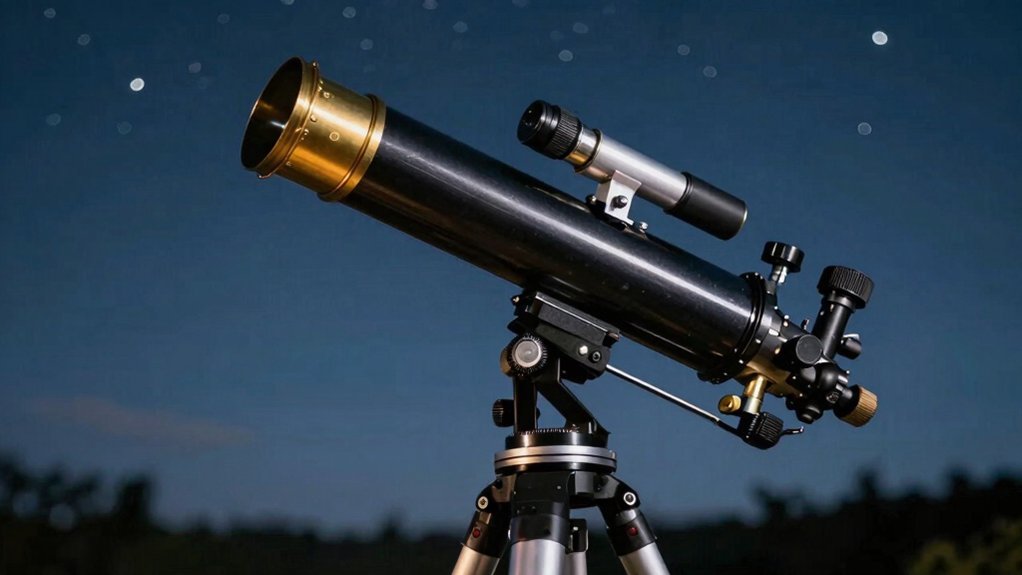
You’re confused by the messy history, but Hans Lippershey filed the first clear patent in 1608. He combined lenses for 3x magnification, though others like Janssen likely built similar devices earlier. Galileo soon boosted this to 30x, revealing Jupiter’s moons and changing astronomy forever. Early glass suffered color blur until Chester Moore Hall fixed it with stacked lenses in 1733. Now you see why the “inventor” title is complicated, yet the real story of optical evolution awaits just ahead.
Who Invented the First Working Refracting Telescope?
If you’re wondering who actually built the first working refracting telescope, you’ve hit on a famously messy bit of history. You’ll find Hans Lippershey, a Dutch spectacle maker, filed the earliest patent in 1608. He combined a convex objective lens with a concave eyepiece inside a simple tube. This device magnified distant objects about three times, proving immediately practical for demonstration.
Now, other makers like Zacharias Janssen claimed similar inventions simultaneously, creating genuine confusion. Yet Lippershey’s legacy endures because his documentation remains the clearest historical record we possess. You see, this moment sparked rapid telescope evolution across Europe within just months. Galileo soon heard these Dutch rumors and built his own improved version by 1609. Obviously, the original design was crude but functional enough to change everything. The initial patent application was ultimately rejected because the device was considered too easy to replicate. This early dispute highlights how the Dutch invention fundamentally shifted scientific observation forever. Notably, the spread of this technology relied heavily on the existing spectacle making trade to produce the necessary glass components quickly.
You now know the likely inventor and the basic optical setup involved. Next, let’s examine whether Lippershey truly deserves sole credit for this breakthrough.
Did Hans Lippershey Really Invent the Refracting Telescope?
Although you’ve heard Lippershey invented the telescope, that claim actually needs some serious unpacking. You see, he filed the first known patent in 1608, describing a practical device with 3× magnification. However, the Dutch government denied his exclusive rights because the concept seemed too familiar already.
Here’s the thing: historians view him as the best-documented early claimant, not the undisputed sole inventor. The records don’t prove he built the very first one, even if he popularized it. Uncertain origin stories among spectacle makers suggest others might have crafted similar lenses earlier. This period marked the beginning of a revolutionary telescope legacy that would fundamentally transform the field of astronomy. His application triggered a wave of optical innovation across Europe, rapidly advancing lens craftsmanship beyond simple magnification. The subsequent spread of these instruments allowed astronomers to make groundbreaking celestial discoveries that reshaped humanity’s understanding of the universe.
Were There Other Early Claimants Besides Lippershey?
So, did anyone else really beat Lippershey to the punch? You might suspect other spectacle makers were tinkering too. Jacob Metius actually filed his own patent just weeks later in 1608. The Dutch government even rejected Lippershey’s exclusive claim because the device seemed widely known already. Now, consider Hans and Zacharias Janssen, who some say built one back in 1595. Their evidence feels shaky compared to Lippershey’s solid paperwork, though. You see, the historical context suggests an active craft environment where multiple people created similar tools independently. These alternative inventors likely used existing lens skills to duplicate the design quickly. Obviously, we can’t name the true first inventor with total certainty today. The records only prove Lippershey was the earliest documented applicant, not the sole creator. This period of simultaneous discovery highlights how optical innovation was ripe for exploitation across the Netherlands at the time. Understanding that early devices relied on simple lens combinations helps explain why so many could replicate the design so quickly. While these early Dutch instruments offered modest magnification, modern stargazers often compare such origins to today’s choices regarding optics and performance. Keep this nuance in mind as you explore how Galileo soon changed everything next.
How Did Galileo Transform the Dutch Spyglass?
You’re wondering how a simple Dutch toy became a serious science tool, and that’s exactly the right question to ask. Galileo heard rumors in May 1609 and immediately built his own version using a tube and two lenses. He didn’t just copy the design; he radically improved it for real-world use.
Galileo’s innovations included pairing a convex objective with a concave eyepiece to create upright images. This specific setup allowed for practical applications ranging from terrestrial viewing to deep sky observation. You see, he pushed magnification from a weak 3× up to an incredible 30×.
Suddenly, you could spot Jupiter’s moons or the Moon’s rough craters clearly. This shift turned a curiosity into a powerful scientific instrument that changed astronomy forever. Now, consider how those specific lens choices defined early optical engineering standards. Understanding light refraction is essential to grasping why this specific combination of lenses successfully bent light rays to magnify distant objects. His work established the optical standards that guided telescope construction for generations of astronomers. For modern enthusiasts, mastering lens alignment remains a critical skill to ensure the clarity and performance of any refracting telescope.
What Defined Early Refracting Telescope Lens Designs?
Several distinct lens pairings actually defined those early instruments, and you’re right to wonder which one mattered most. Galileo’s design used a convex objective and concave eyepiece to keep images upright. Kepler later swapped that eyepiece for a convex one, giving you a wider view but flipping everything upside down.
Early lens crafting relied on simple grinding, so makers couldn’t fix optical errors easily. You’d see nasty colored fringes called chromatic aberration ruining your view constantly. To fight these flaws, builders stretched tubes to incredible lengths just to get a sharper picture. Obviously, single-element lenses had serious limits without modern glass types. Historical records indicate that Hans Lippershey filed the first known patent application for the device in 1608, sparking rapid improvements across Europe. Understanding the specific optical errors inherent in these early designs explains why astronomers struggled to achieve clear images despite increasing the instrument’s length. The inability to correct light dispersion meant that increasing magnification often resulted in a blurrier image rather than a clearer one.
These designs traded image orientation for field width while battling inherent blur. Your early telescope worked, but it demanded patience and steady hands to use effectively. Now you understand why length mattered so much before better solutions arrived.
Who Solved Chromatic Aberration in Refracting Lenses?
How exactly did makers finally fix those annoying color fringes ruining your view? You see, early lenses failed because color dispersion split light like a prism. Isaac Newton even thought you couldn’t fix it with glass alone.
Chester Moore Hall solved this in 1733 by stacking crown and flint glass. His achromatic lenses canceled out the blur, but he kept it quiet. John Dollond then made the design famous in the 1750s.
Now, you get sharp images because two glasses bend colors differently. This pairing brings red and blue light to the same focus point. Obviously, this changed astronomy forever by shortening your telescope tube. This innovation paved the way for the modern refractor designs that dominate amateur astronomy today. Selecting the right optical glass is critical because different materials disperse light at varying rates to achieve this correction. When comparing telescope options, understanding these optical performance differences helps you find the perfect stargazing match for your specific needs and budget.
You now understand who solved chromatic aberration and why it matters. Ready to explore how these lenses shaped modern astronomy?