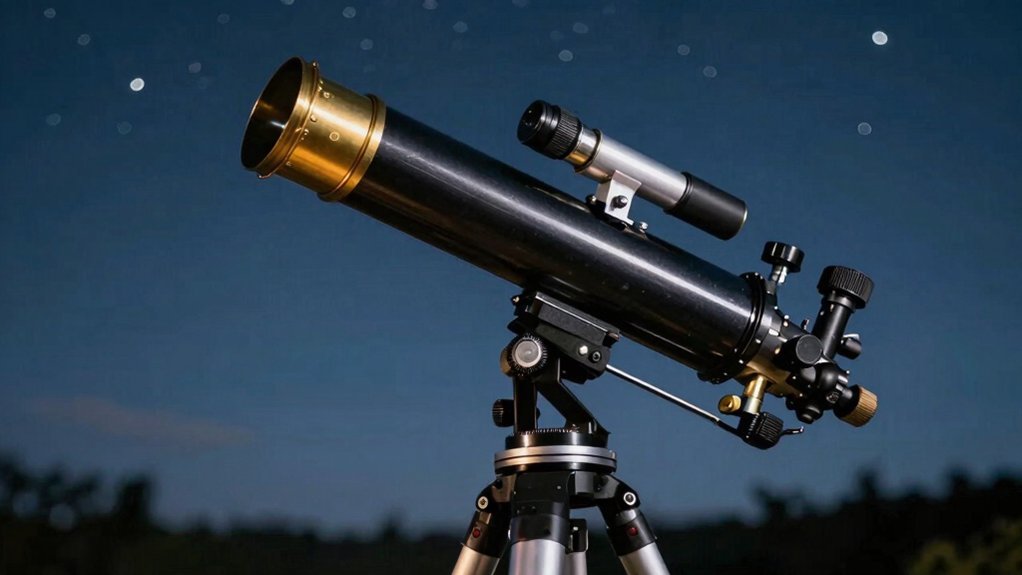
You’re confused because names like Zucchi and Gregory pop up before Newton, right? Here’s the thing: while they designed concepts earlier, Isaac Newton built the first *working* reflector in 1668. He used a metal mirror to stop color fringing that plagued glass lenses. Now, you know Newton made it functional, but earlier attempts existed. Obviously, practical success matters most in history. Keep exploring to see how his design evolved into today’s favorite backyard scopes.
Who Actually Invented the First Reflecting Telescope?
You’ve probably seen Isaac Newton‘s name everywhere and wondered if he really was the first to build a reflecting telescope. Obviously, you aren’t alone in this confusion because the answer involves some nuance. Newton definitely built the first practical, working model using a metal mirror back in 1668.
However, earlier designs from folks like Zucchi and Gregory actually existed before his success. This fact sparks a genuine historical debate about what “invention” truly means today. Did they invent it by drawing plans, or did Newton invent it by making it work? You need to distinguish between a cool idea on paper and a functional instrument in hand. These early conceptual attempts laid the theoretical groundwork for optical innovation even though they lacked immediate practical application.
Newton wins the credit because he solved chromatic aberration with a working device. So, while others dreamed it up first, he actually made it real. Now you know why textbooks highlight his 1668 breakthrough above all those previous concepts. His achievement established the legacy of revolutionary telescopes that fundamentally changed how astronomers observe the universe. This pivotal moment marked the beginning of a telescope revolution that allowed for clearer views of the cosmos without color distortion.
Did Earlier Scientists Build a Working Reflecting Telescope?
You’re wondering if anyone actually built a working reflector before Newton, and that’s a smart question to ask. Many proposed pre Newton designs, yet few became real instruments. Niccolò Zucchi tried building one back in 1616, creating what historians call Zucchi’s instrument. This crude device proves someone physically attempted the concept decades earlier. However, polishing mirrors was incredibly hard then, so most attempts failed or stayed theoretical.
Now, consider Leonard Digges, who might have built a mirror scope in 1556, though evidence remains shaky. James Gregory also designed a reflector in 1663 but never constructed a working model himself. You see, having a plan on paper differs vastly from holding a functional telescope in your hands. Newton succeeded where others struggled because he finally combined usable optics with precise alignment. His 1668 model worked well enough for public demonstration, securing his legacy. So, while others tried, Newton delivered the first truly practical machine. While early inventors struggled with mirror quality, modern guides emphasize that choosing the right telescope today depends heavily on understanding these historical optical trade-offs. Mastering optical alignment is essential because even slight deviations can ruin the image clarity in a reflecting design. Different telescope designs offer unique advantages based on light gathering capabilities, which directly influence how faint objects appear to the observer. Ready to see how this design fixed color issues?
How Did the Reflecting Telescope Fix Color Distortion?
Since you’re wondering how mirrors beat lenses at stopping color blur, you’ve hit on the exact problem Newton solved. Early lenses bent blue and red light differently, creating messy fringes around bright stars. You saw this color distortion ruining your view through old glass tubes.
Now, Newton realized glass separated colors like a prism, but mirrors didn’t. His key optical principle relied on reflection, which treats all wavelengths equally. You get a single sharp focus because the mirror bounces every color to the same spot.
Here’s the thing: he didn’t fix the lens; he removed it entirely. By swapping glass for a concave mirror, you eliminate the root cause of the blur. This design gave you crisp images of planets without those annoying rainbow edges. Newton’s 1668 invention utilized a concave primary mirror to gather light and reflect it toward a flat secondary mirror, ensuring that different colors of light did not refract at different angles as they did in lens-based systems. Unlike refracting telescopes that suffer from chromatic aberration, this configuration allows for shorter focal lengths while maintaining high image clarity. Modern stargazers often choose this design because it offers superior light gathering capabilities at a lower cost compared to similar-sized refractors. While high-end optics can be expensive, understanding realistic price ranges helps buyers find quality instruments that fit every budget without sacrificing performance.
What Made Newton’s First Reflecting Telescope Functional?
You’re probably wondering how Newton actually made his mirror idea work in real life. He crafted a concave primary mirror from speculum metal, avoiding the color distortion plaguing lenses. This metal alloy required intense mirror polishing to create a usable reflective surface. Unlike modern glass mirrors coated with aluminum or silver, his speculum metal composition was prone to tarnishing quickly and required frequent re-polishing to maintain reflective efficiency.
Now, consider his clever optical design. A small flat diagonal mirror intercepted light inside the six-inch tube. It redirected rays ninety degrees toward a side-mounted eyepiece, making observation practical. You’d find this compact layout far easier to handle than huge refractors. By eliminating the need for long tubes to prevent color fringing, this design capitalized on the benefits of folded optics to create a more manageable instrument.
All right, here is the result. His 1668 prototype achieved forty times magnification, proving mirrors could focus light effectively. This working model demonstrated that careful construction overcame earlier theoretical failures. You see, specific details like the one-inch aperture mattered immensely for success.
Ultimately, Newton’s functional instrument validated his entire approach to optics. Ready to explore why this specific layout remains unique today? Understanding optical aberrations helps explain why his reflective design solved problems that lenses could not.
Why Is the Newtonian Reflecting Telescope Layout Unique?
So, why does this specific layout stand out from every other telescope design you’ve seen? You notice the eyepiece sits on the side, not the back. A flat diagonal mirror folds light ninety degrees right before it hits focus. This clever trick avoids drilling a hole in your primary mirror.
Here’s the thing: that simple flat glass boosts your optical efficiency considerably. It redirects beams without adding extra focusing power or complex curves. Your mirror design stays pure, using just two surfaces to gather sharp images. The elliptical secondary blocks only a tiny bit of incoming light too.
Obviously, this open-tube geometry makes viewing comfortable and mechanically simple for you. You get maximum contrast with minimal obstruction blocking your view. This unique combination defines the classic Newtonian reflector forever. Now you understand exactly why amateurs love building this specific, straightforward instrument today. The design allows for larger apertures without the weight issues that plagued early refracting telescopes. Modern builders appreciate how this configuration provides current status as the most popular choice for amateur astronomers worldwide. By eliminating chromatic aberration entirely, the Newtonian layout ensures color-free images that refractors often struggle to achieve without expensive lenses. Expert guidance confirms that mastering optical alignment is essential for maintaining the crisp resolution this design promises.
When Did Reflectors Replace Refracting Telescopes?
Although you might assume lenses ruled forever, reflectors actually started winning the race back in the 1660s. Newton built his first working model in 1668, directly addressing severe refractor limitations like color distortion. You see, early glass lenses simply couldn’t focus light without creating rainbow halos around stars.
Now, reflector advantages grew slowly because polishing metal mirrors was incredibly difficult for centuries. Large refractors still thrived through the 1800s since making huge glass lenses remained technically feasible then. However, silvered glass mirrors arrived by 1857, finally making big reflectors practical for serious observatories. This shift allowed astronomers to construct larger apertures that gathered significantly more light than any refractor could support. Understanding how light reflection functions in these instruments clarifies why they eventually surpassed refractors in both size and image clarity. Modern enthusiasts should also prioritize mirror collimation to ensure their optical systems maintain peak performance during observation.
Is the Newtonian Reflecting Telescope Still Used Today?
Wondering if that old Newtonian design actually still works today? You’ll be glad to know it absolutely does. Modern sellers keep marketing these scopes because you still see them everywhere in backyards.
Here’s the thing about those specific Newtonian advantages. They offer huge apertures without breaking your bank account. You get bright, sharp images since mirrors avoid the color fringing that plagues cheap lenses.
Amateur usage remains incredibly strong across the globe. Hobbyists love building or buying these six-to-twenty-inch giants for deep-sky hunting. While big observatories use fancier layouts, you won’t find a better starter scope for learning the night sky. This design remains a top choice because it provides superior light gathering power compared to refractors of similar cost.
Obviously, this 1668 invention isn’t just a museum piece anymore. It is a living, breathing tool for modern stargazers like you. So, are you ready to point one at the Moon tonight? By utilizing a curved primary mirror, this optical system reflects light to a focal point without the chromatic aberration found in lens-based telescopes.