You’re confused because there isn’t just one “first” space telescope, and honestly, you asked the right question. Ariel 1 launched in 1962, but OAO-2 became the first true operational observatory in 1968 by scanning ultraviolet light. Hubble later revolutionized optics in 1990 with images fifty percent sharper than ground views. Now you see why definitions matter so much here. Keep going to reveal exactly which mission fits your specific research needs.
Why Isn’t There Just One First Space Telescope?
Since “space telescope” means different things, you’ll find multiple “firsts” depending on which definition you use. You might wonder why a single date doesn’t settle this debate once and for all. Obviously, the answer lies in how we define our telescope categories today.
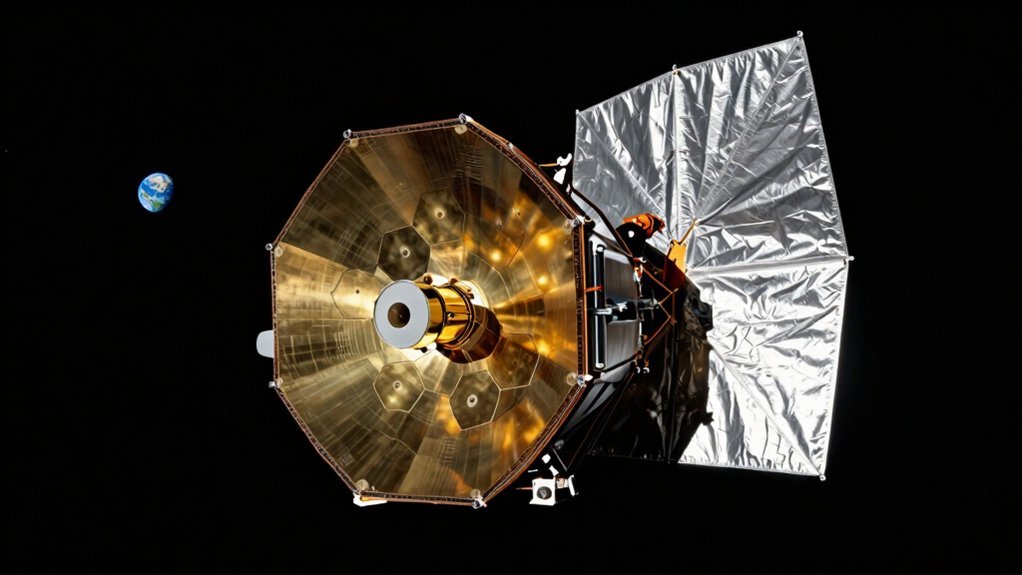
Ariel 1 reached orbit in 1962, yet it wasn’t a dedicated observatory like later missions. OAO-2 followed in 1968 as the first true astronomy satellite, changing everything. Hubble arrived much later in 1990 but claimed the title of first major optical scope.
You see, launch order matters less than your specific research focus right now. Did you need UV data or broad optical views? That choice decides your winner. Dedicated observatories like OAO-2 prioritized science over simple instrument testing. Understanding these telescope categories helps clarify why different missions hold the “first” title depending on your astronomical goals. Just as ground-based observers must consider viewing conditions to see clearly, early space missions had to overcome specific environmental hurdles to capture valid data. Much like selecting the right gear based on optics performance, identifying the inaugural space telescope requires matching the mission’s capabilities to its historical context.
What Did Lyman Spitzer Propose in 1946?
All right, you’re wondering what Lyman Spitzer actually dreamed up back in 1946. He proposed placing a massive telescope in orbit, far above our blurry atmosphere. This bold idea appeared in his paper “Astronomical Advantages of an Extra-Terrestrial Observatory.” You’d see how Spitzer’s vision targeted clear images impossible from the ground.
He argued that space advantages included accessing hidden light wavelengths and sharper resolution. Imagine viewing stars without atmospheric distortion messing up your view. His design suggested a mirror between five and fifteen meters wide. That was huge compared to the Palomar telescope being built then.
Spitzer believed this tool would revolutionize astronomy by revealing totally new phenomena. He wasn’t just tweaking existing methods; he wanted to change everything. This 1946 report became the true starting point for modern space planning. Now you understand the specific origins of the concept before any launch. By avoiding the atmospheric distortion that blurs ground-based views, his proposed observatory could achieve a level of clarity unattainable on Earth. While ground-based observers must carefully compare optics and performance when choosing equipment, Spitzer’s orbital concept eliminated the need to compromise on image clarity due to Earth’s interfering air. Just as selecting the right telescope aperture is crucial for ground-based observation, Spitzer recognized that a large mirror in space would gather enough light to see faint objects clearly.
Was Ariel 1 the First Telescope Launched?
So, you’re wondering if Ariel 1 really holds the title of the first space telescope? You’ve probably seen it mentioned in passing, but here’s the thing: it wasn’t actually a telescope at all.
Ariel 1 was a scientific satellite designed for ionosphere study, not for imaging distant stars or galaxies. Its six experiments measured solar radiation and cosmic rays, focusing entirely on Earth’s upper atmosphere.
You might confuse it because some sources loosely call it an observatory, but that term covers broad satellite research too. Obviously, studying our own planet’s ionosphere differs fundamentally from astronomical observation.
This British satellite launched in April 1962, marking a huge milestone for international cooperation instead. It proved nations could work together in orbit, even without a telescope onboard. While it paved the way for future missions, the true legacy of a revolutionary telescope would only begin with instruments specifically built to capture light from the deep universe. Unlike dedicated observatories that compare optics and performance for stargazers, Ariel 1 lacked the imaging capabilities required to function as a true telescope. The mission instead prioritized collecting data on solar radiation to better understand how the Sun affects our planet’s atmosphere.
How OAO-2 Became the First Operational Observatory
Two earlier attempts failed, so you’re right to wonder how OAO-2 finally cracked the code. You see, OAO-1 died quickly from power issues, but Stargazer solved those Satellite challenges brilliantly. Launched in 1968, it delivered stable power and precise pointing for four whole years.
Now, consider the real OAO 2 advancements that changed everything for astronomers like you. It pointed within one arc second, acting like a steady hand holding a camera above our atmosphere. This stability let instruments scan ultraviolet light from over 1,200 stars and galaxies successfully.
Here’s the thing: previous rockets only offered brief glimpses, yet this observatory worked autonomously for years. You get sustained data on comets and novae that ground telescopes simply cannot capture. Obviously, this mission proved space observatories were practical, not just wild dreams. This success laid the essential groundwork for the legacy of Hubble that would follow decades later.
You now understand why Stargazer stands as the first truly operational eye in space. Ready to see why Hubble later stole the spotlight?
Why Hubble Is the First Major Optical Telescope
You’re probably wondering why everyone calls Hubble the first when OAO-2 beat it by decades. Here’s the thing: earlier scopes like OAO-2 focused on ultraviolet light, not visible optics. Hubble changed everything by becoming the first major optical telescope orbiting Earth.
Now, consider its massive size. This school-bus-sized giant carries a 2.4-meter mirror weighing 27,000 pounds. That scale enabled significant achievements no small experimental instrument could ever match alone. You get images fifty percent sharper than ground-based views because Hubble floats above atmospheric blur. Unlike ground-based instruments that suffer from light pollution and weather, this space-based observatory operates in the vacuum of space to ensure uninterrupted data collection. Just as a successful web page requires a practical step-by-step walkthrough, understanding Hubble’s history demands a clear logical progression of facts to avoid common misconceptions.
All right, so why does this distinction matter to you? These optical advancements let astronomers see objects thirteen billion light-years away clearly. It transformed astronomy from short demonstrations into a long-running scientific platform. Obviously, being “major” means delivering unprecedented clarity for visible-light study. While earlier satellites paved the way, Hubble’s design prioritized visible-light study to match the specific needs of stargazers and professional astronomers alike.
You now understand why Hubble holds the title despite earlier launches. Next, you must decide which definition of “first” actually fits your specific search needs.
Which Definition of “First” Matches Your Search?
How do you pick the right “first” when every source seems to disagree? You must decide what “first” truly means for your specific research needs today.
Do you want the very first hardware launched, like Ariel 1 in 1962? Or do you need the first operational observatory, such as OAO-2 in 1968?
Space telescope history gets messy because early astronomy missions had different goals entirely. Some satellites just carried instruments, while others were built solely for astronomy, like Uhuru.
You should match your definition to your actual question before diving deeper into data. Obviously, picking the wrong standard leads to confusing and conflicting answers quickly.
Now you know which milestone matters most for your own personal project work. Which specific type of “first” are you actually looking for right now?
Understanding these distinctions helps enthusiasts apply expert-backed guidance to clarify historical timelines when exploring the night sky. Just as selecting the right telescope optics determines your view of the stars, defining your historical criteria determines the accuracy of your research. Much like choosing the correct optical design impacts image clarity, identifying the precise mission type ensures your historical analysis remains accurate.