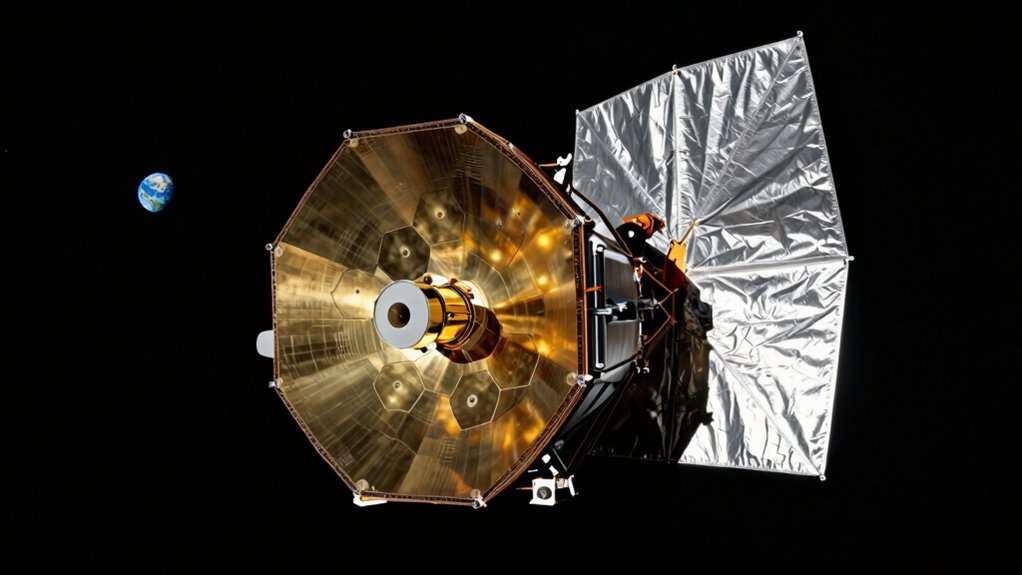
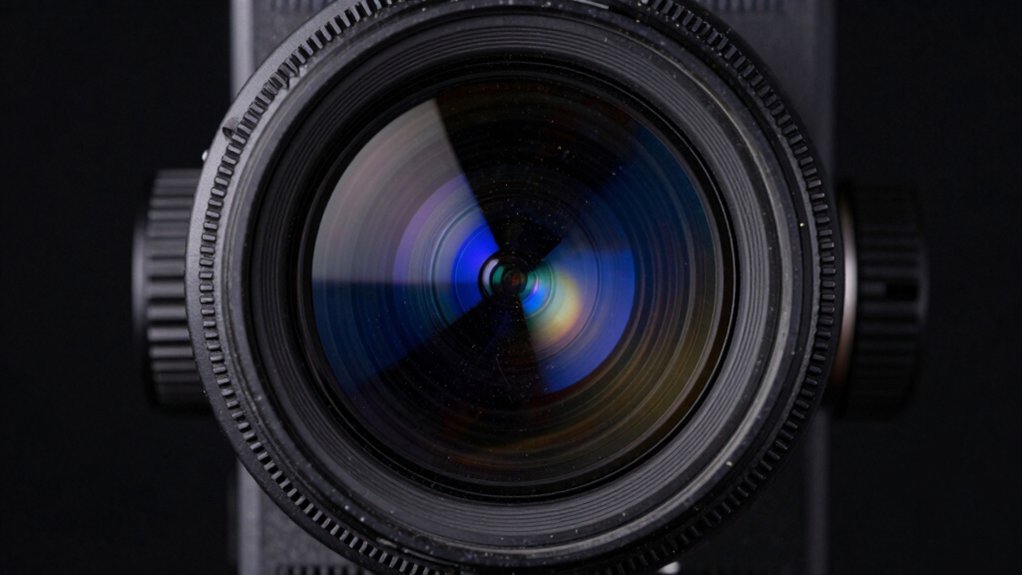
You’re wondering if lenses or mirrors suit your stargazing better. Refractors use front lenses for sharp, high-contrast planet views but suffer from color fringing. Reflectors bounce light off mirrors, gathering four times more light in a 200mm scope than a 100mm one. Obviously, mirrors eliminate color issues and cost less per inch. However, you must align reflector mirrors frequently, while refractors stay ready. Your specific targets decide which tool fits your night sky adventures.
How Do Refractor and Reflector Telescopes Differ?
Since you’re wondering how these two telescope types actually differ, let’s clear up that confusion right now. You see, the core difference lies in their optical design. Refractors use a front lens to bend light directly to your eye. Reflectors bounce light off a curved mirror instead. This fundamental choice shapes everything else about your viewing experience.
Now, consider image quality. Refractors deliver sharp, high-contrast views perfect for planets. However, cheap lenses sometimes show rainbow halos around bright stars. Mirrors avoid this color issue entirely since they reflect all wavelengths equally. Yet, reflectors need careful alignment to keep images crisp. Obviously, no single design wins every category here. Maintaining this optical alignment is essential for reflectors to prevent blurry images caused by mirror shifts during transport or use.
Here’s the thing: your specific observing goals dictate the better choice. Do you prioritize portability or raw light-gathering power? Think about what you actually want to see most often before deciding. Additionally, understanding chromatic aberration helps explain why refractors may struggle with color fringing while reflectors do not.
Why Reflectors Gather More Light for Deep Sky
All right, you’re wondering why reflectors suddenly become the go-to choice for faint galaxies. It’s simple: aperture size drives everything. You need massive light collection to spot dim nebulae or distant star clusters hiding in the dark. Reflectors let you buy huge mirrors cheaply because making big glass lenses costs a fortune.
Here’s the thing: bigger mirrors act like giant buckets catching more photons from space. This extra intensity directly boosts your deep sky visibility, revealing fuzzy patches that small scopes miss entirely. You’ll see sprawling structures clearly because the design prioritizes raw gathering power over perfect sharpness. Obviously, faint objects demand every available photon you can grab with your budget. By maximizing this light-gathering power, enthusiasts can observe celestial details that remain invisible to smaller instruments. Unlike refractors where cost scales rapidly with lens diameter, the mirror manufacturing process allows reflectors to achieve significantly larger apertures for deep sky observation within a reasonable budget. This optical configuration eliminates chromatic aberration entirely, ensuring that color fidelity remains perfect even at high magnifications.
How Refractors Deliver Sharper Planet Views
When you’re hunting for crisp details on Jupiter, you might wonder why refractors often beat bigger scopes. Their unobstructed light path creates a massive contrast advantage, letting fine detail pop instantly. You see sharper edges because lenses scatter only about 2% of light, boosting overall image quality noticeably.
Now, consider how optical simplicity helps your viewing sessions. You skip complex collimation checks and enjoy faster thermal stability than mirror-based designs need. This means you start visual observing sooner with steady, high-definition views right out of the gate. The exposed objective lens allows the system to cool down quickly, ensuring stable air inside the tube for sharper images sooner than larger reflectors. By eliminating the central obstruction found in other designs, these telescopes maximize light transmission efficiency to preserve subtle planetary features that might otherwise be lost. Additionally, the sealed tube design effectively prevents internal air currents from degrading image stability during observation. Beginners should also prioritize proper mount stability to ensure vibrations do not blur the high-contrast views these optics provide.
All right, remember that equal aperture favors the refractor for planetary sharpness every single time. You get tightly defined images where subtle belts and zones remain clearly visible against dark space. Obviously, this specific design delivers superior definition on bright targets without extra hassle or adjustment headaches.
Your next step involves understanding potential lens flaws that might affect these otherwise perfect views.
What Causes Chromatic Aberration in Lenses?
You might spot those annoying color fringes on bright planets and wonder why your perfect lens isn’t perfect. Here’s the thing: glass bends blue light more sharply than red light. This phenomenon, called lens dispersion, splits white light into separate colors before they reach your eye.
Obviously, a single lens element cannot force every wavelength to focus at one exact point. Shorter wavelengths converge sooner, while longer ones lag behind slightly. This mismatch creates visible color fringing along high-contrast edges like lunar craters. You see purple or green halos because your optics simply can’t align everything perfectly. This occurs because shorter wavelengths exhibit greater dielectric capacitance, causing them to refract more intensely than longer red wavelengths. To counteract this issue, advanced telescopes often utilize an achromatic doublet design that combines two different types of glass to bring two wavelengths into focus at the same point.
All right, so simple designs struggle most with this inherent physical limitation. Stronger dispersion in cheap glass makes those blurry, colored edges much worse for you. Understanding this flaw explains why some refractors cost considerably more than others. Now, does this optical trade-off mean you should abandon lenses entirely for your next purchase? While chromatic aberration is a significant concern for refractors, it is completely absent in reflector telescopes because their primary mirror uses reflection rather than refraction to gather light. Consequently, many stargazers find that reflector telescopes offer a more cost-effective solution for deep-sky observing without the burden of color fringing.
Why Reflectors Offer Better Value Per Inch
By shifting from lenses to mirrors, you instantly release way more aperture for your hard-earned cash. You get serious cost efficiency because mirrors cost far less to make than large lenses. This aperture advantage means an 8-inch reflector often costs half as much as a 4-inch refractor.
Now, consider the mirror performance delivering four times the light grasp for faint deep-sky objects. Obviously, bigger mirrors gather way more light without breaking your budget completely. You see dimmer galaxies clearly thanks to this raw optical power. Reflectors utilize a parabolic primary mirror to focus incoming light directly to the eyepiece without the chromatic aberration found in simple lens systems.
All right, size tradeoffs mean these tubes get bulky, and maintenance challenges like collimation exist. You must align mirrors occasionally, unlike sealed refractors needing zero adjustment. Yet, the value remains unmatched for serious observers prioritizing view quality over portability. Just as a clean web page layout enhances user experience, proper optical alignment ensures the clearest possible view of the stars.
You gain massive capability per dollar despite needing occasional tweaks. Ready to see how that extra aperture actually changes your night sky views? Understanding optical design fundamentals helps clarify why this cost difference exists between the two telescope types.
How Aperture Size Changes Your View
That extra aperture you just saved money on actually transforms what hits your eye. You might wonder why aperture importance matters so much for your viewing sessions. Well, light collection scales with area, meaning a 200mm scope gathers four times more light than a 100mm one. This boost directly enhances your brightness perception, making faint galaxies suddenly pop against the dark sky. Now, resolution improvement lets you split tight double stars that smaller tubes simply blur together. However, remember that magnification limits exist; pushing too high just creates a bigger, fuzzy mess without enough glass. Your visibility range expands dramatically as you choose an ideal size like 150mm for planets or 120mm for deep space. Obviously, bigger isn’t always better if you can’t carry it, but more aperture reveals hidden details. Balance your needs carefully before deciding which telescope truly fits your specific observing goals. Since the light gain with bigger apertures is exponential, not linear, even modest increases in diameter yield substantial improvements in detecting faint celestial objects. When comparing optical designs, a reflector telescope often provides larger apertures for the price compared to refractors, allowing budget-conscious stargazers to maximize light gathering power. Understanding optical aberrations is also crucial, as different designs handle color fringing and edge distortions uniquely, affecting the final clarity of your view. Additionally, the focal ratio of your instrument determines the field of view and image brightness, influencing whether your setup is better suited for wide-field nebulae or high-power planetary observation.
What Maintenance Do Reflector Mirrors Need?
Since you’re wondering how often to clean those mirrors, here’s the good news: you rarely need to scrub them. Light dust won’t hurt your views, so save actual mirror cleaning for visible grime only. Frequent washing risks damaging delicate coatings, so inspect first before acting.
Start by blowing loose particles away with a gentle puffer bulb. Avoid brushes that might scratch the surface during this initial step. Obviously, never touch the glass directly with bare fingers.
Use lukewarm water and mild soap if deeper washing becomes necessary. Rinse with distilled water to prevent annoying spots later. Let gravity drain the moisture while the mirror stands vertically.
Don’t forget periodic collimation checks alongside your cleaning routine. Misalignment blurs images just as much as dirt does. Reassemble carefully and cover optics when storing. Proper storage prevents dust accumulation and protects delicate coatings from environmental damage. Understanding how light reflection functions within the tube helps explain why keeping the primary mirror pristine is critical for image quality. Successful observation also depends on finding a location with minimal light pollution to ensure the clearest possible views of the night sky.
Your takeaway: clean less, check alignment more. Now, have you considered why refractors skip this hassle entirely?
Why Refractors Require Less Alignment
Two key design choices keep your refractor’s lenses locked in place forever. You get a sealed tube and fixed lenses, creating unmatched alignment stability. Obviously, this means your optical components stay put without constant tweaking.
Here’s the thing: reflectors need frequent mirror adjustments, but you skip that hassle. Your factory-set lens cell resists shifts from transport or temperature changes. Fewer moving parts equal fewer chances for things to drift out of sync.
Now, imagine setting up quickly while others fiddle with collimation tools. You just point and shoot because the system stays true. Only a hard knock usually demands your attention for realignment checks.
This “no-fuss” reality lets you focus on stars, not screwdrivers. Ready to see how this impacts your specific observing goals?
Which Telescope Fits Your Stargazing Goals?
You’ve nailed the maintenance differences, but picking the right tool depends entirely on what you actually want to see. Your observing preferences dictate everything here. Do you crave sharp lunar craters? Refractors deliver unmatched visual clarity for bright planets without central obstructions blocking light. They shine for crisp, high-contrast views. Maybe you hunt faint galaxies instead? Reflectors gather more light cheaply, making them perfect for deep-sky treasures. Larger mirrors reveal dim nebulae that small lenses miss. You get bigger apertures for your budget. Consider portability too. Small refractors travel easily, while big reflectors bulk up your car trunk. Astrophotographers often pick apochromatic refractors for clean images, though reflectors work for deep-sky imaging if you handle the extra maintenance. Align your gear with your specific targets. For those prioritizing ease of use, altazimuth mounts offer a simpler and more intuitive setup compared to the complex alignment required by equatorial models.
How to Choose Between Refractor and Reflector
How do you actually pick between these two telescope types when both seem perfect on paper? You must weigh your specific observing goals against your budget constraints right now.
Prioritize a reflector if you crave deep-sky views, since mirrors offer huge apertures cheaply. Refractors deliver superior optical quality for planets, giving crisp images without color fringing issues.
Consider telescope portability carefully before you commit to any large instrument purchase today. Small refractors travel easily, while big reflectors need bulky mounts and frequent mirror alignment checks.
Obviously, maintenance matters if you want simple, grab-and-go sessions under the stars nightly. Reflectors demand collimation, whereas refractors stay sealed and ready for immediate viewing action always.
Choose the reflector for faint galaxies or the refractor for sharp lunar details. Which celestial targets excite you enough to justify the extra upkeep or cost?