You’re wondering if your scope can spot billion-light-year galaxies like Hubble. Here’s the thing: distance depends entirely on your aperture size, not just magnification. A small 3-inch telescope sees Andromeda at 2.5 million light-years, while an 8-inch model reaches quasars 2 billion light-years away. Obviously, light pollution and atmosphere limit your view too. Keep exploring to uncover exactly how far your specific gear can truly push the cosmic horizon.
How Far Can Different Telescopes Actually See?
You’re probably wondering if buying a bigger telescope instantly lets you see billions of light-years farther. Honestly, your small 3-inch scope already spots Andromeda at 2.5 million light-years away. That’s pretty amazing for such a tiny instrument.
Different telescope types change what you actually perceive, not just raw distance. An 8-inch model reaches 2 billion light-years, revealing faint quasars clearly. However, magnification limits mean pushing power too high just creates fuzzy, useless blobs. You need light-gathering ability more than extreme zoom for deep space. Even a modest Celestron Astromaster 114 EQ can resolve lunar details as small as 4 kilometers.
Space telescopes like Hubble bypass our atmosphere to see 13 billion light-years back. Your backyard scope can’t match that, but it still shows incredible cosmic depth. Brightness matters far more than simple mileage figures when observing distant galaxies. Ultimately, selecting the right aperture size based on your specific viewing goals and budget is more critical than chasing maximum distance numbers. Understanding how optical resolution functions helps explain why clarity often trumps sheer distance in practical astronomy. The effectiveness of any instrument relies heavily on its light gathering capacity to collect enough photons from faint, distant objects.
What Limits Your Telescope’s Viewing Distance?
Although your scope seems powerful, several hidden factors actually cap how far you can see. You might think bigger lenses solve everything, but aperture effects only matter if light conditions allow faint photons through. Atmospheric impact often blurs fine details before they even reach your eye, ruining resolution factors instantly. The angular resolution determines the smallest detail visible, setting a hard ceiling on how clearly distant objects appear regardless of their brightness.
Now, consider magnification limits; pushing past 50x per inch just creates a dim, blurry mess. Different telescope designs handle these physics differently, yet observing strategies ultimately define your success. You need smart observational techniques to beat sky glow and maximize every session. Obviously, poor planning wastes potential distance regardless of your gear’s theoretical power. The stability of the air, known as atmospheric seeing, frequently dictates the maximum useful magnification more than the telescope itself.
Here’s the thing: dark skies beat huge apertures in suburban backyards every single time. Mastering these variables lets you push boundaries further than raw specs suggest. Ready to test your local limits tonight? To get started, you should first learn what you can realistically see based on your specific location and equipment.
How Far Can a 3-Inch Telescope See?
Since you’re wondering just how far a 3-inch scope really reaches, let’s clear up that confusion right now. You can actually spot the Andromeda Galaxy, sitting 2.5 million light-years away. This distance proves your telescope capabilities extend far beyond our solar system. However, remember that aperture drives your light gathering power directly. You won’t see faint details like larger scopes reveal, but bright clusters shine clearly. The Moon looks fantastic with crisp craters visible at high magnification. Pushing past 150x usually creates blurry, empty magnification though. Atmospheric turbulence often limits sharpness before your optics do. Realistically, expect sharp views of bright objects rather than deep, faint nebulas. Your 3-inch instrument gathers sixty times more light than your naked eye. That difference unveils the universe without needing massive equipment. Now you know exactly what targets fit your current gear. Success also depends on finding dark sky conditions to maximize contrast for those distant views. Understanding the relationship between focal ratio and image brightness will further help you select the right eyepieces for optimal viewing. The maximum useful magnification is generally limited to 50 times per inch of aperture due to optical physics. Ready to see how much further an 8-inch scope pushes those limits?
How Far Can an 8-Inch Telescope See?
So, how much farther does an 8-inch scope really take you? You instantly reveal views reaching two billion light-years away. Bright quasars and distant galaxies become visible deep sky targets under dark skies. Your aperture gathers enough light to reveal faint structures smaller scopes miss completely.
Now, consider your local solar system. You resolve lunar craters just two miles wide easily. Jupiter’s Great Red Spot and Saturn’s rings appear sharp at high magnification. Atmospheric seeing limits planets more than your telescope’s actual power ever could.
Here’s the thing: distance depends on brightness, not a hard horizon. Mastering observing techniques helps you spot faint smudges versus detailed spiral arms. You need dark skies to maximize this instrument’s incredible potential fully. Following a step-by-step walkthrough ensures you avoid common setup errors that often frustrate beginners during their first sessions.
Obviously, better glass means seeing deeper into the universe tonight. When comparing telescope options, you must weigh how optics and performance directly influence your ability to resolve these distant objects against cost and portability. Ready to learn what hides those faint galaxies from your view?
How Does Light Pollution Reduce Your Range?
Even with a great scope, skyglow washes out faint targets by raising the background brightness. You might wonder why your view disappoints despite clear skies. Obviously, artificial brightness from cities creates this glow through light scattering. This skyglow impact directly lowers your telescope effectiveness against faint objects.
Here’s the thing: a brighter sky boosts signal noise, hiding weak details. You need longer exposure times just to match dark-sky observing conditions. Environmental factors like blue-rich LEDs make this scattering much worse nearby. A ten percent brightness jump demands ten percent more time from you. Eventually, those distant galaxies simply vanish within practical limits.
Your big scope acts like a smaller one under these bright skies. Shielded fixtures help, but regional glow often reaches even remote spots. You must chase darker horizons to restore your lost viewing range. Selecting the right telescope aperture becomes even more critical when fighting against such overwhelming skyglow. Understanding how optical resolution functions helps distinguish why magnification alone cannot overcome the loss of contrast caused by light pollution. Ready to find out how far space telescopes actually see?
How Far Can the Hubble Space Telescope See?
How far does Hubble actually peer into the dark? You might think it has a fixed range, but it doesn’t. Instead, light limitations and target faintness set your practical boundary. Hubble revelations like galaxy GN-z11 sit roughly 13.4 billion light-years away in lookback time.
You see these ancient objects because Hubble detects sources ten billion times fainter than your eye. Its 2.4-meter mirror gathers enough light for deep exposures, revealing billions of light-years out. However, resolution limits mean you detect distant smudges rather than sharp details. Understanding light-gathering power is essential, as a larger aperture collects more photons to reveal fainter objects that smaller telescopes miss. The clarity of these distant images also relies heavily on the telescope’s ability to minimize atmospheric distortion by operating above Earth’s turbulent air.
Obviously, you cannot see beyond the observable Universe’s opaque sphere. Hubble pushes close to that edge, viewing galaxies from when the cosmos was merely 400 million years old. You witness history, not current positions, due to cosmic expansion.
Your takeaway? Hubble sees nearly to the beginning, but not past it. Next, you’ll wonder why newer telescopes reach even further back. This milestone was driven by key figures who championed the revolutionary design that made such deep vision possible.
Why Can JWST See Further Than Hubble?
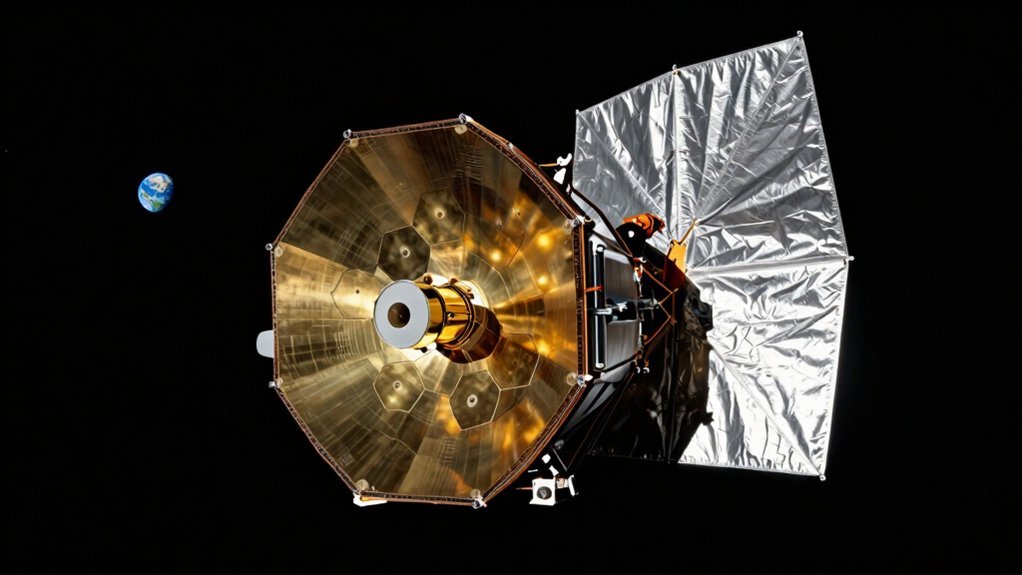
You just learned Hubble hits a wall, so you’re wondering why JWST pushes past it. Here’s the thing: infrared astronomy changes everything. Cosmic redshift stretches ancient light from the early universe into infrared wavelengths that Hubble simply misses. Those Hubble limitations vanish with JWST advantages like massive light collection. Its mirror gathers enough photons to see objects one hundred times fainter than before.
Now, consider thermal noise. JWST operates at freezing temperatures, silencing its own heat glow completely. This cold setup lets you witness astronomical observations deep in time that warm scopes cannot. A proper telescope comparison shows distinct science goals rather than simple replacement. You see clearer images of dusty regions where first stars ignited. Obviously, this specific design targets the cosmic dark ages directly. You now understand exactly how engineering beats distance limits today. The ability to detect these faint signals relies heavily on aperture size to gather sufficient light from the edge of the observable universe. For enthusiasts seeking deeper views, selecting the right optical design is just as critical as understanding these space-based advancements. Different optical systems offer unique benefits depending on whether you prioritize portability or maximum light gathering power for ground-based viewing. Ready to explore what lies beyond our visible horizon?
James Webb’s 6.5-meter aperture collects significantly more light than Hubble’s smaller mirror, enabling it to detect fainter objects from the early universe.
What Is the Edge of the Observable Universe?
So, where does the universe actually end? You might think there’s a physical wall, but you’re really hitting the cosmic horizon. This boundary marks your observable limit, not a true edge in space.
Light from beyond this zone hasn’t had time to reach you since the Big Bang. The radius stretches about 46.5 billion light-years due to expanding space.
Obviously, the universe likely continues infinitely past what you can currently see. No fence blocks your view; physics just delays the arrival of distant light.
Your telescope sees a sphere centered on you, filled with roughly two trillion galaxies. As time passes, more ancient light arrives, shifting your horizon outward slightly. The matter that emitted the oldest detectable radiation is now approximately 46 billion light-years away, illustrating the vast scale created by cosmic expansion. While no instrument can pierce this boundary, understanding cosmic expansion helps enthusiasts grasp why the most distant objects appear farther than their light-travel distance suggests.
How Far Can You See From Earth’s Surface?
Ever wonder why you can’t see forever from your backyard? Earth’s curvature blocks your view after just three miles. Standing five feet up, your horizon distance stops there naturally. Drop to one foot, and you lose two miles instantly.
Now, climb a hundred-foot cliff to spot objects twelve miles away. Higher vantage points expand your sight far more than sharp eyes ever could. Obviously, visibility factors like haze or fog often limit you sooner. Clear Arctic air might let you see clouds sixty-six kilometers out. But atmospheric molecules still scatter light before it reaches your eyes. This perspective is further constrained because haze and refraction typically restrict surface visibility to about 80 km² regardless of elevation.
Bright lights trick you by appearing beyond the geometric horizon at night. A candle flame glows thirty miles away in total darkness. Yet ground objects vanish quickly without that intense contrast. You need height to beat the curve effectively. So, how does adding a telescope change these hard limits?