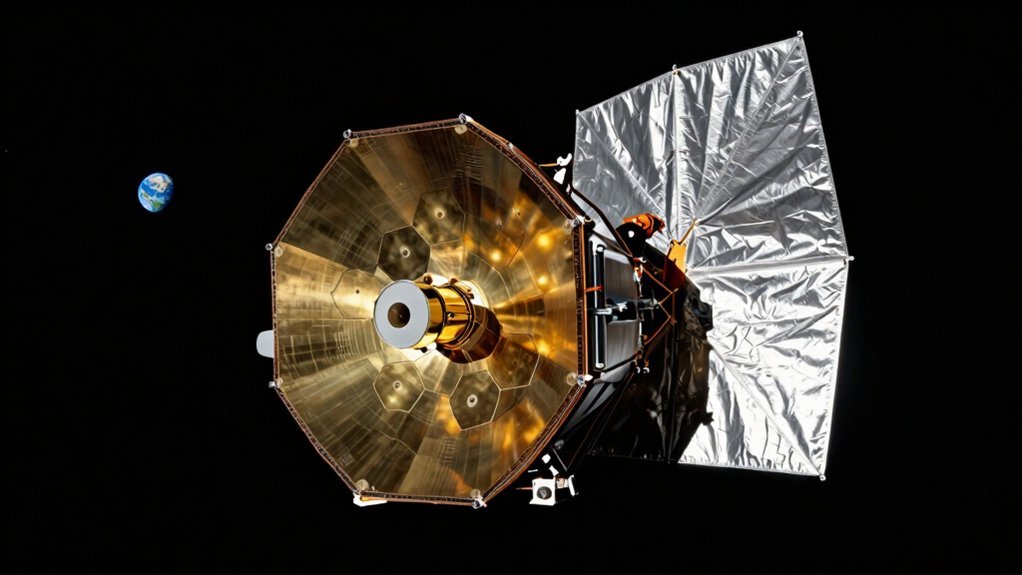
You’re wondering how far back Webb sees, and you’re right to ask. It spots light from 13.5 billion years ago, catching galaxies when the universe was just 100 million years old. Now, that ancient light comes from objects now 34 billion light-years away due to cosmic expansion. Here’s the thing: lookback time isn’t simple distance. You’ll understand exactly why space stretches while photons travel if you keep going.
How Far Back in Time Can Webb See?
If you’re wondering just how far back James Webb can peer, you’ve asked the perfect question. This telescope sees light from over 13.5 billion years ago. You witness the early universe when it was merely 100 million years old.
Now, here’s the thing about looking deep into space. Light takes time to travel across vast distances. So, you actually see galaxies as they existed in the distant past. Webb catches infrared light stretched by expanding space. This lets you observe the cosmic dawn clearly. By gathering this faint radiation, the telescope effectively acts as a time machine revealing the universe’s infancy.
All right, let’s clarify what this means for you. You aren’t seeing the Big Bang itself directly. Instead, you view the first stars and galaxies forming afterward. These ancient objects shine faintly after billions of years. Webb’s sensitive instruments detect that specific redshifted glow easily. To maximize your own viewing potential, understanding optical alignment is crucial for maintaining peak instrument performance. Just as selecting the right telescope optics determines what a stargazer can resolve, Webb’s specialized mirror design allows it to capture these faint, ancient signals that other instruments miss.
You now understand Webb reaches near the beginning of time. Ready to learn exactly how far away those objects sit?
What Is the Maximum Distance Webb Can Detect?
You’ve got the time part down, but pinning down the exact distance gets tricky fast. Webb spots galaxies over 13.5 billion light-years away using its massive mirror. This incredible detection depth lets you see objects ten billion times fainter than naked-eye stars.
Now, remember cosmic expansion stretches space while light travels toward us. That early galaxy at redshift 14.32 actually sits roughly 34 billion light-years away today. You aren’t just looking far; you are looking through expanding space itself. Enthusiasts should note that optical clarity is vital for ground-based observers attempting to track similar deep-space targets before switching to space data.
Obviously, different distance measurements yield wildly different numbers for the same object. Webb pushes near redshift 20, probing when the universe was merely one percent of its current age. You witness the cosmic frontier directly through infrared eyes. To fully appreciate these observations, enthusiasts should understand how infrared vision penetrates cosmic dust to reveal hidden celestial structures. Just as space telescopes avoid atmospheric interference, ground-based stargazers must prioritize stable mounting to ensure their instruments remain steady enough to capture faint details without blur.
Why Lookback Time Isn’t the Same as Distance
Time tricks you into thinking distance and lookback time match up perfectly. You assume a 13-billion-year-old image means the object sits 13 billion light-years away today. That’s a common lookback misconception you need to ditch right now.
Here’s the thing: the universe expanded while that light traveled to your eyes. A galaxy emitting light 13.1 billion years ago is actually 30.384 billion light-years distant now. These distance differences matter because space stretched during the journey.
You see the past, not the present location. Webb captures ancient photons, showing you a young universe that has since moved far away. Don’t mix up when the light left with where the galaxy floats today. To ensure you get it right the first time, remember that mastering these basics requires separating the time of emission from the current physical separation caused by cosmic expansion. Understanding cosmic expansion is essential because it explains why the space between galaxies grows even as their light makes its long journey to Earth. Just as optical designs rely on precise light gathering to reveal faint details, accurate cosmological models depend on distinguishing between lookback time and proper distance to map the universe correctly.
What Limits Webb’s Maximum Observational Reach?
Two main factors cap how far Webb can actually see, and it isn’t just about raw power. You might assume distance alone stops the view, but geometry plays a huge role too. The sunshield creates strict pointing constraints that block views toward the Sun, Earth, or Moon.
Your target must sit between 85° and 135° from the Sun to keep instruments cold. Obviously, this limits where you can look at any single moment during the year. Even if a galaxy exists, you cannot observe it if the angle violates thermal safety rules.
Beyond geometry, your detection capabilities depend on how faint an object truly glows. Webb sees light ten billion times fainter than visible stars, yet background noise still matters. If a source emits outside the 0.6 to 28 μm range, you simply won’t detect it.
Ultimately, reach relies on both sky position and intrinsic brightness working together. Now consider how much sky you access daily. Successful observation also requires understanding optical limitations to ensure the telescope captures the clearest possible data within its operational boundaries. Just as selecting the right equipment depends on matching aperture size to your specific viewing goals, Webb’s ability to resolve distant objects is fundamentally tied to the physical dimensions of its primary mirror. A larger mirror gathers more light, which is why primary mirror diameter is a critical specification when evaluating any telescope’s potential.
How Much of the Sky Can Webb Access Daily?
You just learned geometry limits Webb’s reach, so naturally you wonder how much sky that actually leaves open. On any given day, you get about 40% daily visibility. This field of regard shifts as Webb orbits the Sun. Now, here’s the thing: that 40% moves roughly one degree each day. Over six months, you access nearly the entire sky. Every single spot stays visible for at least 51 straight days. All right, but what about those special observable regions near the poles? Two tiny continuous viewing zones offer year-round access within five degrees. These spots let you monitor targets without seasonal breaks. Your scheduling depends entirely on when targets enter this moving annulus. You can’t see everything instantly, but patience grants full coverage. Understanding these orbital constraints is essential for effective observation planning. Expert observers recommend prioritizing targets based on optimal viewing windows to maximize data quality during these periods. The telescope maintains this stable view by orbiting at the L2 Lagrange point. Next, let’s check if Webb spots objects inside our own solar system.
Can Webb Observe Objects Inside Our Solar System?
Since Webb can’t look toward the Sun, you might wonder which solar system targets are actually off-limits. You cannot see Mercury, Venus, Earth, or the Moon because they sit inside that forbidden eighty-five-degree angle. This inner solar restriction is purely geometric, not a sensitivity issue, so don’t blame the instruments.
Now, turn your gaze outward where things get exciting. You can study Jupiter, Saturn, Uranus, Neptune, and even Titan with incredible detail. These outer solar worlds fit perfectly within Webb’s viewing geometry, allowing you to map their clouds and atmospheres. You also track asteroids, comets, and distant Kuiper Belt objects moving across the dark sky. Webb follows nearly three-fourths of near-Earth objects annually while spotting faint rings around giant planets.
You fundamentally lose the rocky neighbors but gain the icy giants and small bodies beyond. Just like beginner observing requires understanding realistic visibility and conditions, knowing Webb’s geometric limits helps you appreciate what this infrared vision can truly reveal as it pierces through cosmic dust. Selecting the right telescope options depends on similar constraints, as different optical designs offer varying capabilities for viewing specific celestial targets within their mechanical limits. Much like a stargazer must account for light pollution to see faint stars clearly, Webb’s position and sunshield design are critical for blocking thermal interference to detect distant infrared signals.
How Does Infrared Vision Peer Through Cosmic Dust?
How exactly does infrared light slip past those thick cosmic dust clouds? You might think dust blocks everything, but size matters here. Visible light hits grains hard because their wavelengths match perfectly, causing massive scattering. Infrared waves stretch much longer, so they simply flow around those tiny obstacles.
Think of it like ocean waves hitting a pier post; small ripples bounce back, but huge swells roll right through. This infrared penetration lets Webb spot newborn stars hiding deep inside stellar nurseries. Cosmic dust still absorbs some energy, yet the reduction stays far lower than optical telescopes face.
Now you see why dusty regions glow brightly in Webb’s images instead of appearing as dark voids. The telescope captures heat signatures that visible light misses completely. You finally witness planet formation zones previously hidden from human eyes. Understanding wavelength differences is essential for choosing a telescope that can penetrate these obscured regions effectively. Just as selecting the right instrument depends on your specific goals, matching the telescope type to the observed phenomenon ensures you capture the clearest possible data. Ready to explore why this advantage lets Webb see farther than Hubble ever could?
Why Can Webb See Farther Than Hubble Could?
While Hubble did amazing work, it hits a wall when hunting the universe’s earliest light. You see, distant galaxies stretch their light into infrared wavelengths that Hubble simply misses. Webb’s superior infrared capabilities catch this shifted glow, revealing baby galaxies Hubble never could.
Now, consider the mirror size. Webb’s primary mirror collects six times more light than Hubble’s does. This massive jump in telescope sensitivity lets you spot objects one hundred times fainter. Obviously, gathering more photons means seeing deeper into cosmic history than ever before.
All right, think about the cold too. Operating at L2 keeps Webb chilly, slashing internal heat noise. This stability allows longer exposures on those incredibly dim, ancient targets without interference. You get a clearer view of the universe’s first 13.5 billion years.
What Types of Objects Beyond Galaxies Can Webb Study?
You might think Webb only stares at distant galaxies, but that’s not the whole story. You actually get to explore exoplanet atmospheres for signs of life right here. Webb analyzes light to find specific molecules hiding in those distant air layers.
Now, consider brown dwarf characteristics that bridge planets and stars. Infrared eyes reveal their cloudy temps where visible light fails completely. You also peer into dusty stellar nurseries to watch baby stars form.
Don’t forget our own backyard either. Webb tracks solar system bodies like Uranus, comets, and even Pluto. It captures nearly three-fourths of near-Earth objects annually from its orbit.
Finally, you witness violent cosmic events like supernovae within just 48 hours. These rapid observations explain how heavy elements scatter across the universe. Webb truly sees everything, not just faraway galaxy clusters.