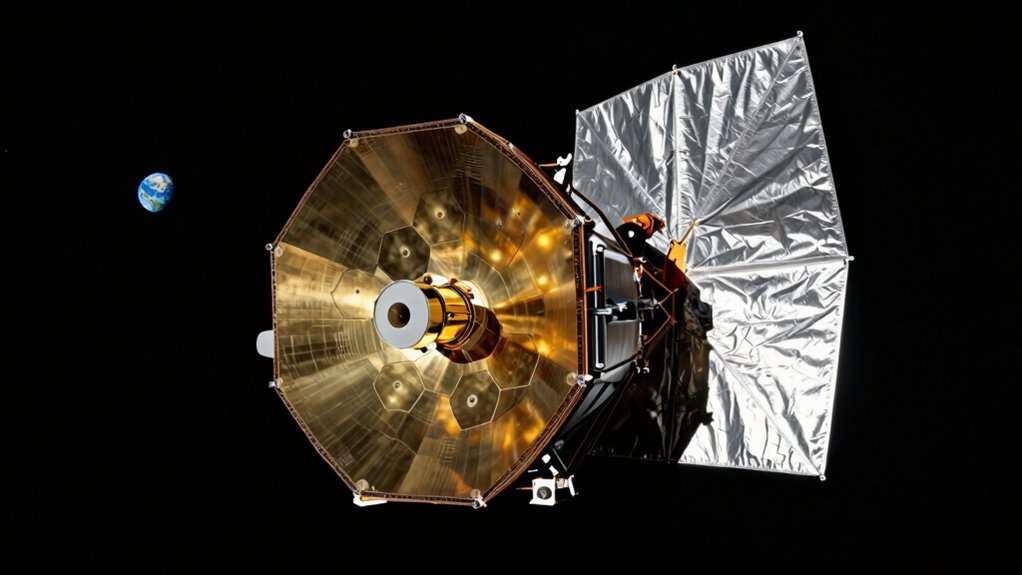
You’re probably picturing a mountain peak, but Chandra actually orbits Earth in a wild, stretched path. It swings from 6,000 miles out to a staggering 86,500 miles, far above our atmosphere. This high spot lets it catch X-rays that air blocks, revealing black holes and exploding stars clearly. Obviously, ground telescopes can’t match that view. Stick around to see how this cosmic watcher still surprises scientists today.
Where Is the Chandra Telescope Located?
Where Is the Chandra Telescope Located?
Where exactly is the Chandra Telescope? You might picture a dome on a mountain, but it’s actually soaring through space. Launched in 1999, this satellite orbits far above our atmosphere to catch X-rays that air blocks.
Here’s the thing: its unique position enables groundbreaking Chandra revelations you can’t make from the ground. The X-ray significance here is huge because Earth’s shield stops these powerful waves completely. You need that high altitude to see black holes or exploding stars clearly. Unlike ground-based instruments that gather visible light, Chandra is specifically designed to detect high-energy X-ray emissions that cannot penetrate the atmosphere.
Now, imagine it traveling a long, elliptical path that takes sixty-four hours to complete. It isn’t stuck in one spot like a building; it zooms way out past the Moon sometimes. This specific orbit keeps instruments safe from radiation belts while maximizing viewing time. Just like ground-based optical telescopes rely on clear skies, Chandra relies on its vacuum environment to function without atmospheric interference.
Your takeaway? Location defines capability for this mission. Next, you’ll want to know just how high it actually flies. By utilizing current locations, the mission delivers precise insights that ground-based observatories simply cannot achieve.
How High Does Chandra Orbit Above Earth?
You’re wondering just how high this telescope actually flies above our planet. It doesn’t stay at one fixed height because its path follows a highly elliptical orbit. This shape means Chandra altitude changes dramatically during every single trip around Earth.
At its closest point, you’ll find it roughly 6,000 miles up. However, it swings out incredibly far, reaching about 86,500 miles away. That distance puts it more than one-third of the way to the Moon. Obviously, this huge range allows for long, uninterrupted viewing sessions without Earth blocking the view.
The entire loop takes about 64 hours to complete from start to finish. You get over fifty hours of clear observation time during each of those long cycles. This unique path keeps the telescope safely above harmful radiation belts most of the time. Now you understand exactly how far out this amazing machine really travels. Unlike ground-based instruments that rely on optics performance to pierce the atmosphere, Chandra’s high orbit allows it to detect X-rays that would otherwise be absorbed before reaching Earth. Selecting the correct aperture size is equally vital for ground observers who wish to gather enough light to see faint celestial objects clearly. For enthusiasts seeking similar precision in their own setups, understanding mirror alignment is crucial for maximizing image clarity regardless of the instrument used.
Why Must Chandra Stay Outside the Atmosphere?
Since you’re wondering why Chandra can’t just sit on a mountain, let’s clear that up immediately. Earth’s atmosphere acts like a thick shield, blocking X-rays before they ever reach the ground. You simply cannot practice effective X-ray astronomy from the surface because the air absorbs those vital signals.
Now, imagine trying to hear a whisper while someone shouts right next to your ear. That is fundamentally what atmospheric interference does to faint cosmic X-rays. Chandra must stay in space to capture high-resolution images of exploded stars and black holes without that noise.
Obviously, placing this telescope in orbit isn’t optional; it is the only way the mission works. Without this specific location, you would miss seeing the hottest, most energetic regions of our universe entirely. Your understanding of these extreme physical processes depends on Chandra operating where air cannot stop the light. Unlike optical instruments that function well on mountaintops, X-ray astronomy requires the vacuum of space to detect high-energy photons that never penetrate our atmosphere. Just as selecting the right telescope type depends on your observational goals, Chandra’s design is strictly bound to the space environment to function at all. This necessity highlights why space-based observatories are essential for studying high-energy phenomena that remain invisible from Earth.
How Did Chandra Reach Its Final Orbit?
Picture the Space Shuttle Columbia heaving the heaviest payload it ever carried into space on July 23, 1999. You might wonder how it traveled so far from that initial low Earth parking spot. Columbia dropped Chandra off first, then an Inertial Upper Stage rocket boosted it higher immediately.
Now, the real magic happened over the next nine days. Chandra’s own built-in propulsion sequence fired five times to push the observatory outward. This careful dance placed you right into a highly elliptical orbit by August 7. Your final path stretches one-third of the way to the Moon, reaching 133,000 km at its farthest point.
Obviously, this unique shape grants you uninterrupted viewing for up to 52 hours. That long gaze defines your entire mission success. You’ve reached your destination, but who actually steers you now? Understanding the mechanics of effective telescope use reveals why this specific orbital trajectory is critical for maintaining the stable pointing required for deep-space X-ray observation. Achieving such stability relies heavily on optical alignment to ensure the mirrors focus X-rays precisely onto the detectors without distortion. Selecting the correct aperture size is equally vital, as it determines the light-gathering power necessary to detect faint X-ray sources across such vast distances.
Who Manages Chandra From the Ground?
So, who actually steers this massive X-ray eye from Earth? You might think one team does it all, but Chandra management splits duties. NASA’s Marshall Space Flight Center handles high-level project control in Alabama. They provide the essential Operational oversight you need for such a huge mission.
Now, daily flight operations happen far away in Burlington, Massachusetts. The Smithsonian Astrophysical Observatory runs the Control Center there. They send your commands and receive telemetry data every single day. Teams from MIT and Northrop Grumman also support these critical ground efforts.
Obviously, coordinating these groups requires serious teamwork across different states. You get specialized expertise because distinct organizations manage specific tasks. This structure keeps the observatory functioning perfectly for decades now. Just as selecting the right instrument depends on optics and performance, Chandra’s success relies on this specialized division of labor among its ground teams. For enthusiasts tracking such missions, understanding the telescope location is key to appreciating how data travels from deep space to these control rooms. Effective mission management also requires precise orbital tracking to maintain the satellite’s unique high-earth trajectory.
You now understand exactly who guides Chandra from our planet. Ready to reveal what cosmic secrets this team helps you find next?
What Cosmic Objects Does Chandra Study?
While you might wonder what exactly Chandra sees in the dark, it actually targets the universe’s most violent events. You’ll find it studying supermassive black holes as matter spirals inward, releasing intense X-rays. It also captures stunning details within supernova remnants like Cassiopeia A.
Now, look at galaxy clusters where hot gas glows brightly in X-ray light. This radiation helps you map the vast cosmic structure holding everything together. Chandra even tracks transient phenomena, such as sudden gamma-ray bursts or flaring stars.
Here’s the thing: these observations reveal how extreme objects shape galaxy evolution over time. You get a clear picture of matter under incredible pressure and heat. Obviously, this data transforms our understanding of the high-energy universe. Just as selecting the right instrument is vital for observation, understanding telescope optics ensures you grasp how Chandra focuses high-energy photons that visible light telescopes cannot capture. The legacy of this revolutionary telescope stems from its ability to unlock secrets of the high-energy cosmos that previous missions could not resolve. Aspiring observers should remember that optical clarity is equally critical when choosing ground-based equipment for viewing faint celestial details.
You now know which explosive objects fill Chandra’s view. Ready to see if another telescope shares its name?
Is the Himalayan Chandra Telescope the Same?
How could two telescopes share a name yet work so differently? You might assume they are siblings, but they are actually strangers. The Himalayan Chandra Telescope sits on Mount Saraswati in India, while NASA’s Chandra orbits Earth. Obviously, their locations define their unique capabilities and limits.
Here’s the thing: their instrument purposes diverge completely. One captures optical light from 4,500 meters up, while the other detects X-rays from space. These telescope differences mean you cannot swap their jobs, as selecting the right instrument requires understanding light spectra to match specific astronomical targets. One studies comets; the other maps black holes.
Don’t let the shared name fool you again. They operate independently under different agencies entirely. Now you know exactly which giant peers where. Both instruments honor the legacy of Subrahmanyan Chandrasekhar, a pivotal figure whose theoretical work underpins the scientific goals of these distinct observatories. Ready to explore what data these distinct eyes actually send back?
How Much Data Has Chandra Sent to Earth?
You might wonder what those distinct eyes actually send back after locating black holes. Well, Chandra has beamed over 70 trillion bytes of raw data to Earth since 1999. That massive data volume fills a digital archive accessible to everyone today.
Now, consider how this information travels every eight hours through global antennas. Scientists process these signals in Massachusetts before sharing them worldwide. This steady stream creates immense scientific impact across the astronomical community.
Researchers have already published over 11,000 papers using these specific observations. Those studies earned roughly half a million citations from other academics. Obviously, this treasure trove helps thousands of students earn their PhDs too. Notably, the mission has directly supported the research of 3,500 students worldwide.
You can access this same history for your own future findings. The archive keeps growing as the telescope continues its long watch. Ready to explore what secrets hide within those trillions of bytes?
Is the Chandra Mission Still Active Today?
So, you’re wondering if Chandra is still up there working after all these years? Absolutely, it is. The Chandra mission maintains full active status today, exceeding its original five-year design life by decades.
You see, NASA still calls it the world’s most powerful X-ray telescope. It orbits high above Earth, capturing images of exploded stars and black holes that visible light misses. Teams in Massachusetts and Burlington manage daily operations right now.
Obviously, this longevity surprises many people, but the data proves its ongoing success. Scientists constantly publish new findings using fresh observations from the satellite. Your research benefits directly from this enduring spacecraft’s sharp vision.
Here’s the thing: Chandra isn’t just a relic; it’s an essential, working tool. You can trust its current data for serious astrophysics work. Next, you might ask how astronomers actually control such a distant observer.