You probably think telescopes just magnify stars, but they’re actually giant light buckets. Hans Lippershey filed the first patent in 1608, yet Galileo proved Earth isn’t the universe’s center. Now, modern instruments see invisible infrared and X-rays that reveal hidden cosmic secrets. The 10.4-meter Gran Telescopio Canarias gathers faint starlight better than any other optical scope. You’ll uncover even wilder details about peering back 13.8 billion years if you keep exploring.
Who Actually Invented the First Telescope?
How did a simple lens trick in 1608 change everything? You probably wonder who really built that first Dutch device. Historians point to spectacle makers, not astronomers, for this breakthrough.
Now, consider Lippershey’s Contributions. He filed the earliest patent on October 2, 1608. His design magnified objects three times, making distant things seem nearby. Obviously, this documentation gives him primary credit among the claimants.
Here’s the thing about this Disputed Invention though. Zacharias Janssen and Jacob Metius also claimed rights immediately. Dutch authorities refused exclusive patents because the stories confused everyone. No single inventor holds universal confirmation today.
You see incremental knowledge sparked this revolution, not one genius. Galileo later improved these tools for stars, but he didn’t invent them. The real story involves shared Dutch craftsmanship and messy legal battles. This collaborative environment among Dutch spectacle makers ultimately accelerated the refinement of early optical instruments.
Remember that 1608 marks the start of documented telescope history. Next, you’ll want to know how these lenses actually brighten distant views. This pivotal moment established the foundation for modern observational astronomy by shifting focus from terrestrial viewing to celestial discovery. The initial devices were primarily intended for terrestrial viewing before astronomers turned them toward the heavens.
How Do Telescopes Make Distant Objects Brighter?
Two main tricks make distant stars pop for you, but neither creates new light. You might think lenses generate glow, yet they simply gather more photons than your eye alone. Think of the aperture as a giant light collection bucket catching every available ray. This massive haul boosts total brightness, letting faint targets suddenly appear clear and distinct. The amount of light gathered increases exponentially with the size of the primary mirror or lens, making larger instruments significantly more effective for deep-sky viewing. Different optical designs manage this gathered light through varying light paths to minimize aberrations and maximize clarity for the observer.
Now, magnification stretches that image so it covers more of your retina, revealing tiny details. However, don’t expect magic for fuzzy galaxies because surface brightness stays the same or even drops. Spreading light over a larger area often makes extended objects look dimmer per square inch. You see more detail simply because the object looks bigger, not inherently brighter overall.
Obviously, matching your exit pupil to your eye’s opening keeps the view as bright as possible. Remember, big apertures win for gathering light, while high power often dims the show. Experts recommend using low-power eyepieces to maintain maximum image brightness when observing faint deep-sky objects. Ready to explore how different shapes handle this light next?
What Are the Three Main Telescope Types?
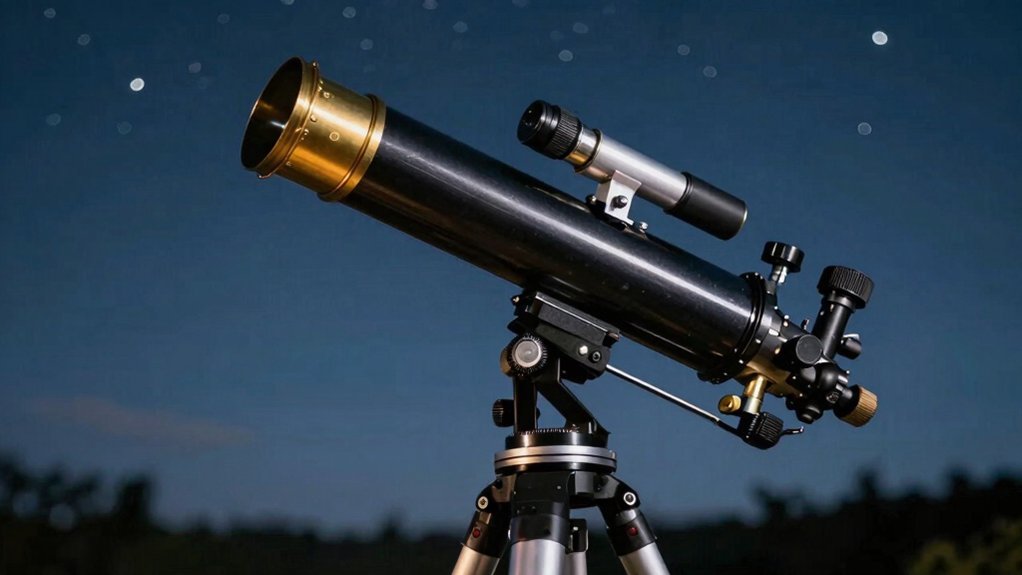
So, how do you actually choose between the three main telescope types? You face refractors, reflectors, and catadioptrics. Each uses different telescope designs to gather light for your eyes.
Refractors use lenses and stay low maintenance, but costs rise quickly with size. Reflectors use mirrors, offering huge apertures for less money, yet need occasional alignment. Catadioptrics mix both elements, delivering compact tubes without sacrificing optical performance.
You pick based on your specific observing goals and budget constraints today. Refractors suit planetary views, while reflectors excel at deep-sky objects easily. Compound scopes balance portability and power for versatile stargazing sessions everywhere. Notably, compound telescopes combine reflecting and refracting systems to significantly reduce optical aberration. Expert guides suggest that understanding optical aberration is key to selecting the right instrument for sharp images. Reflectors often utilize a Newtonian mount design to direct light to the eyepiece efficiently. The light gathering power of a telescope determines how faint an object you can see, making aperture size a critical factor in your decision.
All three bring distant starlight into sharp focus through unique paths. Your decision depends on whether you value simplicity, cost, or portability most. Now you understand the core differences driving your next big choice.
How Did Galileo’s Discoveries Change Astronomy?
You just picked a telescope type, but you might wonder why pointing one at the sky actually matters. Galileo didn’t just look; he changed everything by grinding lenses to reach 30x magnification. His Galilean Impact shifted astronomy from pure philosophy to hard, empirical science based on real measurements.
Now, consider his proof against Earth being the center. Seeing Venus’s phases and Jupiter’s four moons offered essential Heliocentric Validation. These observations proved other worlds orbited something besides our planet, shattering ancient geocentric models forever. This revolutionary approach established the scientific method as the foundation for modern astronomical inquiry.
He also uncovered the Moon wasn’t perfect, spotting rough mountains and deep craters using shifting shadows. This revelation dissolved the strict divide between heavenly perfection and earthly imperfection instantly. You now see how one tool sparked a massive revolution in human understanding of the cosmos. While Galileo pioneered optical observation, modern groundbreaking telescopes continue this legacy by exploring the universe beyond visible light. Understanding light spectrum ranges is crucial for enthusiasts who wish to grasp how different instruments reveal hidden cosmic details. Ready to explore what lies beyond visible light?
Can Telescopes See Beyond Visible Light?
Something you might not realize is that your eyes miss almost the entire cosmic story. Visible light represents just a tiny slice of the electromagnetic spectrum available out there.
Now, infrared technology lets you peer through dusty clouds to spot cool, hidden stars forming. Radio detection captures long waves that travel billions of light-years, working day or night effortlessly.
Here’s the thing: x-ray astronomy reveals scorching black holes while gamma-ray telescopes catch explosive bursts. Earth’s atmosphere blocks these high-energy signals, so satellites must observe them from space directly.
Obviously, different wavelengths disclose unique physical properties like temperature and chemical composition within distant galaxies. You finally see the full picture instead of just a narrow, visible fragment of reality.
This multi-wavelength approach reveals stellar nurseries and exoplanet atmospheres that optical scopes alone cannot find. Ready to explore how massive instruments capture these specific signals next? Relying solely on visible light results in missing significant cosmic details. Understanding the electromagnetic spectrum is essential for selecting the right instrument to access these hidden layers of the universe. While optical models are popular, choosing the correct telescope aperture is equally critical for gathering enough light to detect faint objects across these varied wavelengths. Larger mirrors significantly improve light gathering power, allowing astronomers to detect fainter objects that smaller instruments would miss entirely.
What Is the World’s Largest Optical Telescope?
You’ve seen how telescopes catch invisible light, but which giant actually rules the visible spectrum right now? Meet the Gran Telescopio Canarias, sitting high on La Palma. This beast boasts a massive 10.4-meter primary mirror made of 36 hexagonal segments.
Here’s the thing: it isn’t one solid piece of glass. That segmented design lets engineers build huge collectors without breaking them. Since 2007, this Spanish marvel has dominated optical astronomy by gathering faint starlight efficiently. You’ll find it operated by teams from Spain, Mexico, and the US. The segmented mirror technology pioneered in the 1980s and 1990s was the crucial innovation that allowed for such massive aperture sizes beyond previous limits. While refractors use lenses that can suffer from color fringing, this reflector design ensures sharp image quality across its vast light-gathering surface. Selecting the right aperture size is critical because it directly determines the instrument’s ability to resolve fine details and detect dim objects. The location at high altitude significantly reduces atmospheric interference to provide clearer views of the universe.
Obviously, bigger rivals like the ELT are coming soon with 39-meter mirrors. But for today, the GTC holds the crown firmly. Keep this current champ in mind as you explore deeper space mysteries. Next, let’s see how Hubble changed everything we understand about observing the cosmos.
How Did Hubble Transform Space Observation?
Now that you’ve seen ground giants, you might wonder how a smaller scope in space changed everything. Hubble’s orbit above Earth’s atmosphere removes blurring, giving you sharper images than any ground telescope ever could. You see faint details clearly because its stable platform allows exposures lasting weeks.
Here’s the thing: Hubble impact reshaped cosmology by proving the universe’s expansion accelerates due to dark energy. Telescope advancements let astronomers confirm supermassive black holes sit at most galactic centers, turning theory into fact. You now know galaxies formed earlier than expected thanks to these deep, precise views.
Obviously, this shifted astronomy from distorted guesses to precision mapping of stars and distant systems. You witness dynamic storms on planets and protoplanetary disks forming new worlds right before your eyes. The takeaway? Space observation became exact science overnight. Ready to explore just how far back these eyes actually see? By eliminating atmospheric turbulence, space telescopes capture light without the shimmering effect that plagues ground-based instruments.
Understanding how atmospheric distortion affects light explains why Hubble’s position was critical for such clarity.
How Far Back in Time Can We See?
Ever wonder exactly how far back your telescope actually sees? You’re looking at light that left objects years ago, making every scope a time machine. A star four light-years away appears as it was four years in the past. Obviously, greater distances mean deeper lookback depth into cosmic history.
Now, consider the absolute limit. The universe is 13.8 billion years old, but you can’t see the very start. Early space was opaque until 380,000 years after the Big Bang released the cosmic microwave background. This radiation marks the practical edge of direct observation for ordinary telescopes today.
Modern tools like JWST push further, spotting galaxies from just 250 million years post-Big Bang. Hubble saw GN-z11 from 400 million years after creation, probing over 90% of cosmic history. Expansion stretches current distances far beyond light-travel time, creating a vast observable radius. Your view depends on wavelength sensitivity, not just raw distance. The Hubble deep field image spans over 10 billion light years back into the universe’s past, revolutionizing our understanding of the cosmos. Next, let’s explore why location matters so much for clarity.
Why Are Observatories Built on Mountaintops?
Why do astronomers haul massive telescopes up steep, rocky peaks? You might think it’s just for the view, but you’re actually chasing better atmospheric conditions. Thinner air means less distortion, so stars stop twinkling and images sharpen instantly.
Now, consider the mountain advantages. High peaks sit above most water vapor, letting you capture clear infrared data from cold space objects. Obviously, remote locations also block city lights, giving you dark skies to spot faint galaxies easily.
You’ll find fewer clouds interfering with your long observing nights up there too. This height grants wide horizons without trees or buildings ruining your field of view. Ultimately, you get cleaner data by escaping Earth’s messy lower atmosphere.
Ready to learn how these clear views help us look back in time?