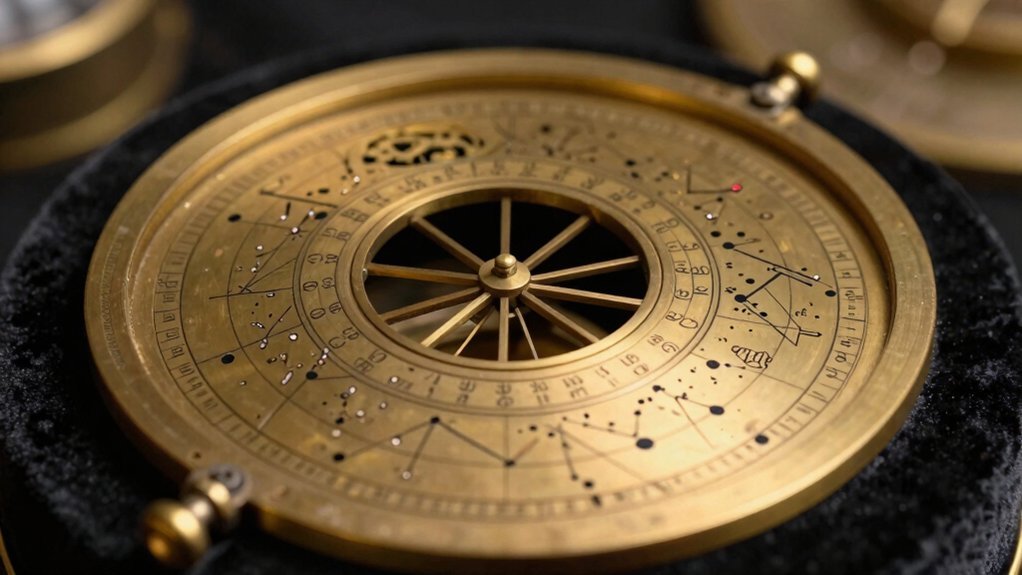
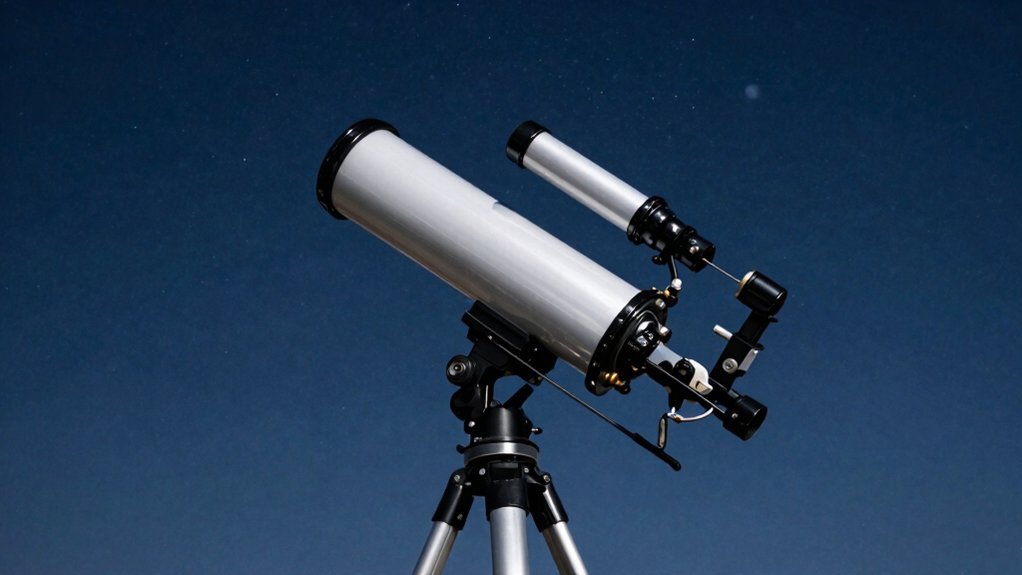
You’re right to wonder why one telescope isn’t enough since visible light only shows a slice of reality. Astronomers actually need instruments detecting everything from 380nm visible photons to high-energy gamma rays because dust blocks your view. Infrared sees through that grime while X-rays reveal black holes that optical lenses miss entirely. Standard mirrors fail here, requiring special grazing angles to catch these energetic signals. Combining these views builds the full picture you’re looking for as you explore further.
How the Electromagnetic Spectrum Defines Telescope Types
You’re probably wondering why astronomers need so many different kinds of telescopes instead of just one super-powerful scope. Well, light isn’t just what you see; it spans a huge electromagnetic classification range. Each type of wave reveals unique cosmic secrets that others miss completely.
Here’s the thing: telescope functionality depends entirely on the specific wavelength you want to catch. Radio dishes collect long waves, while X-ray scopes need special mirrors for high energy. You can’t use glass lenses for gamma rays because they simply pass right through. Different instruments rely on distinct optical designs to successfully focus these varied forms of radiation onto a detector.
Obviously, Earth’s atmosphere blocks many signals, forcing some telescopes into space. Infrared instruments peek through dust, whereas ultraviolet ones track hot, energetic stars. You need the right tool for every job to get the full picture. To truly understand the universe, enthusiasts must recognize that optical telescopes are only one part of a much larger observational toolkit designed to capture specific bands of radiation. For instance, observing radio waves requires massive dish antennas rather than the mirrors found in traditional optical models.
What Visible-Light Telescopes Reveal to Human Eyes?
You’ve just learned why different waves need different scopes, so what does the specific light your eyes see actually show? These optical telescopes gather photons between 380 and 700 nanometers, revealing exactly how stars and galaxies would look if your eyes were huge. You see real shapes, edges, and surface features that remain invisible to the naked eye alone. To get the best view, you must find a location with dark sky conditions away from city glow. Expert observers recommend allowing your equipment to reach thermal equilibrium with the night air to prevent internal heat from distorting these sharp images.
Now, consider how this helps science. Astronomers use these clear images for precise stellar morphology studies, analyzing the physical structure of distant suns. You can make a direct visual comparison between planets or nebulae because the colors match your natural perception. Obviously, this intuitive data makes spotting details much easier than interpreting false-color charts from other bands.
Here’s the thing: while infrared sees through dust later, visible light shows you the universe as it truly appears. You get immediate context for cosmic objects without needing translation. This approach provides current status and quick facts all in one place, allowing you to instantly grasp the condition of celestial bodies. Ready to see what hides behind those colorful clouds?
How Infrared Telescopes Penetrate Cosmic Dust Clouds?
Since visible light hits dust like rain on a window, you can’t see what hides behind those thick clouds. You need infrared advantages to pierce those dark veils blocking your view of newborn stars.
Here’s the thing: infrared light has longer wavelengths than visible rays, so tiny dust grains scatter it less. Cosmic dust transparency actually increases at wavelengths beyond twenty microns, letting you spot warm protostars inside.
Now, you observe heat radiation from the dust itself instead of just silhouettes against bright backgrounds. Instruments like Webb’s MIRI capture these longer waves to reveal cooler cloud chemistry clearly.
You finally see embedded structures that were previously invisible to optical telescopes alone. This clarity transforms dark patches into vibrant nurseries of forming planetary systems right before your eyes.
Applying this expert-backed guidance ensures you select the right equipment to maximize these observational breakthroughs, such as choosing mounts with precise tracking to maintain steady views during long exposures. Following a step-by-step walkthrough helps beginners avoid common setup errors that could blur these delicate infrared images.
Ready to explore why ultraviolet targets hot objects next?
Why Ultraviolet Telescopes Target Hot Stellar Objects?
Why do astronomers chase ultraviolet light when visible stars look so bright? You might think optical views show everything, but hot star characteristics change the game entirely. These blazing objects peak in UV output, hiding their true power from your naked eye.
Here’s the thing: UV light advantages let you see temperatures and compositions that visible telescopes miss completely. Young stars accreting gas glow fiercely at these short wavelengths, revealing active formation zones. You’ll spot magnetic heating and ionized gas clouds that ordinary cameras simply cannot detect. While beginners often start by learning observing conditions for visible stargazing, professional UV astronomy requires escaping Earth’s interference entirely. Obviously, Earth’s atmosphere blocks this crucial data, so we launch space telescopes like Hubble to catch it. This approach exposes stellar secrets hidden within standard bright lights. Now you understand why targeting hot objects requires looking beyond the visible spectrum. Understanding atmospheric absorption is key to realizing why ground-based instruments fail at these wavelengths. Even for those just starting out, knowing the impact of light pollution is essential before attempting to view faint celestial details. Ready to explore even higher energy mysteries next?
What High-Energy Secrets X-Ray Telescopes Uncover?
How do you spot heat that hits billions of degrees? You track X ray emissions from superheated cosmic plasma. Obviously, normal light won’t show these extreme temperatures.
You’ll find a black hole feeding as matter screams into the void. Supernova remnants glow brightly here, revealing shocked gas from ancient explosions. Neutron stars and pulsar winds also light up the dark sky.
Active nuclei in distant galaxies pour out incredible energy too. Scientists even hunt for dark matter signatures within this high-energy band. You see the universe’s most violent moments clearly now.
This view exposes physics impossible to study on Earth. Your telescope reveals the hot, hidden universe above us. Next, you need to understand even wilder cosmic blasts. The revolutionary telescope designs pioneered in astronomy history enabled these precise observations by overcoming atmospheric limitations.
To capture these signals, instruments must operate in space using grazing incidence mirrors to effectively collect photons that atmospheric interference would otherwise block. Expert guidance suggests that maintaining optical alignment is critical for these space-based observatories to function correctly. Choosing the right mounting system ensures your instrument remains stable during long exposures of these faint, high-energy sources.
How Gamma-Ray Detectors Track Violent Cosmic Events?
When you wonder how we catch light billions of times stronger than X-rays, you’re asking the right question. Gamma rays pack immense energy, often exceeding 100 keV, so ordinary mirrors simply won’t work for you. Instead, detectors track violent cosmic phenomena like gamma ray bursts by converting photons into measurable electronic signals.
Now, pair-conversion telescopes like Fermi use tungsten layers to transform incoming rays into electron-positron pairs. You see, tracking these particle paths reveals the original gamma ray’s precise arrival direction on the sky. Compton telescopes take a different approach by measuring how photons scatter off electrons in scintillator layers.
Obviously, shielding blocks billions of distracting cosmic rays so only true gamma signals remain. These tools let you witness supernovae and black holes directly. Understanding the electromagnetic spectrum is essential because different telescope designs are required to capture specific energy ranges that optical instruments cannot detect. Since standard glass lenses absorb high-energy radiation, engineers must rely on particle detection methods to visualize these extreme events. Unlike optical systems that use mirrors to focus visible light, these high-energy instruments require specialized detector layers to capture radiation that would otherwise pass through or damage traditional optics. Ready to explore how radio waves map the cold universe next?
Why Radio and Microwave Telescopes Map the Cold Universe?
Ever wonder how we spot the universe’s coldest corners? You see, cooler objects glow at longer wavelengths, pushing their signal into radio bands. Radio telescopes detect this cold matter that visible light completely misses.
Now, consider the Cosmic Microwave Background. It is cooled remnant radiation from just after the Big Bang. Sensitive instruments map tiny CMB fluctuations, measuring temperature differences a million times smaller than one degree. These maps reveal gravitational seeds for future galaxies.
Here’s the thing: Earth’s atmosphere blocks much microwave light, so we often launch satellites. Planck scanned nine wavelength bands to capture this ancient snapshot. You get a clear view of the universe at 380,000 years old.
Obviously, these tools expose dark matter clues hidden in plain sight. They show us where structure began. By utilizing large dish antennas, these instruments gather faint signals that would otherwise be lost in background noise. Just as optical astronomers rely on gentle cleaning tips to maintain mirror clarity without scratching coatings, radio engineers ensure their massive receivers remain free of debris to preserve signal integrity. Next, you might ask why standard mirrors fail for high-energy light instead.
Why Standard Mirrors Fail for High-Energy Light?
You just saw how radio waves reveal cold space, but you’re wondering why those same mirrors can’t catch X-rays. High-energy photons smash right through standard glass or turn into heat instead of bouncing back. Obviously, ordinary mirror limitations stop them from reflecting these energetic rays at normal angles.
Here’s the thing: X-rays only reflect when they skim surfaces at incredibly shallow angles. Scientists call this specific behavior grazing incidence. Even tiny bumps measuring just five angstroms scatter the light and ruin your image. You need perfectly smooth surfaces to force those photons toward a focus. In conductive materials like silver, light intensity drops exponentially within a penetration depth of mere nanometers, preventing standard thick coatings from reflecting high-energy rays effectively.
Standard coatings fail because they absorb high-energy light rather than returning it efficiently. Specialized optics must replace flat mirrors to capture these elusive signals effectively. Now you understand why regular telescopes miss the hottest cosmic events entirely.
How Multiwavelength Data Creates a Complete Cosmic Picture?
Confusion fades when you realize single-band views lie to you. Dust blocks optical light, hiding star-forming regions you’d miss completely. Radio waves map cold gas while X-rays expose black holes instantly.
Now, multiwavelength synergy connects these separate physical components into one clear picture. You see Andromeda’s stars in optical light but find warm dust via infrared. This combo reveals the true cosmic composition of any galaxy you study.
High-energy data adds extreme environments that visible sensors simply cannot catch. Composite images layer these bands so you spot hidden astrophysical processes easily. One object like the Crab Nebula shows totally different faces across four bands.
You get a fuller map of matter distribution when combining all emissions. Obviously, each telescope adds unique info to build this complete cosmic history. Next, you’ll want to know how specific instruments capture these distinct signals.