You’ve probably heard wild rumors about Webb spotting aliens, but it actually confirmed 3I/ATLAS, an ancient comet. This object zooms past at 152,000 mph on a one-way trip from the Milky Way’s thick disk. Its unique carbon dioxide ratio proves it formed over 7 billion years ago, long before our solar system existed. Obviously, this isn’t an alien spacecraft, but a genuine cosmic time capsule offering rare chemical clues. Stick around to reveal exactly how this icy visitor rewrites our understanding of galactic history.
What Did Webb Confirm About 3I/ATLAS’s Trajectory?
You’re probably wondering if Webb actually changed the story on 3I/ATLAS’s path. No, it didn’t. Your trajectory analysis confirms the comet follows a hyperbolic route, meaning it never loops back.
NASA’s orbital classification stays solid because Webb saw no closed orbit around our Sun. You’re looking at a visitor from outside, passing through just once. It won’t hit Earth, staying 170 million miles away at its closest point.
Now, consider how this flythrough places the object in the Milky Way’s thick disk. That steep angle suggests an ancient origin, possibly ten billion years old. Webb simply verified the data you already suspected was accurate. Understanding the optical design of such instruments clarifies why Webb’s infrared capabilities were essential for analyzing the composition of this interstellar visitor without interference from solar glare. Selecting a telescope with the correct aperture size ensures sufficient light gathering power to detect faint interstellar objects like 3I/ATLAS against the dark background of space. When evaluating different models, comparing telescope options side by side helps stargazers understand the trade-offs between optics, performance, and cost for various observation goals.
How Does CO2 Prove 3I/ATLAS Is Interstellar?
You might think that extreme CO2 levels alone prove this comet came from another star. That’s a logical guess, but you’d be wrong. Trajectory data actually confirms its interstellar status, not just chemistry.
Now, consider the specific CO2 composition. JWST found a wild 7.6 ratio of CO2 to water. This far exceeds normal solar system trends. Such extremes suggest unique processing history rather than simple origin proof.
Here’s the thing: cosmic ray influence likely baked this ice over eons. Galactic rays alter outer layers, boosting CO2 while depleting other volatiles. This signature points to long exposure in deep space before arrival. Following a practical step-by-step walkthrough helps beginners understand how these complex chemical signatures are analyzed without error. Just as selecting the right telescope type depends on your specific stargazing goals, interpreting these chemical ratios requires matching the analytical method to the unique properties of the object being studied. Enthusiasts should remember that maintaining optical alignment is equally critical when verifying such precise spectral data through ground-based observation.
Why Is 3I/ATLAS the Oldest Comet Ever Found?
Some numbers sound too wild to be true, don’t they? You’re wondering how a comet could beat our Solar System’s age by 2.4 billion years. Oxford models suggest 3I/ATLAS is over 7 billion years old, likely born in the Milky Way’s thick disk.
Here’s the thing: this age estimation relies on where it formed, not direct dating. Comet formation around ancient stars explains why you see such an old traveler now. It wandered the galaxy long before Earth even existed.
Obviously, you can’t trace its exact parent star after billions of years of travel. Statistical modeling of stellar populations gives us that 68% confidence range up to 14 billion years. This makes it a genuine time capsule from the early galaxy. Just as astronomers compare optics and performance to find the perfect telescope for viewing such distant objects, analyzing 3I/ATLAS requires matching the right observational tools to its ancient origins. Understanding these cost differences ensures that both amateur and professional observers can access the technology needed to study such rare interstellar visitors. To capture clear images of such faint, ancient travelers, observers must carefully select a telescope with sufficient light gathering power.
How Does 3I/ATLAS Compare to ‘Oumuamua and Borisov?
You’ve just seen how old 3I/ATLAS is, so comparing it to its predecessors makes perfect sense. You might wonder how this new visitor stacks up against ‘Oumuamua and Borisov. Let’s break down the key comparison factors right now.
Unlike asteroid-like ‘Oumuamua, 3I/ATLAS acts like a true comet with a visible tail. Its behavior mirrors Borisov, yet 3I/ATLAS dwarfs both in sheer physical scale. You’re looking at an object potentially ten million times more massive than ‘Oumuamua. The James Webb Telescope confirmed its robust core through mass analysis, distinguishing it from the more elusive compositions of earlier visitors.
These distinct interstellar characteristics include a wilder orbit with higher eccentricity too. Traveling at 61 km/s, it moves faster and on a steeper path. Early detection gives you more time to study its composition before it vanishes, much like selecting the right telescope optics ensures clarity when observing faint celestial bodies. Just as different stargazers require specific gear based on performance and cost, scientists tailor their observation strategies to the unique properties of each interstellar object.
Clearly, this giant comet offers unprecedented data compared to previous visitors. Now, you probably ask if Webb found something truly extraordinary nearby.
Did Webb Really Spot an Alien Spacecraft Near Earth?
Rumors about an alien spacecraft near Earth have likely crossed your feed. You probably wondered if Webb actually spotted something strange heading our way. Here’s the thing: those viral claims lack any real scientific backing whatsoever.
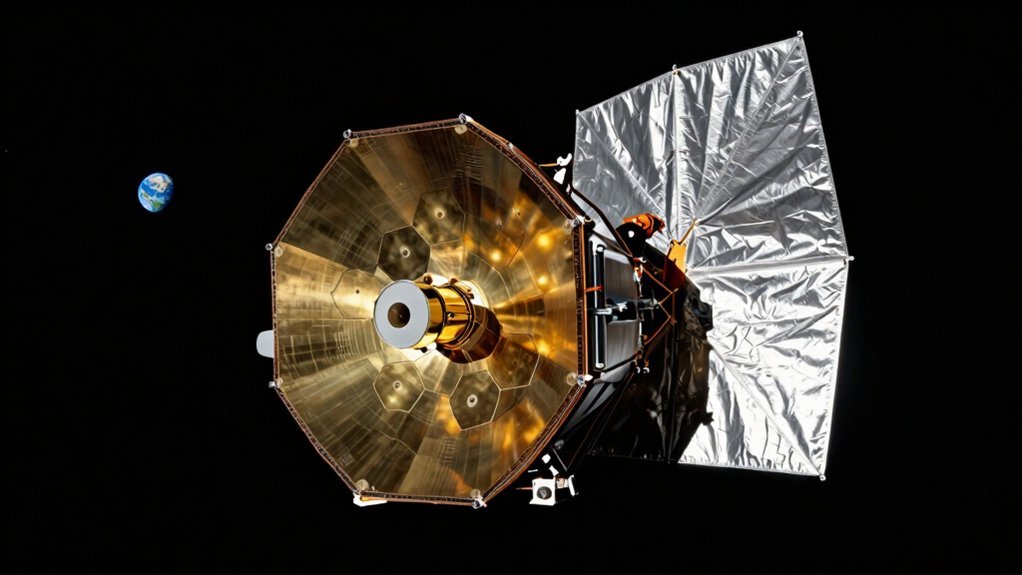
No official report from NASA ever mentioned detecting an alien craft. The story started with social media posts, not actual astronomers or data. Webb sits 1.5 million kilometers away at the L2 point, studying distant galaxies. It doesn’t patrol Earth’s neighborhood looking for visiting spaceships or mysterious objects. Obviously, a telescope designed for infrared astronomy can’t track vehicles approaching our planet. Fact-checkers found zero evidence supporting these wild stories circulating online recently. You should trust peer-reviewed science over unverified internet speculation every single time. While debunking these myths, it is worth noting that Webb recently confirmed the presence of carbon dioxide in the coma of the interstellar object 3E Atlas, demonstrating its true role in analyzing cosmic chemistry rather than tracking terrestrial threats. By collecting faint light from deep space, the instrument relies on primary mirrors to gather the infrared signals necessary for such detailed chemical analysis. Beginners should understand that these optical components are specifically engineered to capture invisible heat signatures from the early universe. Effective observation requires selecting a device with the appropriate aperture size to ensure sufficient light-gathering power for detecting such faint cosmic details.
The takeaway is simple: Webb studies cosmic chemistry, not extraterrestrial visitors. Now you know the truth behind those confusing headlines.
What Other Exotic Interstellar Objects Has Webb Studied?
How exactly does Webb study these rare cosmic travelers? You might wonder how scientists catch such fleeting visitors. Webb uses infrared eyes to spot gas and dust that visible telescopes miss. It acts like a chemical detective, analyzing molecular signatures in seconds.
Now, consider 3I/ATLAS, the third confirmed interstellar object Webb examined in 2025. This ancient traveler, possibly seven billion years old, revealed carbon dioxide and water ice. Such Webb findings reveal secrets about its native planetary system’s history. You see, analyzing interstellar composition tells you how other star systems differ from ours. The object’s confirmed speed of 152,000 mph exceeds any vehicle ever launched from Earth, highlighting its extreme interstellar origin. Beginners who follow a step-by-step walkthrough can better appreciate the precision required to capture such fleeting data before it vanishes. Just as selecting the right telescope optics determines what a stargazer can see, Webb’s specialized mirrors allow it to detect faint heat signatures from distant objects. Even from your backyard, understanding the observing conditions needed for clear viewing helps you grasp why space-based instruments are essential for detecting faint cosmic travelers.
All right, so these objects offer direct samples from deep space without leaving Earth. They help refine your understanding of planet formation and ejection across the galaxy. Obviously, catching them requires rapid Target of Opportunity scheduling before they vanish forever.
You now grasp why these brief visits matter so much to astronomy. What specific chemical clue would convince you aliens engineered an object?