You’re wondering how raw glass becomes a window to the cosmos, right? You start by grinding blanks to within 0.005 μm precision, then coat mirrors to reflect 97% of light. Large apertures gather faint photons while curved surfaces focus them sharply onto your detector. Obviously, avoiding atmospheric blur makes space telescopes even clearer. Now you see the basics, but wait until you find out exactly how engineers align these massive mirrors for perfect vision.
How Do Telescopes Gather and Focus Light?
Since you’re wondering how telescopes actually catch light from billions of miles away, you’ve hit on the exact right starting point. You need massive mirrors to collect those faint photons effectively. Larger apertures grab more light, revealing distant galaxies your eyes miss. The objective lens or mirror defines the telescope’s total light-gathering ability based on its aperture size.
Now, consider how these tools master specific light gathering techniques. Curved surfaces bounce parallel rays toward a single focus point. Obviously, this concentration creates the sharp picture you crave. This process relies on the principle of optical reflection to direct incoming starlight precisely where it needs to go. High-quality coatings are often applied to these surfaces to maximize light transmission and minimize signal loss during observation.
Here’s the thing about image formation: it happens at the focal plane. The mirror shapes incoming beams until they meet perfectly. Detectors or eyepieces then capture that concentrated energy clearly.
You see, gathering and focusing work together to build usable views. Without both steps, you’d just have a bright blur. Ready to explore how different lens shapes change this game?
How Do Refracting Telescopes Use Lenses?
When you wonder how glass lenses beat mirrors for sharp views, you’re asking the perfect question. Refractors bend light through specific lens types to gather distant starlight efficiently. The large objective lens focuses parallel rays into a real image inside the tube.
Now, the eyepiece acts like a magnifier for that tiny, focused picture. You see image inversion clearly here because the final view often appears upside down. This happens naturally as light crosses at the focal point within the design.
All right, let’s talk spacing. You set the distance between lenses to match their combined focal lengths. This arrangement sends parallel rays to your eye, allowing relaxed viewing without strain. Magnification simply depends on the ratio of the two focal lengths you choose.
Obviously, sealed optics keep dust out while making objects appear brighter and clearer. You now understand exactly how these glass tools create magnified virtual images for observers. Next, consider why some builders prefer mirrors instead of heavy glass lenses. While refractors excel at optics performance, choosing the right telescope ultimately depends on your specific stargazing needs and budget. High-quality glass minimizes chromatic aberration to ensure colors remain sharp across the entire field of view. Achromatic doublets combine different glass types to correct color fringing effectively in standard models.
Why Do Reflecting Telescopes Use Mirrors?
So, why do builders swap heavy glass for shiny mirrors? You likely wonder if this choice truly matters for your viewing experience. Obviously, it changes everything about how you see the stars.
Mirrors gather parallel light rays and focus them without creating color fringes. Lenses often split light into rainbows, but mirrors keep your image sharp. This eliminates chromatic aberration completely, giving you crystal-clear views of distant galaxies.
Consider the mirror advantages: you only polish one surface instead of two. Large mirrors stay lighter and cheaper than massive lenses, letting you build bigger scopes. Builders achieve incredible optical precision while saving weight for easier support structures. By supporting the glass from behind rather than just the edges, engineers can construct massive primary mirrors that would otherwise sag under their own weight if made as lenses.
Now, you understand why almost every major observatory uses reflectors today. They scale up beautifully without breaking the bank or your back. This design evolution paved the way for revolutionary telescope milestones that defined modern astronomy. Ready to see how artisans actually grind these perfect curves?
How Are Telescope Optics Fabricated?
Although the previous section explained why mirrors rule, you’re probably wondering how artisans actually grind those perfect curves. You start with optical blanks formed near final size, sometimes joining segments at 1500 °C. Experts check these blanks for internal defects before any cutting begins.
Now, generating uses diamond tools to shape the glass within 0.1 mm of target. This rough step removes bulk material but leaves a damaged layer you must fix.
Next, grinding and lapping with loose abrasives bring the surface within 1 μm accuracy. You repeat this cycle, measuring constantly to guarantee the figure moves toward specification.
Finally, polishing creates that smooth, specular finish using pitch tools and cerium-oxide slurry. This fabrication processes stage reaches 0.005 μm accuracy while figuring adjusts the shape precisely. Different telescope designs rely on these exacting standards to ensure optical performance meets the demands of both amateur and professional stargazers. The selection of specific glass types during the initial blank formation is critical because different materials expand and contract at varying rates under temperature changes.
You now see how raw glass becomes a precision instrument. But what holds this delicate optic securely in place? Understanding telescope terms helps clarify why every step in this delicate process matters for the final image quality.
What Materials Form the Telescope Tube?
You’ve got a perfect mirror, but what holds it steady while you chase stars across the sky? That job falls to your telescope tube. It keeps optics aligned regardless of where you point. You need stiffness, low mass, and minimal thermal expansion. Obviously, picking wrong means blurry views.
Aluminum offers great strength-to-weight ratios for many builders. Steel provides extra rigidity when weight matters less. Carbon fiber shines in high-end gear because it’s light and stiff. Even cardboard tubes work well for amateur Dobsonians. Non-metals like fiberglass reduce internal air currents too. Just as selecting the right structure is vital, using proper methods for cleaning telescope optics ensures your lenses remain free of scratches and haze. Maintaining a stable thermal equilibrium prevents image distortion caused by temperature differences between the tube and surrounding air.
Your choice of tube materials dictates overall performance. Modern construction techniques often blend aluminum with carbon fiber. Large scopes might skip solid walls entirely for truss designs. These open structures improve cooling and portability considerably. This design approach is particularly effective when comparing telescope options for every stargazer who prioritizes rapid thermal equilibrium.
Balance cost against thermal stability for your specific needs. Now you know what frames your view. Next, how do coatings actually boost that visibility?
How Do Mirror Coatings Boost Visibility?
Why does a bare mirror lose so much light before it even reaches your eye? You’d be shocked how much gets absorbed or scattered without help. That’s where modern coating technology steps in to save the day for your views.
Standard aluminum reflects 89% of light, but enhanced coatings push that number up to 97%. This reflectivity enhancement means faint galaxies suddenly pop against the dark sky instead of hiding. Silver coatings boost visible light by 20% compared to basic options you might expect.
Protective layers shield these delicate metals from rust, dust, and nasty scratches too. You get brighter images and crisper planetary details because more signal hits your eye. Obviously, better coatings make those dim nebulae stand out clearly for you. The efficiency of these dielectric layers determines how much photon loss occurs across different wavelengths of the spectrum.
Now you see why raw glass just won’t cut it for serious stargazing tonight. When selecting equipment, understanding the differences between telescope types ensures your optical system aligns with your specific viewing goals. Regular maintenance of your optics is crucial to prevent dust accumulation from degrading the performance of these advanced coatings over time.
How Is a Telescope Assembled and Tested?
Since you’re wondering how scattered parts become a precision instrument, let’s walk through the actual build process. You start by securing the mount to your base, then attach the optical tube carefully. Tighten hardware just enough to hold alignment without stripping threads. Obviously, accessories like finders go on last.
Now, apply specific assembly techniques to guarantee every bracket fits perfectly. You must balance the whole system so it doesn’t tip during use. Reflectors need extra care here because their mirrors require precise collimation. For models like the Explore Scientific ES15476, this involves sliding springs onto bolts with the thinner side facing outward to create the necessary tension before attaching the tube to the base.
Here’s the thing: mechanical alignment isn’t enough for clear views. You perform optical calibration by centering distant targets in both scopes. Small screws adjust mirrors until light paths match perfectly. Night testing finally verifies resolution under dark conditions. Just as a well-structured web page layout guides a user intuitively, a properly assembled telescope ensures every component works in harmony for optimal viewing. Understanding the difference between refractor and reflector designs is crucial during this phase to ensure the correct handling of lenses versus mirrors.
Your finished scope now meets strict quality standards for vibration and focus. Ready to see why some builders skip Earth entirely?
Why Build Telescopes Directly in Space?
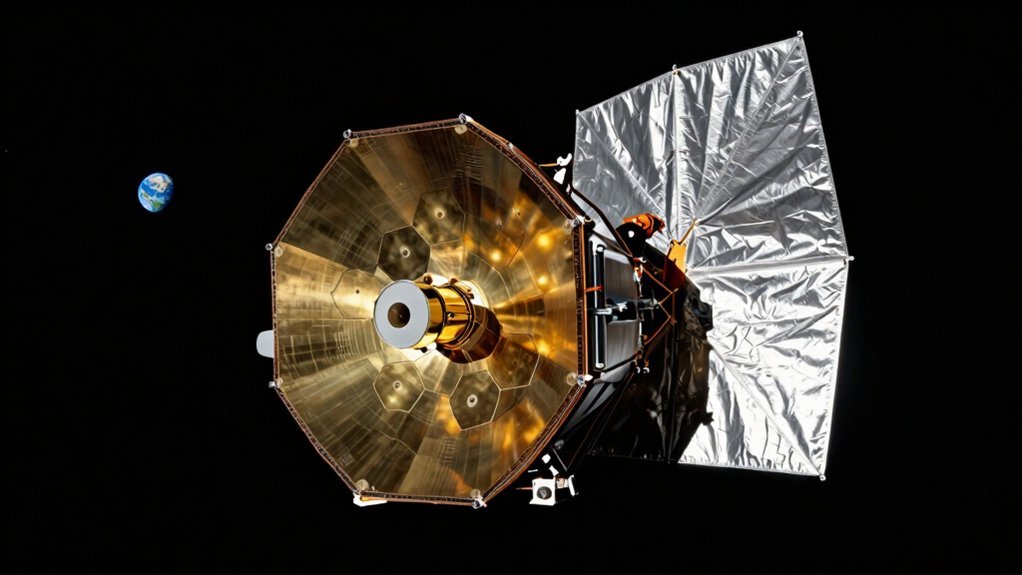
You just finished assembling a perfect scope on Earth, so why would anyone want to launch one into the void? Your atmosphere blocks gamma rays, X-rays, and most infrared light. Space telescopes dodge this blockage to see the full spectrum. They also escape twinkling stars that blur your ground-based images.
Now, consider the darker, colder environment up there. It lets you spot faint galaxies without atmospheric glow ruining your view. These space advantages reveal secrets hidden from Earth-bound eyes. By operating outside Earth’s warmth, these instruments utilize cooling mechanisms to capture clean infrared imaging that ground telescopes cannot achieve.
What about building huge mirrors bigger than any rocket fairing? Assembly benefits let engineers construct massive, modular scopes directly in orbit. You aren’t limited by launch vehicle size anymore. This approach allows ten-meter apertures impossible to launch whole. History shows that pioneering innovations in telescope design have consistently pushed the boundaries of what is observable from our planet. The legacy of this telescope revolution demonstrates how shifting observation platforms has fundamentally altered our understanding of the cosmos.
Clearly, leaving Earth expands your cosmic reach considerably. Ready to explore how engineers actually build these orbital giants?