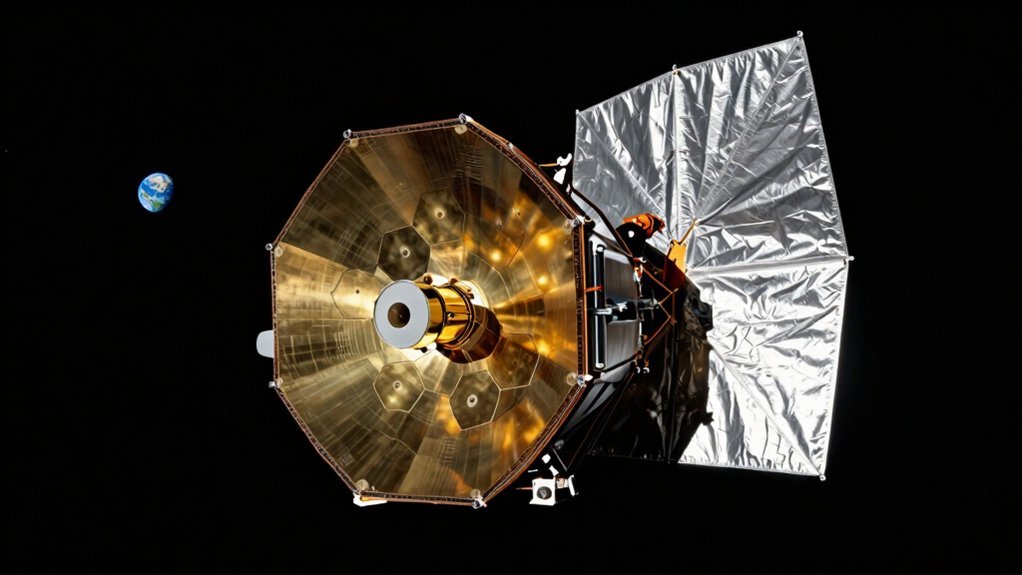
You’re wondering how a telescope actually works, and honestly, it’s simpler than you think. Your objective lens or mirror gathers light to form a real image, while the eyepiece magnifies that view like a handheld glass. Obviously, bigger apertures collect more photons; a 200mm scope grabs four times the light of a 100mm one. Now, let’s explore why mirrors often beat lenses for serious stargazing and how you can fix those upside-down views.
How Do Telescopes Magnify Distant Objects?
Since you’re wondering how telescopes actually make distant stars look bigger, you’ve hit on the exact right question. Telescopes don’t physically pull objects closer; they simply increase the angle of light entering your eye. This trick creates angular magnification, making tiny details appear remarkably larger instantly.
Your objective lens or mirror gathers light to form a real image first. Then, the eyepiece handles the critical job of image scaling for your viewing pleasure. By swapping eyepieces with shorter focal lengths, you boost magnification numbers like 25× easily. Obviously, this math drives all your successful distant observations of planets and stars. The focal length ratio between these two optical components determines the final magnification power achieved.
Remember that magnification alone doesn’t brighten dim galaxies; it just spreads existing light out. You need good optics to keep those scaled-up views sharp and clear always. Now you understand the basic mechanism behind seeing small things big in the sky. Next, let’s explore why aperture size matters even more than raw power. Crucially, a larger aperture size collects significantly more light, which is essential for resolving faint deep-sky objects that high magnification alone cannot reveal. The light-gathering power of your telescope determines how much detail you can see in nebulae and star clusters, often outweighing the benefits of extreme zoom.
Why Is Aperture More Important Than Magnification?
You might think cranking up the magnification is the secret to seeing better, but that’s a common trap. Magnification only enlarges the image your aperture already captured; it adds no new light or detail. Pushing past magnification limits just creates a dim, blurry mess instead of a sharper view.
Aperture benefits truly shine because larger diameters gather considerably more light. A 200mm scope collects four times more light than a 100mm one, revealing faint galaxies easily. This extra light allows you to separate close stars and see fine lunar structures clearly. Without sufficient aperture, high power merely stretches existing blur until nothing remains visible. The light-gathering power of your instrument determines the faintest objects visible, making it the most critical specification for deep-sky observation. Different telescope designs utilize specific optical configurations to maximize this light collection while minimizing aberrations for clearer views. Ultimately, choosing the right instrument requires understanding optical resolution limits to ensure your viewing experience matches your astronomical goals.
How Do Lenses Bend Light in Refracting Telescopes?
Two key steps explain how your refractor actually bends light. First, refraction occurs as light slows down entering glass from air. This speed change forces the rays to bend sharply toward a focus. You see, different lens types curve uniquely to control this bending power. The specific shape of the glass determines the focal length, which dictates how far light travels before converging into a clear image.
Now, consider how light wavelength affects your view. Blue light bends more than red, creating colorful fringes sometimes. Your convex objective lens gathers parallel rays and converges them tightly. The eyepiece then straightens these rays so your eye sees a magnified image. Obviously, precise curvature determines exactly where that focal point lands inside the tube.
You get a brighter, clearer picture because lenses direct every photon efficiently. Understanding this bending action helps you choose the right optical design later. Next, you might wonder why some astronomers prefer mirrors over glass lenses entirely. This phenomenon follows Snell’s Law, which defines the relationship between the angle of incidence and the angle of refraction based on the medium. Additionally, selecting the correct aperture size ensures your telescope gathers enough light to reveal faint celestial details effectively. Remember that maintaining optical clarity often requires using specialized cleaning tools to remove dust without scratching delicate coatings.
Why Do Reflecting Telescopes Use Mirrors?
While lenses bend light, mirrors bounce it straight back without splitting colors. You’ve probably wondered why big observatories skip glass lenses entirely. Here’s the thing: mirrors gather faint starlight efficiently while avoiding those annoying colorful fringes.
You get massive apertures because mirrors weigh far less than thick glass. Engineers love these mirror advantages when building giant research tools. A single polished surface beats shaping two perfect lens sides every time.
These benefits shape modern telescope designs for both ground and space use. You’ll find parabolic curves focusing parallel rays to one sharp point easily. Obviously, lighter structures mean easier launches and better mechanical support overall. This design choice allows amateur astronomers to access larger apertures at a fraction of the cost of comparable refractors.
Now you see why reflectors dominate professional astronomy today completely. Ready to learn how secondary mirrors redirect those light paths next? When comparing telescope types, optical performance varies significantly based on whether the design uses lenses or mirrors to gather light. Different stargazers will find that cost efficiency often dictates whether they choose a reflector or a refractor for their personal observing needs.
How Do Secondary Mirrors Redirect Light Paths?
That little secondary mirror is the traffic cop directing your light. You might wonder how it actually moves that beam around inside the tube. It intercepts rays heading to the primary focus and shoves them sideways or back.
Now, consider how secondary mirror functions change your viewing experience entirely. In Newtonians, a flat diagonal at 45° turns light 90° to your eye. This optical path folding lets you stand comfortably beside the scope instead of climbing on top. Cassegrain designs bounce light right back through a hole in the main mirror. By utilizing convex hyperbolic shapes, these systems effectively extend the focal length within a short physical tube. The precise alignment of this component ensures optical axis stability for sharp images across the field.
Obviously, this trick makes huge telescopes compact enough for your backyard. You lose a tiny bit of brightness due to the blockage, but gain massive flexibility. Without this redirection, your telescope would be impractically long and awkward to use. Understanding these mechanics helps you appreciate what you can realistically see when observing under the right conditions.
Where Is the Real Image Formed Inside?
So where does that actual picture materialize inside your tube? You might wonder exactly where those light rays finally cross paths to create something tangible. That specific spot is called the focal plane, and it holds your real image securely.
In a refractor, this picture forms one focal length behind your main lens. Reflectors work similarly, with the primary mirror focusing light onto its own focal plane. Obviously, the image sits inverted and diminished right there between your optics.
You can even capture this real image on a screen placed precisely at that convergence point. It exists physically because light rays actually meet there, unlike virtual images your eye sometimes creates. This intermediate picture becomes the object your eyepiece will soon magnify for your viewing pleasure. To get the best view of this image, you must ensure you are observing under dark sky conditions that minimize light pollution.
How Does the Eyepiece Lens Magnify the Image?
Since you’ve got that real image sitting at the focal plane, you’re probably wondering how it suddenly looks huge in your eye. The eyepiece acts just like a simple magnifying glass, enlarging that tiny picture for your retina. It doesn’t create the image itself but boosts the angular spread of light rays leaving the focal point.
Your telescope’s magnification equals the objective focal length divided by the eyepiece focal length. A 20 mm lens on a 2000 mm scope gives you 100× power. Shorter eyepiece focal lengths always produce higher magnification numbers instantly. However, aperture limits useful zoom before things get dim or soft. The objective lens remains fixed while you swap eyepieces to alter the final magnification power.
Good eyepiece design guarantees you see sharp details without strain. Poor optics ruin image clarity even at low powers. You swap lenses to change zoom levels easily while keeping the main tube fixed. This flexibility lets you adapt views for different targets quickly. Expert observers recommend starting with low magnification to locate objects before increasing power for detailed study. Understanding the exit pupil size helps ensure the bright image formed by the eyepiece matches your eye’s capabilities for optimal viewing. High-quality glass elements within the eyepiece minimize chromatic aberration to preserve color fidelity across the entire field of view.
What Is Angular Size and Why Does It Matter?
Angular size is just the apparent width of an object as seen from your specific viewpoint. You might wonder why this visual angle matters more than actual physical diameter. It determines exactly how much sky an object covers for your eyes.
Here’s the thing: distance tricks you constantly. A huge galaxy far away shares the same apparent size as a tiny asteroid nearby. Astronomers measure these slices of sky in degrees, arcminutes, or tiny arcseconds. You need this data because telescopes resolve details based on angles, not miles. If two stars sit too close together angularly, they blur into one dot. This limitation is directly tied to the telescope’s angular resolution.
Now, consider your own hand. Hold it near your face; it blocks the sun. Move it back, and the sun wins. That shifting visual angle explains everything. You cannot judge true scale without knowing distance first. This concept lets you calculate real sizes from mere observations. For instance, the Moon and Sun both appear to have an angular size of roughly 0.5 degrees.
How Do Corrective Lenses Fix Blurry Images?
You might wonder why your glasses make distant signs snap into focus while bare eyes see only a smear. Refractive errors scatter light before it hits your retina, creating that frustrating blur. Your eye either over-converges or under-converges incoming rays, missing the perfect focal point entirely.
Now, specific lens types fix this by bending light paths precisely where they belong. Concave lenses diverge rays for nearsightedness, while convex ones converge them for farsightedness. Cylindrical shapes handle astigmatism by correcting uneven curvature across different meridians of your eye. This process ensures that light focuses directly onto the retina to generate clear electrical signals for the brain.
Here’s the thing: these adjustments restore vision clarity by landing images directly on your retina. Obviously, dirty lenses or poor fits still hinder sharpness even with the right prescription. You get sharper signals instantly, though the lenses compensate rather than cure your underlying condition.
Keep your lenses clean and updated to maintain that crisp view. Next, let’s explore why telescopes flip everything upside down.
Why Do Telescopes Show Upside-Down Views?
Why does your new telescope flip the whole world upside down? You aren’t broken, and neither is your scope. Light rays from the top and bottom of an object cross as they converge toward the focal plane. This natural crossing creates an inverted image before your eye even sees it.
Here’s the thing: this telescope inversion stems directly from basic optical design. Your objective lens or mirror focuses light into a cone, flipping the picture automatically. An even number of elements usually keeps it upside down. Obviously, astronomers don’t care because space has no true up or down.
You can fix this with a prism diagonal if you view birds. However, standard mirrors often leave images reversed left-to-right instead. Don’t panic; your gear works perfectly fine. The flip proves your optics focus light correctly. Just rotate your star chart to match the view. Ready to learn how diagonals change what you see?