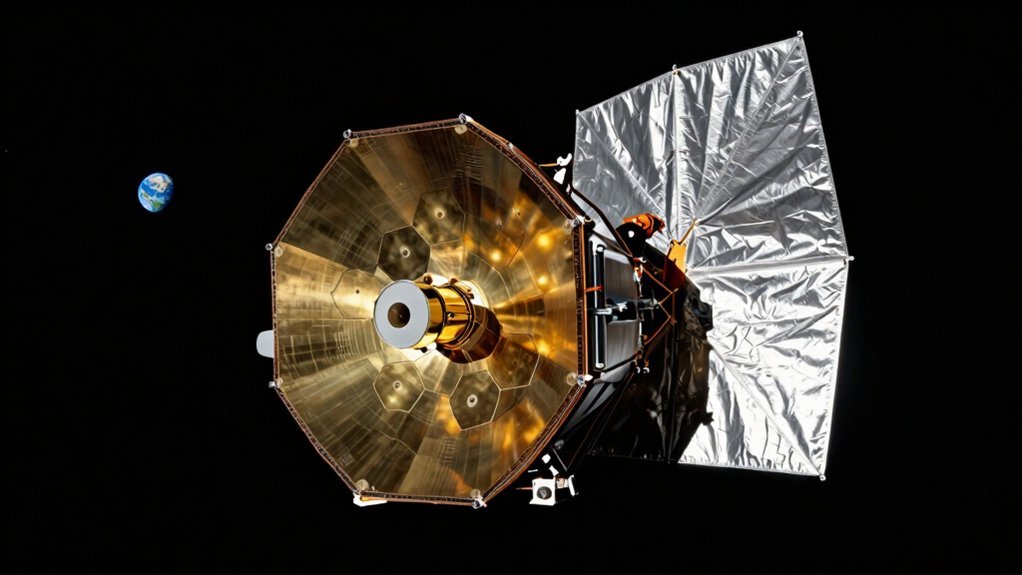
You’re wondering why radio dishes stretch hundreds of meters while optical ones fit in a backyard. Here’s the thing: cosmic radio waves are incredibly faint and have wavelengths up to 100,000 times longer than visible light. You need that massive collecting area just to catch enough energy and focus those long waves into a clear image without blur. Obviously, bigger structures reveal fainter objects that smaller antennas miss entirely. Stick around to see how engineers overcome these giant size limits.
Why Radio Telescopes Must Be So Large
Since you’ve noticed those giant dishes and wondered why they can’t be smaller, you’re asking exactly the right question. Cosmic radio signals arrive incredibly faint after traveling vast distances across space. You need a massive collecting area just to gather enough energy for detection.
Here’s the thing: weak signal strength creates strict design constraints for engineers building these tools. Bigger apertures intercept more radiation, directly boosting your ability to hear faint whispers from distant galaxies. Obviously, small dishes simply miss too much data against background noise. While optical telescopes often prioritize light-gathering power to reveal dim stars, radio instruments must scale up even further to compensate for the low energy of their target wavelengths.
Sensitivity requirements demand huge surfaces to measure weak emissions above static. Think of it like using a large bucket to catch rare raindrops during a light drizzle. Without that width, you detect nothing but silence.
You must prioritize size to overcome nature’s faint signals effectively. Now consider how wavelength further dictates these massive dimensions. Because radio waves have much longer wavelengths than visible light, achieving clear images requires a significantly larger aperture diameter to maintain sufficient angular resolution. Unlike optical instruments that rely on glass lenses or mirrors, these systems utilize a large dish to focus long-wavelength radiation onto a receiver.
How Wavelength Dictates Dish Size Requirements
Two main factors force those giant dishes, and wavelength is the big one you’re missing. You see, radio waves stretch from millimeters to over ten meters, roughly a million times longer than visible light. This massive wavelength impact directly blurs your image unless you build a huge collector.
Now, physics demands your dish spans several wavelengths to focus signals sharply. If you observe a one-meter wave with a tiny antenna, you get nothing but a fuzzy blob. Your dish design must consequently scale up massively to match optical resolution. A million-times larger aperture fixes the diffraction limit inherent to long waves.
Obviously, building something that big isn’t arbitrary; wave optics strictly require it. You cannot cheat nature’s math here without losing all fine detail. So, you need enormous structures just to see clearly. Next, let’s explore why weak signals also demand such massive collecting areas.
Why Weak Signals Need Massive Collecting Area
Even though you’ve got a huge dish for resolution, those cosmic signals still arrive incredibly faint. You need massive collecting area because radio waves travel vast distances and lose intensity. A bigger dish intercepts more energy, boosting your sensitivity to detect faint sources effectively.
Here’s the thing: weak signals often hide right near the noise floor of your electronics. You require significant signal amplification just to make these whispers stand out from background static. Observing longer won’t fix a small dish when the signal is this weak.
Obviously, gathering more power creates a stronger measurable signal for your receiver to process. This extra energy pushes your data above the threshold needed for reliable scientific measurement. Without enough collected area, you simply miss the universe’s quietest objects entirely.
Since radio wavelengths are much longer than visible light, achieving clear images requires large aperture sizes to overcome the natural diffraction limits inherent in the physics of wave propagation. Just as optical telescopes rely on specific optics to gather and focus light, radio telescopes depend on their physical dimensions to capture sufficient wave energy for analysis. The historical development of these instruments highlights how groundbreaking telescope designs were essential to unlocking the radio spectrum for modern astronomy.
What Dish Size Matches Human 20/20 Vision?
no single diameter works everywhere because physics demands larger dishes for longer waves. The critical factor is angular resolution, not just raw collecting area. At common frequencies, you might need a dish hundreds of meters wide to match human sight. Smaller dishes simply blur fine cosmic details together like blurry vision. To overcome this, enthusiasts often rely on interferometry techniques to synthesize a much larger effective aperture. This approach compensates for the fact that light gathering power alone cannot resolve small objects when the wavelength is vast compared to the telescope’s size. While optical telescopes prioritize mirror quality to sharpen visible light images, radio astronomy must scale physical dimensions massively to achieve similar clarity due to the nature of radio waves.
Can Interferometry Replace a Single Giant Dish?
So, can you really swap one massive dish for a network of smaller ones? Yes, for sharpness, you absolutely can. Interferometry links separate antennas to create a giant virtual telescope. Your effective diameter becomes the distance between them, not the dish size.
Now, consider angular resolution. Long baselines let you see details 1000 times better than optical scopes. A pair of small dishes kilometers apart beats any single impossibly large structure. You get fine detail without building a mile-wide mirror.
Here’s the thing: sensitivity still needs raw collecting area. Many small dishes might miss faint signals that one huge bowl catches easily. Also, correlating signals demands precise timing or your data blurs instantly.
You gain incredible sharpness but lose some light-gathering power. Single dishes still rule when detecting weak whispers from deep space matters most. Which trait do you prioritize for your specific observation goals? While optical enthusiasts often focus on mirror coatings and mount stability, radio astronomers must master signal correlation to synthesize clear images from distributed data. Just as a beginner web page requires a practical walkthrough to ensure success, understanding these trade-offs provides the essential foundation for accurate radio astronomy. Effective telescope selection ultimately depends on matching these technical capabilities to your specific observation goals.
How Radio Arrays Sharpen Deep-Space Images
You’re probably wondering how scattered little dishes beat one giant mirror for sharpness. It’s all about baseline length. Your telescope arrays use wide array geometry to simulate a massive aperture. This setup drastically boosts your imaging resolution beyond any single dish’s limit.
Now, signal combination makes this magic happen. Each antenna captures weak waves, creating correlated signals through precise timing. Your data processing system then aligns these inputs perfectly. Fringes analysis reveals hidden interference patterns within the combined data. These patterns encode vital spatial details about distant cosmic objects. Supercomputers are required to handle the combinatorial data handling that exponentially increases with the number of dishes in the array. The development of this technique was pioneered during the 1960s interferometry experiments which proved that separated antennas could achieve unprecedented angular resolution. While optical telescopes rely on glass lenses to focus visible light, radio arrays synthesize a much larger effective aperture through software and geometry. Mastering the basics of data alignment ensures that every wave arrives in sync for a clear result.
Here’s the thing: bigger separation means finer detail. You get microarcsecond clarity by stretching your array across continents. Obviously, complex math reconstructs the final picture from those raw fringes. You fundamentally turn many small ears into one giant, sharp eye. This method lets you see black hole shadows clearly. Ready to explore why radio waves pierce through cosmic dust next?
Why Radio Waves Penetrate Cosmic Dust Clouds
Since you’ve seen how arrays sharpen images, you’re probably wondering why radio waves slice right through thick cosmic dust. It’s all about size. Visible light hits tiny grains hard, but radio waves are huge compared to those particles. You see, dust absorption and radio scattering mostly affect short wavelengths, leaving long radio signals mostly untouched.
Now, imagine throwing a beach ball at a chain-link fence. It passes right through, unlike a ping-pong ball getting stuck. That’s exactly what happens here. Your radio telescope catches signals from deep inside stellar nurseries that optical scopes miss completely.
Here’s the thing: this weak interaction lets you map the Milky Way’s hidden heart clearly. You finally see gas clouds and young stars birthed behind opaque veils. This unique penetration power makes radio astronomy essential for studying our galaxy’s true structure. Next, let’s look at why those giant dishes don’t need perfect surfaces to work.
How Rough Surfaces Still Work for Radio Dishes
You might think a dented, rusty dish ruins the signal, but radio waves don’t care about optical perfection. Here’s the thing: your dish just needs decent surface accuracy, not a mirror finish. If bumps stay smaller than one-tenth of the wavelength, you’re golden. For 21 cm waves, that means centimeter-scale dents barely matter at all.
Obviously, you still need proper reflective materials to bounce those signals home. Steel works nearly as well as aluminum because currents only skim the metal’s thin skin. You can even use wire mesh if the holes stay tiny compared to the wave. This trick saves you massive weight and wind drag while keeping performance high. While optical instruments demand gentle cleaning tips to avoid scratching delicate coatings, radio dishes are far more forgiving of surface imperfections and environmental wear. Unlike visual observation which requires clear skies to see faint stars, radio telescopes can often operate effectively even when clouds obscure the view. This resilience stems from the fact that radio waves possess much longer wavelengths than visible light, allowing them to penetrate atmospheric conditions that would block optical telescopes.
Why Bigger Telescopes Find Fainter Space Objects
Size is your secret weapon for spotting faint cosmic whispers. You wonder why massive dishes matter so much for dim objects. Obviously, bigger apertures gather far more radiation than small ones do.
Here’s the thing: collecting area scales with diameter squared directly. A four-meter mirror grabs sixteen times more light than a one-meter version. This huge boost drives successful faint source detection easily. You need those extra photons to lift weak signals up.
Now, consider how radio waves carry extremely tiny amounts of energy. Large surfaces collect enough power to beat back receiver noise effectively. Your signal to noise ratio jumps when you add more antennas. Better sensitivity lets you study cold gas or distant quasars clearly. Without big dishes, these invisible targets stay lost forever in static. Understanding light-gathering power helps explain why optical telescopes also rely on large mirrors to detect dim stars and galaxies. While radio dishes capture long wavelengths, optical instruments often use reflecting telescopes to focus visible light onto a detector.
You now see why size reveals the universe’s quietest secrets. Next, ask yourself what stops engineers from building even larger single dishes.
What Limits the Practical Size of Radio Dishes
Although you might think building a bigger dish is just a matter of adding more metal, physics puts a hard stop on that idea. You face serious mechanical constraints once dishes exceed 100 meters. Moving such massive weight creates huge structural challenges for engineers.
Surface irregularities also wreck your signal at shorter wavelengths. Your dish needs perfect shape relative to the tiny radio waves you catch. Even small bumps scatter energy and ruin your data quality.
Your beam width stays frustratingly wide because radio waves are so long. You need a 300 km dish for sharp optical-like resolution! That is obviously impossible for one single structure.